Daniel Ellsberg was a former marine, a Harvard PhD, a strategy analyst at the Rand Corporation and spent some time in the 1960’s in the Department of Defense. In his position he had access to tens of thousands of classified documents concerning the government strategy and prosecution of the Vietnam War. As Ellsberg became disillusioned with the war and as he found that the documents he had access to were telling a completely different story than what was being told to the American people, he copied and released those documents in 1971 to the New York Times and Washington Post, both of which published stories about them.
These documents, which would become known as the Pentagon Papers, showed that as early as 1965, high level persons in the state and defense departments had little expectation of winning the Vietnam War. They seemed focused not on achieving any particular goals, but rather in trying the make the impending failure not look like failure. This was 1965! The war would continue for another eight years, More than 58,000 Americans and a countless number of Vietnamese would die.
The Pentagon Papers didn’t end the war. But they played a role in bringing down the Nixon Administration. The leak resulted in Nixon setting up a group to pursue leaks and leakers, a group, which included G. Gordon Liddy, that was eventually responsible for the Watergate break-in which would end Nixon’s presidency.
Ellsberg was charged and tried under the Espionage Act of 1917. Largely because of the actions of the government in trying to find evidence, actions that included a break in at Ellsberg’s psychiatrist’s office, the judge threw out the charges.

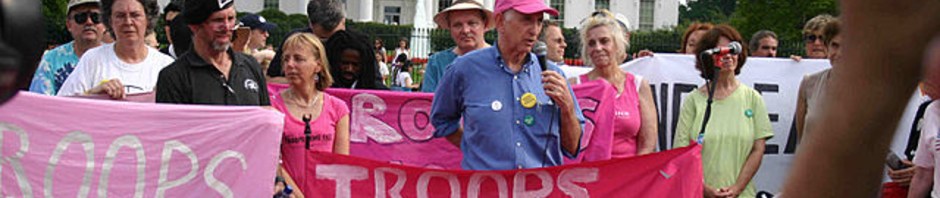
So now that he was no longer welcome at Rand or in government, what happened to Daniel Ellsberg? He remained true to himself and to his principles for his entire life. He was an activist and an advocate for peace, for nuclear disarmament, and for government transparency. He encouraged and championed other whistleblowers.
These wire service reports give you some idea of what he was up to over the years.
Oct. 19, 1976
Daniel Ellsburg, who released the Pentagon Papers, on Monday addressed a rally of about 700 people taking part in a demonstration by the Continental Walk for Disarmament and Social Justice at the Pentagon. About 30 demonstrators — including Ellsberg — were arrested on misdemeanor charges of impeding traffic. (caption from AP Wirephoto)
May 8, 1978
GOLDEN. Colo.. (UPI)—Jefferson County sheriff’s deputies hiked across snow covered fields at the Rocky Flats nuclear weapons plant today to arrest Daniel Ellsberg and 19 other antinuclear demonstrators for trespassing.
The arrests occurred without violence. “We’ll be back.” Mr. Ellsberg said. “We are effective here, as the arrest shows. If they keep us in jail, it doesn’t matter, because there are many more ready to take our places.”
The protesters, known as the Rocky Flats Truth Force, set up camp April 29 on the railroad tracks leading to the plant and pledged to remain until May 27, when a national demonstration against nuclear weapons is scheduled.
May 9, 1978
DENVER, May 9 (AP)—Daniel Ellsberg and eight other demonstrators were released on $200 personal recognizance bonds today, a spokesman for the Jefferson County Sheriff’s Department said.
The protesters were arrested for the second time in four days yesterday at the Rocky Flats nuclear weapons plant on charges of criminal trespassing and obstructing a passageway.
Feb. 12, 1980
BERKELEY, Calif (UPI) — In scenes reminiscent of the anti-war movement of a decade ago California-students Monday staged a “death-in” chanted slogans and applauded the anti-draft leaders of yesteryear who urged resistance to any attempt to renew the military draft. Monday kicked off demonstrations lined up through the week at 15 campuses from San Diego to Sacramento to give draft-age students a chance to mount the first widespread concerted draft opposition since the Vietnam war. At Berkeley 2000 students cheered as anti-war activist Daniel Ellsburg proclaimed “I commit myself to encourage counsel aid and abet those who stand in nonviolent resistance” to the draft.
April 10 1982
Former Defense Department consultant Daniel Ellsburg and West German peace activist Thyra Quensel are led away by a police officer Friday morning after being arrested for trespassing at the Nevada Test Site at Mercury. Nev. The pair was protesting the testing of nuclear weapons in the desert near Las Vegas. (caption from AP photo)
July 7, 1985
Daniel Ellsberg, the antiwar activist, will serve a two-day jail sentence in mid-July for his part in a demonstration against the Reagan Administration’s policy in Central America, according to the authorities. (UPI)
Aug. 13, 1987
The antiwar activist Daniel Ellsberg has been fined $50 for his involvement in a protest last April at the headquarters of the Central Intelligence Agency. The former Pentagon analyst, who says he disclosed the Pentagon Papers to the press, pleaded no contest Tuesday in Fairfax County General District Court to a charge of obstructing free passage. (AP)
Jan. 15, 1991
The police arrested three protesters near the White House tonight while Indians with a “peace drum” pounded out a protest against the prospect of war in the Persian Gulf. The national park police estimated that 5,000 people in an evening prayer service marched past the White House.
The three arrested were Dick Gregory, the former comedian and now a crusader for social causes, who was arrested three times; Carol Fennelly, an advocate for the homeless, and Daniel Ellsberg, the longtime antiwar advocate. (AP)
Nov. 24, 2005
CRAWFORD, Texas – A dozen war protesters including Daniel Ellsberg were arrested Wednesday for setting up camp near President Bush’s ranch in defiance of new local bans on roadside camping and parking. About four hours after the group pitched six tents and huddled in sleeping bags and blankets, McLennan County sheriff’s deputies arrested them for criminal trespassing. (Angela K. Brown Associated Press)
In 2017, Ellsberg offered his views on the danger of nuclear weapons and on the way that danger has been handled in a book titled The Doomsday Machine: Confessions of a Nuclear War Planner.
In New York Magazine, Andrew Rice, (Nov. 28, 2017) offered this review:
“The Doomsday Machine represents Ellsberg’s attempt to reconstruct, via his memories and now-declassified documents, the knowledge that was washed away. The book examines many close brushes with nuclear war. He says that at least twice during the Cold War — once aboard a Soviet submarine during the Cuban Missile Crisis, once inside an air defense bunker outside Moscow in 1983 — a single individual came close to triggering a nuclear war because of a false alarm. ‘There is a chance that somebody will be a circuit breaker,’ Ellsberg says. ‘What I conclude is that we’re lucky, very lucky.’”

Garret M Graff of the Washington Post (Jan 21, 2018) added this:
“Ellsberg offers what amounts to a travelogue of what he calls the ‘Doomsday Machine,’ the systematized procedures, protocols and strategies that guided how the country’s nuclear weapons would be fired if Armageddon arrived, most of which remain in place to this day. The book’s exposes, such as they are, offer for historians not much that is new or revelatory, but casual readers will probably be shocked by just how boneheaded and illogical much of the Cold War’s grand strategy really was. Yet Ellsberg’s book, perhaps the most personal memoir yet from a Cold Warrior, fills an important void by providing firsthand testimony about the nuclear insanity that gripped a generation of policymakers.”
Based on the premise that you can’t believe what you hear from the government, Ellsberg publicly encouraged whistleblowers to step forward, and when they did, they received his support and praise.
“Understandably, the American people are reluctant to believe that their president has made errors of judgment that have cost American lives. To convince them otherwise, there is no substitute for hard evidence: documents, photographs, transcripts. Often the only way for the public to get such evidence is if a dedicated public servant decides to release it without permission.” (Opinion piece written by Ellsberg in the New York Times, Sept. 28, 2004.)
His support included Julian Assange. New York Times writers John F. Burns and Ravi Somaiya wrote about that (Oct. 23, 2010): “Julian Assange, the WikiLeaks founder, and Daniel Ellsberg, who leaked the Pentagon Papers, lashed out together on Saturday at the Obama administration’s aggressive pursuit of whistle-blowers, including those responsible for the release of secret documents on the Iraq war.
“Mr. Ellsberg, who said he had flown overnight from California (to London) to attend, described Mr. Assange admiringly as ‘the most dangerous man in the world’ for challenging governments, particularly the United States. He said the WikiLeaks founder had been ‘pursued across three continents’ by Western intelligence services and compared the Obama administration’s threat to prosecute Mr. Assange to his own treatment under President Richard M. Nixon.”
He backed the soldier who leaked documents to Assange:
“…the young soldier accused of leaking the secret documents that brought WikiLeaks and Mr. Assange to fame and notoriety is locked in a tiny cell at the Quantico Marine Corps Base in Virginia. The soldier, Pfc. Bradley Manning, who turned 23 last month in the military prison, is accused of the biggest leak of classified documents in American history. He awaits trial on charges that could put him in prison for 52 years, according to the Army.
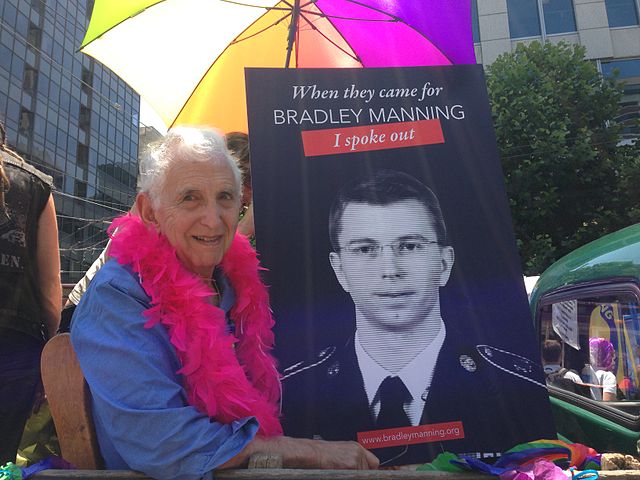
“Private Manning’s cause has been taken up by the nation’s best-known leaker of classified secrets, Daniel Ellsberg, who gave the Pentagon Papers to the press in 1971. He denounces Private Manning’s seven months in custody and media coverage that has emphasized the soldier’s sexual orientation (he is gay) and personal troubles. Mr. Ellsberg, 79, calls him a courageous patriot.
‘I identify with him very much,’ Mr. Ellsberg said. ‘He sees the wars in Iraq and Afghanistan, I’d say correctly, as I saw Vietnam — as hopeless ventures that are wrong and involve a great deal of atrocities.’” (Scott Shane, New York Times, Jan. 13, 2011)
Another New York Times story (by Charlie Savage, June 14, 2014) addressed his support for Edward Snowden.
“Edward J. Snowden, the former National Security Agency contractor whose leaks of secret documents set off a national and global debate about government spying, is joining the board of a nonprofit organization (Freedom of the Press Foundation) co-founded by Daniel Ellsberg, the well-known leaker of the Pentagon Papers during the Vietnam War.
“‘He is no more of a traitor than I am, and I am not a traitor,’ Mr. Ellsberg said in an interview. He added that he was proud that Mr. Snowden would serve alongside him on the group’s board, calling Mr. Snowden a hero who ‘has done more for our Constitution in terms of the Fourth and First Amendments than anyone else Mr. Ellsberg knows.”

Last year, Ellsberg was diagnosed with pancreatic cancer and was given three to six months to live. That didn’t stop him.
“Mr. Ellsberg announced in an email to friends and supporters on March 1 that he had pancreatic cancer and had declined chemotherapy. Whatever time he had left, he said, would be spent giving talks and interviews about the Russian invasion of Ukraine, the perils of nuclear war and the importance of First Amendment protections. (Harrison Smith and Patricia Sullivan, Washington Post, June 16, 2023)
Ellsberg died on June 16, 2023. He was 92. Just 12 days before he died he gave this interview to Michael Hirsh of Politico. (June 4, 2023)
“Ellsberg, snowy-haired but energetic despite the cancer — renowned for his eloquence, he still speaks in perfect paragraphs — was calm, even jovial, during what his son, Robert Ellsberg, said would be his last interview. Based on his experience in the covert world, Ellsberg sees a direct line between the deceptions and lies that led to the Vietnam War — and 58,000 American deaths — and the deceptions and lies that justified the Iraq war. This high-level deceit, Ellsberg says, extends to America’s current drone war policy around the world, in which the government has allegedly covered up the number of civilian deaths it causes.”
Of all of the Ellsberg obits that I reviewed, I liked this comment by Syracuse University Professor Roy S. Gutterman. “History judges people like Ellsberg. As polarizing as he was, history should be a kind judge for someone as unique, conscientious, passionate — and ultimately correct — as Ellsberg was.” (June 22, 2023)
-0-
Whatever Happened To?
 off the leash
Excellent essay. I admire the amount of research you did.
LikeLiked by 3 people
I like the way you structured this story, Ken. Using parts of the news dispatches was an effective form of telling a complex story in an easier-to-absorb way and moved the storytelling along at a good pace. I applaud what Daniel Ellsberg did and appreciate you providing an updated report that highlighted the importance of his action. Love the line about him being true to himself and to his principles throughout his life.
LikeLiked by 1 person
Pingback: Whatever Happened To? Mary Lou Retton | off the leash
Pingback: Whatever Happened To? Roger Clemens | off the leash
What a great read! I didn’t remember any of this and wouldn’t have been able to tie Ellsberg to the Pentagon Records, so thanks for the thorough history lesson. He sounds like a force!
LikeLiked by 1 person
Ellsberg was a great American and a brilliant man. A very fine writer as well. Doomsday Machine is a sobering read.
LikeLike
Pingback: Whatever Happened To? Pam Grier | off the leash
Pingback: Whatever Happened To? Lance Armstrong | off the leash
Pingback: Whatever Happened To? Roman Pulanski | off the leash
Pingback: Whatever Happened To? George Foreman | off the leash
Pingback: Whatever Happened To? Bobbie Gentry | off the leash
Pingback: Whatever Happened To? Fernando Valenzuela | off the leash