
Do you remember Mary Francis Penick? Maybe you remember her as Skeeter Davis. If that still doesn’t sound familiar you may remember this:
Skeeter Davis – The End of the World (HD)
Skeeter Davis was a country music singer from Kentucky who was nominated for a Grammy five times. “The End of the World” was her greatest success, a 1963 crossover song that rose to the top ten in the country, pop, adult contemporary and rhythm and blues charts. She appeared on American Bandstand and toured with both Elvis and the Rolling Stones. She joined the Grand Ole Opry in 1959 and continued to perform on the Opry stage in Nashville until 2000.
The name Skeeter came from her grandfather, “who said she was always flittering around like a ‘skeeter.’” (Judy Morgan, Texarkana Gazette, May 2, 2024) The name Davis came from a high school friend, Betty Jack Davis. The two performed as a duet, the Davis Sisters, until a car crash killed Betty Jack.
Davis once said of herself “I don’t do anything. I’m so straight it’s ridiculous.” (Daily Telegraph, London, Oct 4, 2004). That makes her sound a lot less interesting than she really was.
During the 1960’s, Davis was an outspoken opponent of the Vietnam War, for which she got a good deal of grief from the country music community. She recorded an anti-war song, ‘One Tin Soldier.’ “At the end of the 60’s she was wearing granny dresses and blue jeans on the Grand Ole Opry. Her band was made up of scruffy, long-haired musicians — which displeased Opry management.” (Texarkana Gazette)
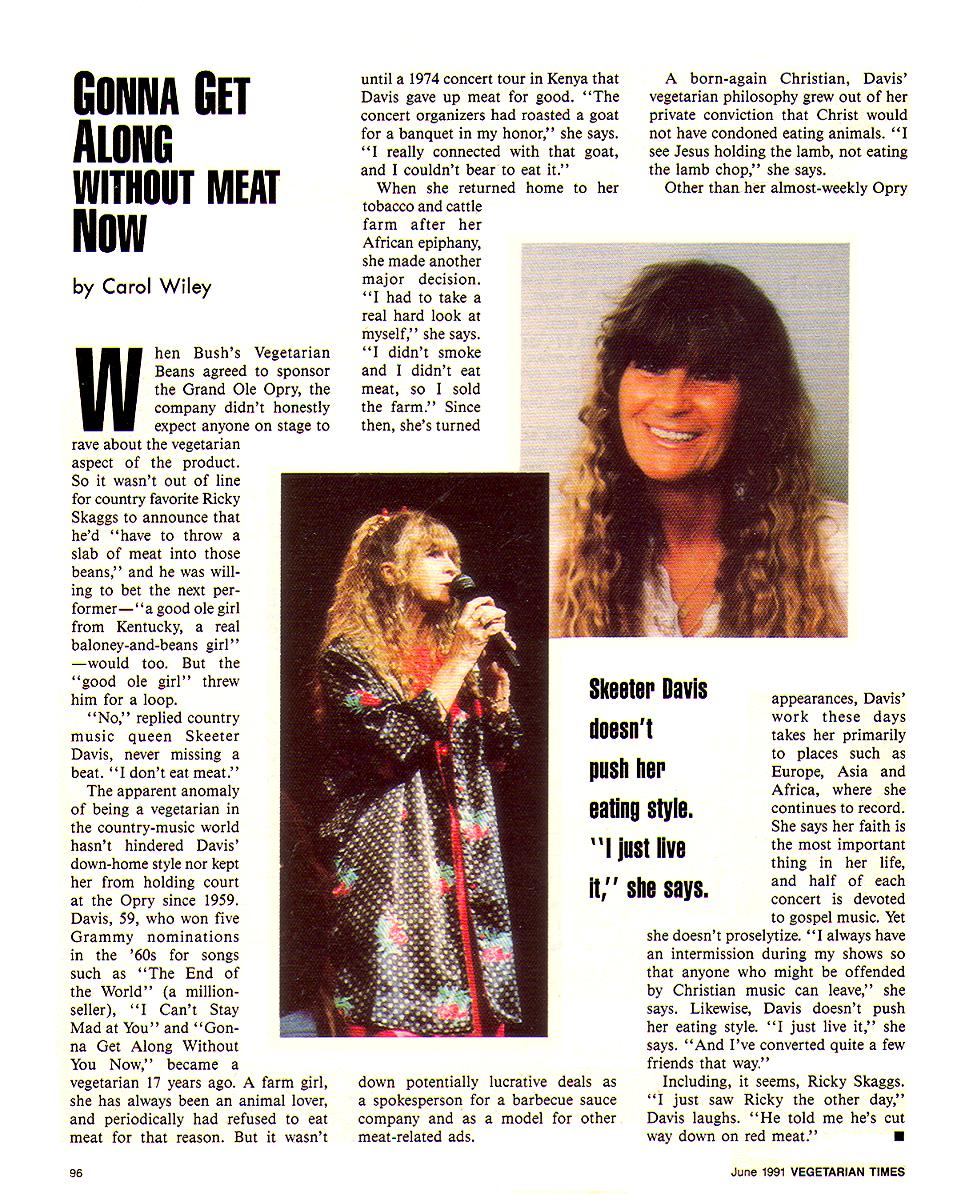
Davis was also a vegetarian. That started after an incident while she was on tour in Kenya in 1964. “’The concert organizers had roasted a goat for a banquet in my honor,’ she says. ‘I really connected with that goat, and I couldn’t bear to eat it.’ When she returned home to her tobacco and cattle farm after her African epiphany, she made another major decision. ‘I had to take a real hard look at myself,’ she says. ‘I didn’t smoke and I didn’t eat meat, so I sold the farm.’” (Carol Wiley, Vegetarian Times, June 1991)
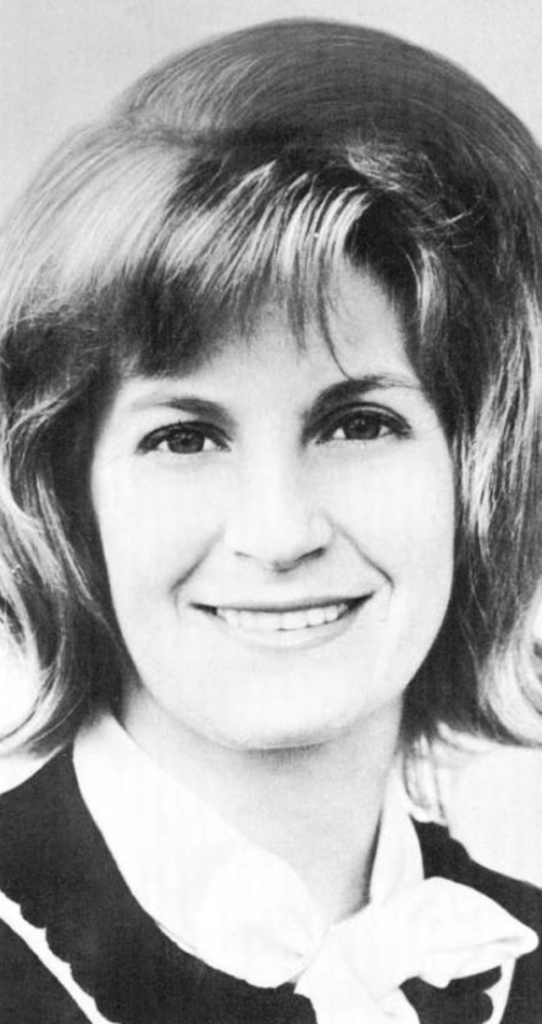
“Wholesomeness was Skeeter Davis’ stock-in-trade. A devout Southern Baptist, she took her religious beliefs seriously and refused to perform at venues which sold alcohol.” (Daily Telegraph, London, Oct 4, 2004)
Those religious beliefs once got her suspended from the Opry. “In 1973, a group of young people were arrested for allegedly bothering Nashville shoppers by talking to them about Jesus. When she defended the young people’s actions on the stage of The Grand Ole Opry, the management suspended her from the Opry for one year. And according to Skeeter, her manager quit and she lost her contract with RCA Records because of the incident.” (Texarkana Gazette)
Davis was diagnosed with breast cancer in 1994, then with bone cancer in 1996. She passed away in a Nashville hospice in 2004. Whenever possible, she continued to perform while she was being treated.
Rita Rose of the Indianapolis News (Aug 6, 1999) met her on the occasion of the 40th anniversary of the Grand Ole Opry at the Country Time Music Theater in Little Nashville, Ind. She noted, “At 65, Davis is a warm, ebullient, chatty woman who embraces everything in her life: work, friends, family and several pets. And, above all, her faith in God which has carried her through some rough years lately.”
Davis is well remembered in and around Dry Ridge, Kentucky, where she was born and raised. There’s even a highway named after her there.
The Lexington Herald-Leader had this story on March 14, 1998. “Country music singer Skeeter Davis will be honored in her hometown of Dry Ridge this morning as local officials, fans and Davis herself gather to dedicate a local highway in her name. A section of Ky. 22 from US 25 to Interstate 75 will be renamed Skeeter Davis Highway during a ceremony at 9 a.m. today at Ky. 22 and U.S. 25.”
She was inducted into the Kentucky Music Hall of Fame in 2013. And in Williamstown, Ky., there continues to be an annual all-day music festival called Skeeter Fest at the Grant County Fairgrounds. Davis is the only Grand Ole Opry member from Grant County.

In 1993, Davis published her autobiography “Bus Fare to Kentucky.” Lexington Herald-Leader reviewer Judy Jones Lewis (Oct. 17, 1993), had this to say: “…it is so much better than the usual crop of country singer’s autobiographies that it stands as a metaphor for the nation’s rise from the Great Depression to the excesses of the post-war boom years. The story is told with such amazing good humor, the reader comes away with more respect for Skeeter’s tenacity and wit than her singing skills.”
One point of interest in the book is Davis’ comments about Ralph Emery, her second husband, to whom she was married for four years.
“Much of the attention the book is gathering is due to the portrait Davis paints of Ralph Emery, her former husband and former host of the Nashville Network’s popular ‘Nashville Now’ program. In the book, Davis recounts Emery’s mental and sometimes physical abuse during their four-year marriage. She says Emery was an adulterer and didn’t really like country music.” (Wayne Bledsoe, music critic, Knoxville News-Sentinel, Oct. 31 1993)
Davis had been married to a railroad worker Kenneth DePew from 1956 to 1959. She married Emery in 1960. Her third husband, who she married in 1987, was Joey Spampinato, a bass player from the rock band NRBQ. In 1985 she had recorded an album with NRBQ called “She Sings, They Play.”
Her marriage to Spampinato lasted until 1996 and ended after her bone cancer diagnosis. According to Davis “he couldn’t cope with her disease. ‘He didn’t even want to kiss me,’ she said.” (Rita Rose, Indianapolis News, Aug 6, 1999)
In her obit in the Guardian (Oct. 1, 2004), Alan Glayson said “After the break-up of her third marriage, she devoted herself to animal welfare and record releases that focused chiefly on religious material.”
Few people, other than maybe Emery, have anything bad to say about Skeeter Davis. Here’s one example:
“Skeeter is no sophisticate, just a hard-working, hard-driving, Christian woman. That character shines through with a clarity uncharacteristic of entertainment industry hype.” (Judy Jones Lewis, Lexington Herald-Leader, Oct. 17, 1993)
-0-
(Note on sources: Newspaper articles that do not include links were accessed on newspapers.com)
Whatever Happened To?
 off the leash
The names Mary Francis Penick and Skeeter Davis meant nothing to me. Never recall hearing of them. So thanks for including the You Tube link. Yeah, that song I certainly know, remember and like.
Thanks, too, for a fascinating story. She toured with Elvis and the Stones! Whoa! Kudos, too, for her stand against the war.
LikeLiked by 1 person
I really liked her singing. Nice to know she was a vegetarian & anti the war. Sounds like she had a difficult life at times
LikeLiked by 1 person
I have to admit the name Skeeter Davis didn’t register with me at all, but I do remember the songs “The End of the World” and “Tin Soldier.” Interesting story about her.
LikeLiked by 1 person
Great post, Ken! I remember “The End of the World” well—such a hauntingly beautiful song that still resonates today. I had no idea Skeeter Davis was such a trailblazer, from her stand against the Vietnam War to her advocacy for animal welfare. Her life seems to have been filled with both triumph and hardship, yet she stayed true to her beliefs through it all. Thanks for shedding light on her story—this was a fascinating read! PS I tried searching for that portion of Ky. 22 named “Skeeter Davis Highway” and it was not on Google. Maybe you could correct this?
LikeLiked by 2 people
Pingback: Whatever Happened To? Chubby Checker | off the leash