
In 1932, the U.S. was in the throes of the Depression. 13 million Americans were unemployed, almost 25% of the population. Herbert Hoover was president but he was about to be defeated by Franklin Roosevelt in a landslide. Charles Lindbergh’s 20-month-old son was kidnapped and later found dead. Al Capone was convicted of tax evasion. Amelie Earhart became the first women to make a solo crossing of the Atlantic. And in Oklahoma, the parking meter was invented.
The lead story in the current week’s Radio Guide, the issue dated Oct. 1, 1932, was headlined “Crime Pays – On Air.” It discussed the proliferation of crime drama on radio and the broadcasters search for more mystery writers. There was a news story that both networks, CBS and NBC would be carrying the upcoming World Series between the New York Yankees and Chicago Cubs and the announcing teams would include two legends of early sports broadcasting, Graham McNamee for NBC and Ted Husing for CBS. Another story revealed that, under pressure from advertisers, the networks were dropping a long-standing ban on mentioning prices on air. NBC agreed to one-price mention per 15 minute program. CBS would allow two but added the further restriction that “sales talk” could not exceed 90 seconds during a 15-minute span. Radio Guide hailed this as the “most drastic step thus far in cutting down the sometimes tedious blurbs which clutter the air.” Ads in this week’s edition were few and far between but included a pitch for a new lighter microphone and a display ad from station WGES promising listeners official race results.
On the night of Thursday, Sept. 29, 1932, a typical American family may have been worried about finding work, keeping their home and maybe just finding the money to put food on the table. Radio though was free, and here’s what they might have heard that night.
There was canine drama on the NBC network at 7:30 with Rin Tin Tin. The radio show was inspired by a German Shephard that had been rescued by an American soldier in World War I. Rin Tin Tin became a film star appearing in some 27 films, most of them silent. They had titles like Rinty of the Desert and Hero of the Big Snows. The radio program started in 1930 as the Wonder Dog and while some of the early shows had the real Rin Tin Tin offering a bark or two, most of the dog noises were created by man with the appropriate last name Barker. By 1932 the show had been renamed Rin Tin Tin. It was sponsored by Ken-L Ration and, after a move to the rival CBS network, lasted until 1934. It reappeared as a TV series, the Adventures of Rin Tin Tin in 1954.
Radio programs at the time were usually 15 minutes long. After the excitement of Rin Tin Tin you could calm down at 7:45 with the undoubtedly more serene National Oratorio Society program. And at 8, a switchover to CBS would deliver a solid block of music including “Music That Satisfies,” “The Mills Brothers,” and “Gus Arnheim’s Orchestra.”
The Mills Brothers were four African-American brothers, sons of a barber shop owner in Ohio. As a jazz quartet they are an example of how radio gave African American artists an audience at a time when many segments of American society was segregated. They originally became local radio stars through their appearances on WLW in Cincinnati. After appearing with the Duke Ellington Orchestra in Cincinnati they caught the attention of a record company that moved them to New York. After getting an audition with William Paley of CBS, he signed them to a three-year contract making them the first black artists to get a network radio show.
NBC at the time ran two networks, the blue network and the red network, and at 9 p.m. they offered options of Phil Lord, the Country Doctor, or the Lucky Strike Dance Hour. Most programs at the time had one sponsor. The opening for the Lucky Strike program went like this: “Ladies and gentlemen , the Lucky Strike Dance Hour presented for your pleasure by the manufacturers of Lucky Strike cigarettes. Three times each week we bring you the Lucky Strike thrills, 60 modern minutes with the world’s finest dance orchestras, and, in addition, the melodrama and mystery of real New York Police cases on Tuesdays ; your New York correspondent Walter Winchell on Thursdays, and Bert Lahr, Broadway’s craziest comedian, on Saturdays.”
After 60 minutes of “Lucky thrills” 10 p.m. was Amos ‘n’ Andy time. (Radio Guide was published in Chicago so all times herein are Central time.) Amos ‘n’ Andy was the top rated show at the time. It was perhaps the most popular radio show ever, on for 15 minutes every night. It was also a show that created humor out of demeaning racial stereotypes. The basic plot was about two black farmers from Atlanta, portrayed as gullible stumblebums, who moved to Chicago and started their own business, the Fresh Air Taxi Company, so named because their car had no roof. The dialogue was characterized by one prominent black church official at the time as “crude, moronic and repetitious.” The characters were actually voiced by two white actors, Freeman Gosden and Charles Correll, who also were the writers of the show. Andy’s daughter was voiced by a Chinese American woman. It is estimated that at one point the show attracted 40 million listeners, a full third of the U.S. population.
In the 30’s, perhaps because of the struggles faced by so many Americans, comedy replaced music as the most popular radio programming.
CBS had no answer to Amos ‘n ‘ Andy’s popularity. The second network followed with more music, bandleader Little Jack Little at 10:30 and the Ozzie Nelson Orchestra at 10:45. There was no 11 o’clock news and the rest of the evening was given over to music programming, primarily dance orchestras.
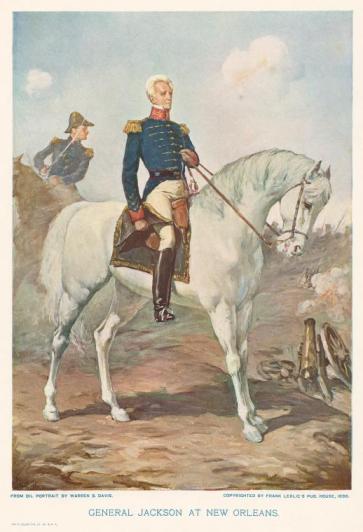 When the question was put to Quora users, a popular choice was the man whose oversized head defaces the $20 bill. Influenced by having watched the play Bloody, Bloody Andrew Jackson not too many years ago, he’s my personal choice. He is most widely reviled, and deservedly so, for the Indian Removal Act, which forced the relocation of 45,000 Native Americans and led to the Trail of Tears. This slave-owner virtually institutionalized the practice of patronage in his hiring to federal jobs thus paving the way for future generations of Cabinet nominees like Betsy DeVos. He openly defied the Supreme Court after the justices issued a ruling that was favorable to Native Americans in Georgia. With a human rights record that is about the same level as that of Attila the Hun, jail would have been a more appropriate home for this guy than the White House.
 Now that the Presidency is in the hands of a narciscistic blowhard, I have softened by view of Dubya. Here is a man who probably would know the right people to put together a dynamite backyard barbeque. But a
 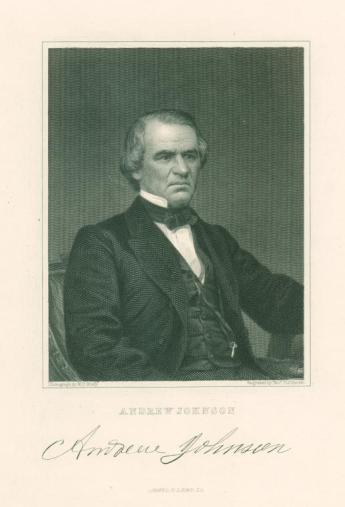 A 2006 Siena College poll that included 744 professors placed Andrew Johnson at the bottom of the pile. Johnson was president from 1865-1869. He had been vice president when Lincoln was assassinated. Based on some administrative rules that I don’t understand, Congress impeached Johnson in 1868 but fell one vote short of removing him from office. A former pro-slavery governor of Tennessee (how the hell did Lincoln pick this guy?), Johnson vetoed every civil rights bill Congress passed and condoned white terrorism in the south. He is generally considered to have set the stage for the Jim Crow south. His total unfitness to hold the office can be summed up in his own words. “This is a country for white men, and by God, as long as I am president, it will be a government for white men.” This is not a president who was ever elected.
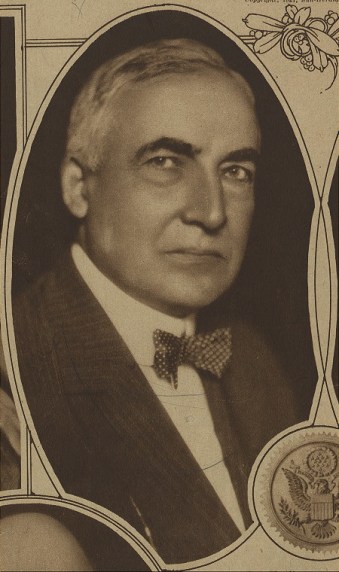 A 1996 poll of academics by noted historian Arthur Schlesinger, Jr., points the finger of shame at Warren Harding. Harding won a landslide victory in the Presidential election of 1920 campaigning against Woodrow Wilson’s globalism and becoming the first Presidential candidate to play the red scare card. In office he refused to recognize post-revolution Russia. Harding is not so much reviled for what he did but rather for how little he did. He only lasted two years. He suddenly died of a heart attack in 1922 after originally being diagnosed with food poisoning. His brief time in office was characterized by charges of corruption against others in his administration, the best known of which is the Teapot Dome Scandal. Affairs with other women were also part of the buzz around his presidency and it is believed that the Republican Party paid hush money to one, Carrie Phillips, who was a German sympathizer during the war. No one has ever substantiated the rumors that his wife poisoned him.
 It was the wireless of the early 20th century. Radio. And for a little more than two decades, from the late 1920’s to mid-century, listening to radio was the prime time pastime for a pretty large percentage of American homes. It may not have been the first widely used home entertainment device, that was the phonograph, but it was surely America’s first mass medium. It was, in the words of
























 off the leash