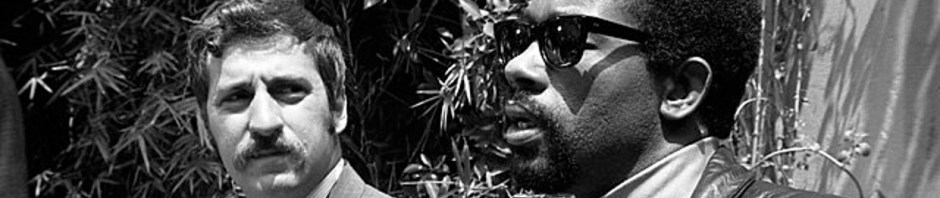
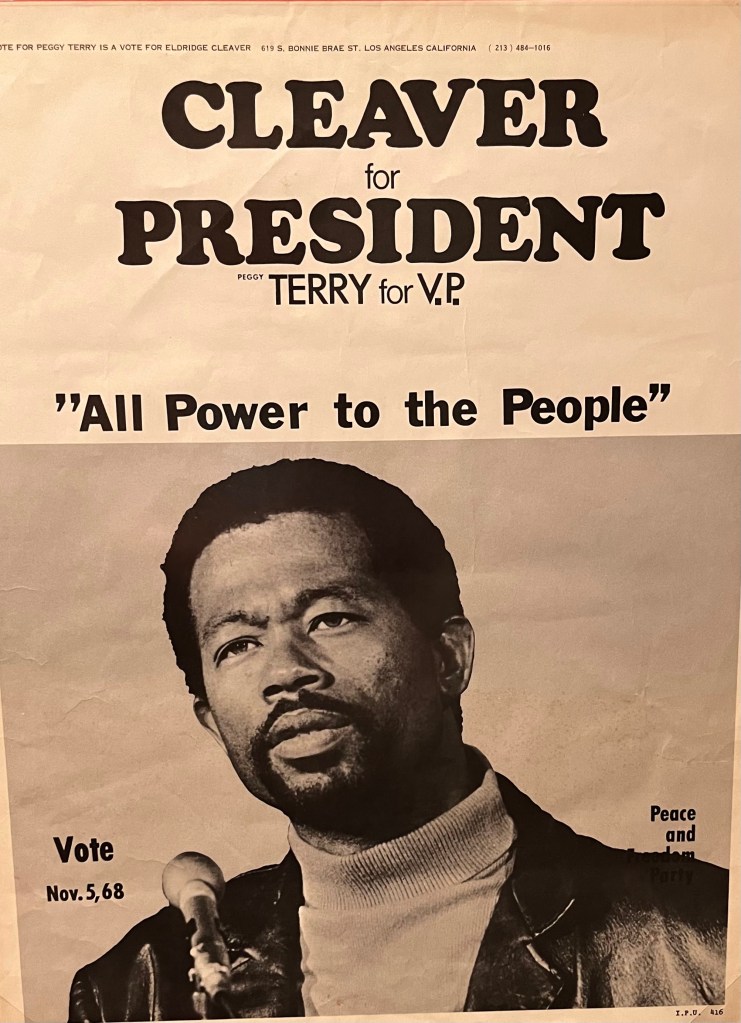
In 1968, Eldridge Cleaver, Minister of Information and head of the international section of the Black Panthers, ran for president on the ticket of the Peace and Freedom Party. In 1986, the same Eldridge Cleaver ran in the Republican primary for a U.S. Senate seat. (He lost both times.) What happened in the intervening 18 years that turned a radical revolutionary into a GOP aspirant?
Cleaver has a decades long rap sheet. Between the ages of 18 and 23, he was convicted of a felony drug charge, rape and assault with attempt to murder. He did time in Soledad, Folsom and San Quentin. While in prison he wrote a series of essays for Ramparts magazine which later were published as a book Soul on Ice (1968). The book contains this shocking quote:
”I became a rapist. To refine my technique and modus operandi, I started out by practicing on black girls in the ghetto — in the black ghetto where dark and vicious deeds appear not as aberrations or deviations from the norm, but as part of the sufficiency of the Evil of the day — and when I considered myself smooth enough, I crossed the tracks and sought out white prey. I did this consciously, deliberately, willfully, methodically — though looking back I see that I was in a frantic, wild and completely abandoned frame of mind.
”Rape was an insurrectionary act. It delighted me that I was defying and trampling upon the white man’s law, upon his system of values, and that I was defiling his women — and this point, I believe, was the most satisfying to me because I was very resentful over the historical fact of how the white man has used the black woman. I felt I was getting revenge.”
Also in 1968, an event occurred that changed Eldridge’s life. Two days after the assassination of Martin Luther King, Eldridge led a group of Panthers on an armed ambush of some Oakland police. Two cops were injured and a 17-year-old Panther, Bobby Hutton, was killed. Eldridge jumped bail.
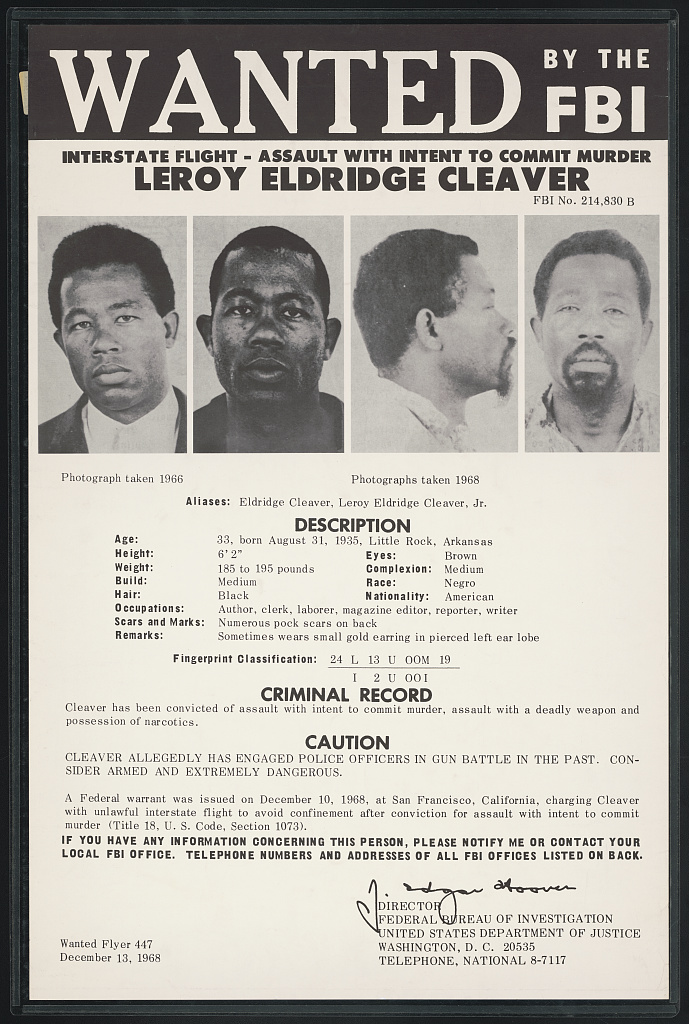
Kathleen Cleaver, Eldridge’s wife for 20 years, told the story in an article published in the Los Angeles Times (Dec. 1, 1975).
“On Nov. 27 (1968), the date scheduled for his surrender to prison authorities, Eldridge Cleaver was watching the proceedings on television in Montreal. Many people were glad that he had been able to escape the clutches of the law enforcement paraphernalia of the state, and considered his action a wise choice. Fully convinced that the revolutionary societies outside the United States would aid the burgeoning revolutionary movement inside America, Eldridge Cleaver left Montreal on an odyssey that took him to Cuba, Algeria, North Korea, China, Vietnam, the Soviet Union, and the People’s Republic of China. By 1972. his flagging belief in the substance of international proletarian solidarity was shattered by the visit of Richard M. Nixon to China, considered the beacon light of revolutionary struggle in the world. To see Richard Nixon and everything he represented being welcomed by Chairman Mao to the People’s Republic of China signaled the death knell of a certain period of international relations in which Eldridge’s political ideology had been formed and nourished.
“Eldridge Cleaver chose to seek political asylum in France, as an individual, since it was a country traditionally receptive to political refugees from all over the world, and its extradition laws would protect him from being returned to the United States. While living anonymously in France, Eldridge was treated to the spectacle of the Watergate expose, the resignation of President Nixon and the arrest of his attorney general, John N. Mitchell, under whom the destruction of the Black Panther Party had been engineered…
“Recognizing that a fundamental transition is in progress within the American government apparatus, Eldridge Cleaver decided that his own exile could be terminated and that he could safely return home to stand trial.”
Here’s what happened after he came home.
Cleaver became an evangelist.
“This Cleaver is giving himself a year starting last June 1 to get onto the road the Eldridge Cleaver Crusades an enterprise he says has been blessed by Billy Graham and to start a contracted book on his spiritual metamorphosis. ‘I talked with Billy Graham and found him warm, friendly, encouraging,’ says Cleaver ‘We prayed together, embraced each other. He gave me advice on how to start the crusade.’ Cleaver has spoken at 30 colleges and 20 church rallies since returning from seven years as a refugee… (Modesto Bee, July 23, 1977)
Cleaver became a fashion designer.
“The tiny men’s boutique, only a few blocks from Beverly Hills on trendy LaCienega Boulevard, is adorned by a simple sign: ‘Eldridge Cleaver Unlimited.’ The name itself suggests this is no ordinary tiny men’s boutique. This one is operated by a Black Panther Party cofounder turned born again Christian turned haberdasher.
“Nor is the merchandise ‘ordinary,’ even in the context of west side Los Angeles where fashion, to be fashion at all, must be at least a trifle outrageous. This shop, quietly opened three months ago by one of the country’s best known ex-revolutionaries, sells only one product, a special type of pants designed by Cleaver himself while living in exile in Paris during the early 1970s.
“THE PANTS, put discreetly, feature a front pouch. It is a style that was much in vogue during the late 15th Century, the conspicuous anterior adornment then known as a ‘codpiece.’
“Cleaver admits he has never actually seen one of his creations being worn by a man on the street, but he is convinced that day will come. ‘Right now, I think they mostly wear them to the discos,’ he added.”(Chicago Tribune, Oct 3, 1978)
Cleaver became a Mormon.
“Former Black Panther leader Eldridge Cleaver is exploring the possibility of becoming a Mormon. church officials say. They said yesterday that Cleaver has received lessons in the Mormon religion from missionaries in Menlo Park and has talked privately with Elder Paul Dunn, a member of the church’s leadership body the Quorum of the Seventy. Dunn said he had met with Cleaver to discuss church teachings and membership.” (UPI, Jan. 23, 1981)
Cleaver became a Moonie.
“Mr. Cleaver appeared here Tuesday in the University of Maryland’s Student Union to extol the virtues of America, democracy and the Unification Church.
“’The Rev. Moon is certainly one of the most important spiritual leaders of our era,’ Mr. Cleaver said. ‘His church is doing good works in many nations. His teachings have influenced my own theological studies.’ So begins a two-month nationwide tour of about 60 college campuses, sponsored by the Collegiate Association for the Research of Principles, run by the Unification Church.” (Baltimore Evening Sun, Sept. 30, 1982)
Cleaver became a patriot.
“Eldridge Cleaver is standing stiffly behind a lectern at Boston College, proud to share the stage with an American flag and glad to be able to urge 150 students to dust off their national identity and get a firm grip on patriotism. He is proclaiming America to be the last, best hope against communist domination of the planet. He is cheerleading for private ownership, arguing that racial barriers in America have been largely overcome, demanding a strong national defense and consigning Karl Marx to roughly the same political dustbin he once assigned J. Edgar Hoover.” (Boston Globe, Nov. 25, 1982)
Cleaver became a conservative.
“The scene was too bizarre to believe. Standing shoulder-to-shoulder on the speaker’s platform at a press briefing by the Populist Conservative Tax Coalition yesterday were these three well-known men: Richard Viguerie. publisher of the Conservative Digest; Paul Weyrich. chairman of the conservative based Coalitions for America; and Eldridge Cleaver late of extreme left-wing radicalism, admitted rapist, veteran of shootouts with the police, jailbird, revolutionary and one-time resident of such politically far away places as Cuba and North Korea.
“It was like Dorothy and the Wicked Witch of the West holding a joint social.” (Miami News, Aug. 21, 1984)
And, ultimately, he added to that rap sheet.
“Oakland police Lt Larry Newman said Cleaver and his companion 40-year-old Lothario Lotho of Berkeley were arrested when police found several pieces of rock cocaine in Cleaver’s gold 1986 Hyundai Excel. Officer Michael Cefalu stopped the car just after 6 pm at 59th and Racine streets after Cleaver began driving on the wrong side of the street. (AP, Oct. 5, 1987)
Cleaver was next in the news when he held a yard sale, including some of his furniture, to raise money for his legal fees.
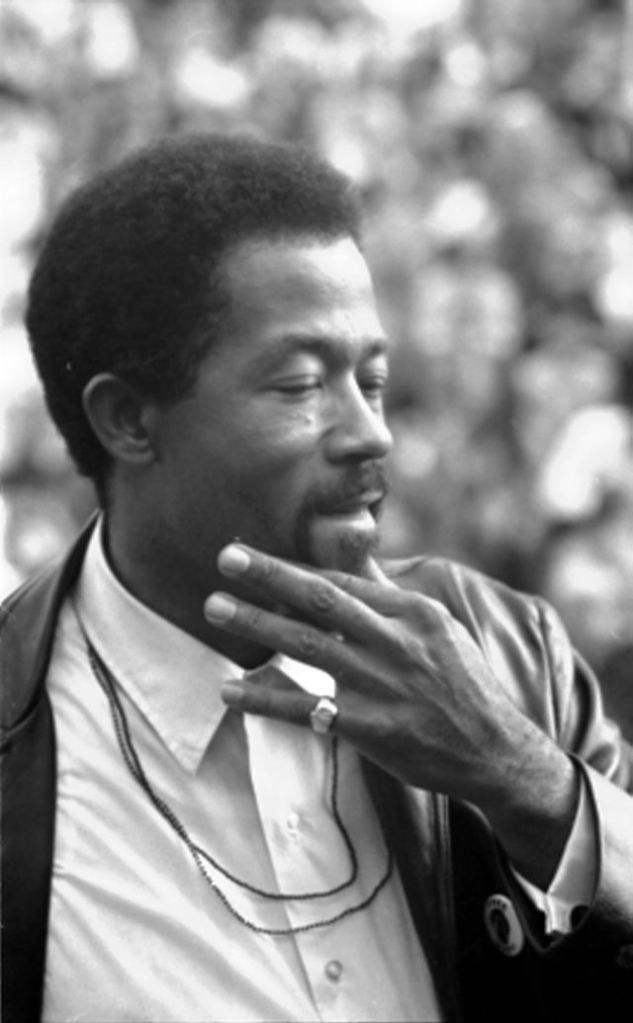
Cleaver died in 1998 at age 62, a victim of prostate cancer. The New York Times obit (May 2, 1998) recalled this vision of Cleaver: “In the black leather coat and beret the Panthers wore as a uniform, Mr. Cleaver was a tall, bearded figure who mesmerized his radical audiences with his fierce energy, intellect and often bitter humor.”
Before doing the research for this blog post, I didn’t know much about the criminality, nor the craziness that followed his return from exile. It’s pretty amazing that this guy actually spent so much time out of jail.
What I remembered is this Cleaver quote from the 60’s that has stayed with me ever since: “You’re either part of the problem or part of the solution.”
-0-
Whatever Happened To?
 off the leash
Thanks for the research, Ken
Eldridge Cleaver turned to two of the oldest criminal cons: religious salvation and patriotism. For instance, in 2017, People Magazine reported that David Berkowitz, the serial killer known as Son of Sam, rechristened himself Son of Hope, claiming he was a born-again Christian. And, as Bob Dylan wrote in his song Sweetheart Like You:
“They say that patriotism is the last refuge
To which a scoundrel clings”
LikeLiked by 3 people
That’s a great line from Dylan. Hadn’t heard that before.
LikeLike
Getting out of the world’s limelight is a smart move. I remember Eldridge and the era. Great share.
LikeLiked by 2 people
Unfortunately before any spiritual enlightenment, Cleaver is why the Black Panther Party went from grass roots community protection and self-elevation through organization to the shootouts that were their own demise. Cleaver undermined the Panthers and turned them from revolutionaries to guerillas. A damn shame, since they had the best of intentions in the beginning.
LikeLiked by 1 person
💯 Interesante.
LikeLike
Pingback: Whatever Happened To? Grace Slick | off the leash
Pingback: Whatever Happened To? Lorena Bobbitt | off the leash
Pingback: Whatever Happened To? Elian Gonzalez | off the leash
Pingback: Whatever Happened To? Jennifer Capriati | off the leash
Pingback: Whatever Happened To? Dave Clark | off the leash
Pingback: Whatever Happened To? Gerard Depardieu | off the leash
Pingback: Whatever Happened To? Sly Stone | off the leash
Pingback: Whatever Happened To? Lenny Dykstra | off the leash
Pingback: Whatever Happened To? Jerry Rubin | off the leash
Pingback: Whatever Happened To? Ronnie Spector | off the leash
Pingback: Whatever Happened To? Gennifer Flowers | off the leash
Pingback: Whatever Happened To? G. Gordon Liddy | off the leash
Pingback: Whatever Happened To? Patty Hearst | off the leash
Pingback: Whatever Happened To? Daniel Ellsberg | off the leash
Pingback: Whatever Happened To? Mary Lou Retton | off the leash
Pingback: Whatever Happened To? Roger Clemens | off the leash
Pingback: Whatever Happened To? Pam Grier | off the leash
Pingback: Whatever Happened To? Lance Armstrong | off the leash
Pingback: Whatever Happened To? Roman Pulanski | off the leash
Pingback: Whatever Happened To? George Foreman | off the leash
Pingback: Whatever Happened To? Bobbie Gentry | off the leash
Pingback: Whatever Happened To? Fernando Valenzuela | off the leash