
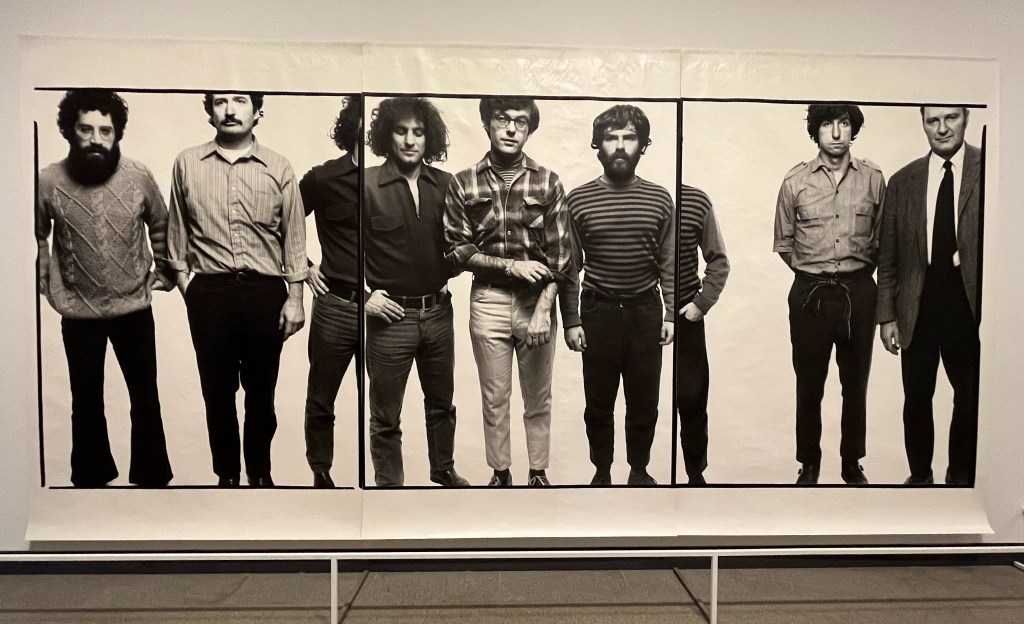
The photo above is a Richard Avedon mural of the Chicago Seven (on display at the Metropolitan Museum of Art in New York). Third from right, in the striped shirt, is Jerry Rubin. He was one of the most recognizable faces of the antiwar and counterculture movements of the 1960’s. As early as 1965 Rubin founded the Vietnam Day Committee which led some of the first large-scale protests of the Vietnam War. In 1967 he was one of the organizers of the March on Washington. Rubin and Abbie Hoffman (third from left in the Avedon mural) created the Youth International Party, heretofore to be known as the Yippies.
The Yippies merged theater and politics. Hoffman and Rubin staged increasingly more audacious events that seemed primarily aimed at attracting TV cameras. And they did. Rubin, who was called to testify several times by the House Un-American Activities Committee, showed up at various times dressed as a bare-chested guerilla in Viet Cong PJ’s, as one of the founding fathers, and as Santa Claus. At the 1968 Democratic National Convention, the Yippies nominated a pig for president. It was the tumult at that convention that led to the Chicago Seven trial. In the courtroom, Rubin paraded in front of the judge shouting ‘Heil Hitler’ and at another session showed up dressed in judge’s robes.
One of Rubin and Hoffman’s stunts brought them to the balcony of the New York Stock Exchange, from which they threw money down onto the trading floor. The mayhem that ensued, as traders scrambled for the bills, temporarily shut down the exchange.
Fast forward to 1980 and Jerry Rubin is back on Wall Street, donning a suit and tie, and sitting at one of the desks of his new employer, John Muir and Company. A 60’s Yippie becomes an 80’s Yuppie. What path led from the chaos outside the DNC in Chicago to the epicenter of American capitalism? It wasn’t a straight line. Here’s some of the stops along the way.
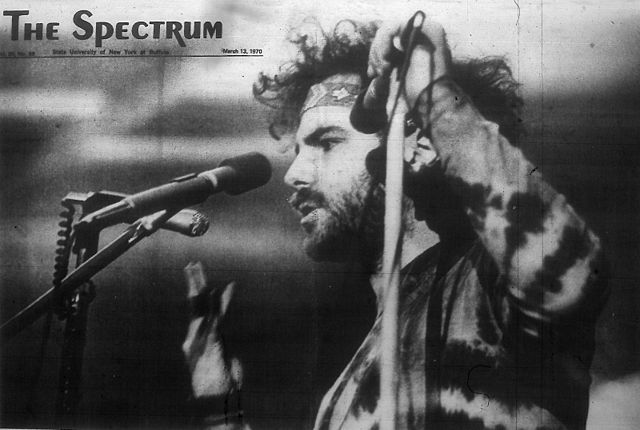
In 1976 Rubin published a book titled “Growing Up at 37.” In reviewing that book, Paul Wagman, in the St. Louis Post Dispatch (April 4, 1976), comments “His attention and prodigious energy, once concentrated mainly on society, are now focused chiefly on himself.”
“The book traces Rubin’s journey through the multitude of psychological ‘therapies’ that comprise today’s human potential movement. Zen, health foods, jogging, est (Erhard Seminars Training), acupuncture, bioenergetics Rubin tries them all.
“Sometimes he tries them all in the same day. ‘I’d be up at 7 a.m. to jog two miles,’ Rubin writes near the beginning of the book, ‘then run from modern dance class to tai chi practice to yoga to swimming to an organic meal to a massage class to a sauna bath to a night therapy or growth group, with weekends filled with more growth and spiritual experiences.’ If this sort of approach sounds to you a bit shallow, if it sounds like the kind of crash course approach you would take to learning German or gourmet cooking but not to your soul, if it sounds as it it would inevitably sabotage any possible benefits of the therapies, then you won’t be surprised by the rest of the book.
“Rubin spends 208 pages baring his soul to us, telling us the most embarrassing, personal kinds of details, without conveying any clear sense of his character. After reading the entire book, you have less idea about what he is like than you do after reading one page of a character sketch by any good novelist.”
In 1979 there’s another new book “The Zen of Erections.” Rick Nichols of the Philadelphia Inquirer writes (Feb. 15, 1979) “He came to Philadelphia’s Walnut Street Theatre Sunday to talk about sex. ‘Not just sex,’ he said, his hands jerking back to his shoulders. ‘I’m not interested in sex. I’m interested in fear among men, in intimacy, sex without performance, sex without conquest, sex without power. I’m interested in (demythologizing) erections.’”
Nichols caught up with Rubin “on the 10:20 p.m. Betsy Ross Amtrak express. He’s bound for New York and the 21st-floor East Side apartment overlooking Second Avenue that he shares with his wife, Mimi Leonard.
“Ms. Leonard is in furs, honey hair tumbling. ‘Are we happy?’ she whispers to Jerry Rubin. He has just pocketed $250 for telling maybe 300 folks in Philadelphia about his thoughts on erections, but somehow he does not look particularly happy. He looks beat.”
Rubin moved into Wall Street in 1980 and apparently had some early success. Leonard Sloane of the New York Times reported on Jan. 15, 1981:
“Jerry Rubin, the former Yippie and Chicago Seven defendant who surprised many who knew him by taking a job on Wall Street six months ago with John Muir & Company, has been promoted to director of business development of the brokerage firm. Sounding like a born and bred capitalist, he spoke yesterday about his plans in his new post.
”’I hope to actively communicate the opportunities that John Muir presents to the economy, to the entrepreneur and to the investor,’ Mr. Rubin asserted. ‘Using my knowledge of the media and my communications abilities, I hope to effectively communicate.’”
Rubin’s time at Muir and Company proved to be short-lived as the firm closed its doors in August of 1981. But Rubin wasn’t done with the Wall Street set. Myra MacPherson of the Washington Post (Oct. 18 1981) describes another Rubin initiative:
“It is Manhattan, 1981, and Rubin is waiting for his guests in his East Side apartment. Done in early sterile modern (the clearest impressions are of oatmeal wall-to-wall carpeting and a blowup of Deborah Harry in the john), it is set up for circulating, with coffee table pushed against the wall; a stage waiting for arrivals. A carpet-covered platform divides the bedroom area from the rest of the room. Outside the apartment are two young women, eager imitations of high-fashion gloss, presiding over the guest book. (Name, address, home phone and, of course, business phone.)
“Inside, lest you think there is anything at all casual about this gathering, are two piles of literature on a table set smack in your line of vision. One pile contains photocopies of a New York magazine article on Rubin’s latest venture. The other pile explains it all. JERRY RUBIN SALON PARTY AND CATERING SERVICE INC. headlines the announcement: ‘For the past 26 weeks, Jerry Rubin’s networking salon has received recognition as a unique and fascinating concept in entertaining.’”
MacPherson concludes: “The flamboyant costumes are long gone, leaving a man with thinning hair, indistinguishable from any other Madison Avenue consultant. There is something painfully pathetic in the eager smile of New York’s newest caterer-and-party-giver, greeting freeloader after freeloader.”
The New York Times reported this story on April 18, 1986.
“Jerry Rubin, the former political activist who is currently the head of Network America Inc., has filed an initial public offering of 1.65 million units with the Securities and Exchange Commission. The estimated proceeds of the offering is $2.97 million.
“Each unit consists of one share of common stock and a warrant to purchase an additional share of common stock.
“Mr. Rubin told the S.E.C. that the proceeds from the offering, which contains a warning of a high degree of risk, would be used to complete a prototype of a future nationwide chain of networking restaurants. The prototype would be located in midtown Manhattan. Mr. Rubin currently runs ‘networking’ parties at a nightclub in New York, at which professional men and women socialize. Mr. Rubin is the president of Network America; his wife, Mimi L. Rubin, is executive vice president. They control 97.5 percent of Network America’s shares. At the completion of the proposed offering, they would hold 68.8 percent.”
Syndicated columnist Bob Green found Rubin’s next money-making scheme in 1990, as he once more planted himself in front of TV cameras. (Detroit Free Press, May 31, 1990.)
“…the other night, I was flipping through TV channels when I saw Jerry Rubin. It was that Jerry Rubin, all right; he was wearing a business suit, and he was being interviewed on a national cable channel devoted to financial news. ‘What I really want to do is to bring capitalism back to America,’ Jerry Rubin was saying. He was waving a white plastic jug.
“I watched the show. It seemed that Rubin was promoting a drink that allegedly contains vitamins and nutrients. From what I could tell, he was in the business not only of selling the drink inside the plastic jugs, but of signing up other people to sell the drink, too.
“Still waving the plastic jug, Rubin looked away from the interviewer and into the camera and said to the viewers at home: ‘This is a way for you to make money.’ The interviewer, looking uncomfortable, said, ‘You sound like a huckster, Jerry.’ Rubin replied: ‘What’s a huckster?’”
Jerry Rubin died on Nov. 14, 1994. He died as a result of an illegal act. No, it wasn’t drugs, no riots or political violence, and no defrauding anyone with his business ventures. He was hit by a car as he jaywalked across Wilshire Boulevard in Los Angeles where he had a penthouse apartment.
-0-
(Newspaper quotes are sourced from and available at newspapers.com and the New York Times archive.)
Whatever Happened To?
 off the leash
Jerry Clyde Rubin was born on July 14, 1938 — that makes him 56 on Nov. 14, 1994. I was taught to look both ways, carefully, when crossing the street and, incidentally, to ignore provocateurs and demagogues.
LikeLiked by 2 people
Good lessons.
LikeLiked by 1 person
Interesting. Reading about how the rest of his life unfolded, his antiwar stunts seem to be less about conviction and devotion to a cause than about drawing attention to himself.
LikeLiked by 2 people
Yes that seems to be the one theme throughout.
LikeLiked by 1 person
Jerry Rubin started out in journalism. He was the editor and sports editor of the Walnut Hills High School newspaper in Cincinnati. While a student at Walnut Hills and then at the University of Cincinnati, Rubin worked as a “youth pages reporter” for The Cincinnati Post, an afternoon daily, from 1956 to 1960. (I later worked at The Post as its sports editor). According to The Post, the crew-cut Rubin mostly covered “sock hops, sorority and fraternity news” and helped out in the sports department. At 19, The Post named him editor of its youth pages. One of the stories about Rubin told at The Post is that he once sent a memo to the advertising department, demanding that he be given 16 columns of ad-free space so that he could have more room for his youth stories.
LikeLiked by 1 person
That was a different era for journalism when you could afford to pay somebody to cover sock hops.
LikeLike
A most unusual person.
LikeLiked by 1 person
To be sure.
LikeLiked by 1 person
This got me thinking of the Yeats quote: “The best lack all conviction, while the worst are full of passionate intensity.”
LikeLiked by 2 people
Pingback: Whatever Happened To? Gennifer Flowers | off the leash
Pingback: Whatever Happened To? G. Gordon Liddy | off the leash
Pingback: Whatever Happened To? Patty Hearst | off the leash
Pingback: Whatever Happened To? Daniel Ellsberg | off the leash
Pingback: Whatever Happened To? Mary Lou Retton | off the leash
Pingback: Whatever Happened To? Roger Clemens | off the leash
Pingback: Whatever Happened To? Pam Grier | off the leash
Pingback: Whatever Happened To? Lance Armstrong | off the leash
Pingback: Whatever Happened To? Roman Pulanski | off the leash
Pingback: Whatever Happened To? George Foreman | off the leash
Pingback: Whatever Happened To? Bobbie Gentry | off the leash
Pingback: Whatever Happened To? Fernando Valenzuela | off the leash
Pingback: The Dawn of the Antifa War - Attack the System