
A Review of The Freaks Come Out to Write by Tricia Romano

When I was a teenager in the 1960’s, and later in the 70’s and into the 80’s, if it was Wednesday, I was combing the newsstand (we had those then) for the new Village Voice. It was where I could read about the kind of music I liked to listen to, the kind of movies I wanted to see and the dissident politics I subscribed to. It was at Stonewall, at the epicenter of the feminist movement and the AIDS crisis. The Voice covered off-Broadway, independent film and the downtown club and music scene. Readers of the Times, the New Yorker and the tabloids would find nary a word of any of that. And there were the classifieds, the anything goes personal ads, and most importantly the job and apartment listings. If you were a Greenwich Villager, or wannabe Greenwich Villager, you might find yourself scheming to get an early copy of the Voice to get a first shot at an apartment. Thursday was too late. I once scored a job in the Voice, while on a brief hiatus from college, picking orders in the Grove Press book warehouse on Hudson Street. More notably, Max Weinberg tells of how he got his job with the E Street Band through the public notice music section of the Voice. At least for its first couple decades, the Village Voice was, above all else, a community newspaper for a distinctly unique community.
Tricia Romano was an intern at the Voice, and later a contributing writer. She has put together an oral history starting with its founding in 1955 and going through to the off-again, on-again recent history. We hear the voices of writers, founders, editors, owners and sometimes even subjects. It’s Mailer, Hentoff, Newfield, Christgau, Musto, et al. For some who have passed away she has used surrogates or archived interviews.
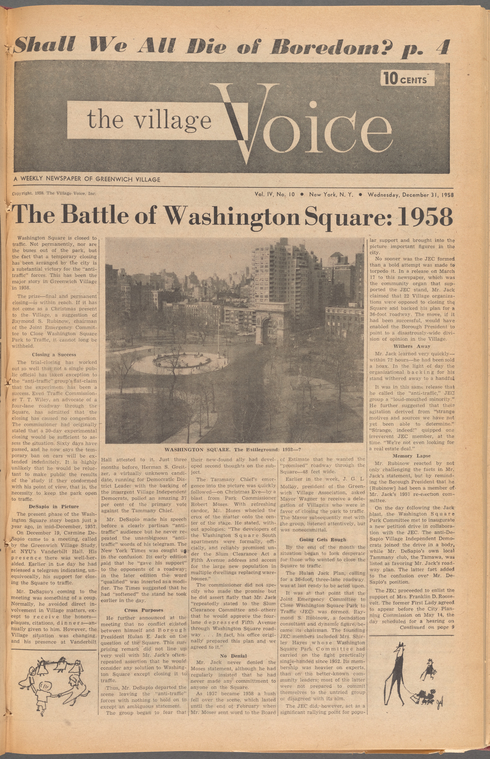
There were some surprises. Did you know the Voice was once owned by Rupert Murdoch? Or that Colin Whitehead was once a contributing writer? Here’s one of my favorite stories.
Staff news writer Wayne Barrett offered this description of lunching with Trump crony Roy Cohn:
“I had lunch many times with Roy Cohn. Roy Cohn ate with his fingers. I kid you not. He brought a little glass inside of his coat pocket. He would pop little white pills when he thought you weren’t looking. He was the most satanic figure I ever met in my life. He was almost reptilian”
I forgot that the Voice had a sports section. I loved it and read every word.
Allen St. John, a contributor, notes how it differed from other media’
“In the Wall Street Journal, you’re writing about the Yankees, the first reference would be ‘Derek Jeter.’ And the second reference would be the very stilted ‘Mr. Jeter.’ If you were writing about Derek Jeter in the Village Voice, it would be ‘Derek Jeter’ and then the second reference would be ‘Mariah Carey-banging motherfucker.’”
It was chaotic and there was no end of the intrastaff feuding. One notable example being the Marxist feminists vs. the old white guys.

This is not necessarily a smooth read. There are dozens and dozens of folks whose voices are included here. If you are the type that needs to know exactly who is talking in each passage, you’ll go nuts going back and forth from the list of participants at the front of the book. Also I found that it wasn’t always clear who the interviewees were talking about. I remember a chapter where everyone commented on “Jack.” I had no idea what “Jack” they were talking about. Lots of discussion about various editors at the Voice which made me think how a bit of a better editing job would have benefitted this book.
Having said that, I still found “Freaks” invaluable. It documents a very notable piece of the history of New York journalism and culture, as well as my own personal history. There is still a Village Voice online, though I don’t know of anyone who reads it. I checked it before writing this review and found hardly anything written since last month.

Romano closes with this obit-sounding bit from former senior editor Joe Levy:
“So, without the Voice, there is one less advocate for the rights of sex workers, or the rights of immigrants. One less outlet hearing those voices. One less place to be noticed as an aspiring playwright, musician, choreographer.”
 off the leash
Thanks for the insights into this book. Reading The Village Voice was like opening a present because of the anticipation of finding what was inside. I’d always be sure I carved out some time to read it, not just scan it, and it always was time well spent.
LikeLiked by 1 person
Growing up in the middle of Canada, the Village Voice was not part of my experience, but it certainly was, as you said, “a notable piece of the history of New York journalism and culture.” It sounds like the book The Freaks Came Out to Write has a lot of interesting insights into the paper and its creators.
LikeLiked by 1 person
I’d heard of the VV, but never read it–not sure growing up in podunk PA that I ever laid eyes on a copy. Love your descriptions of reading it.
LikeLiked by 1 person