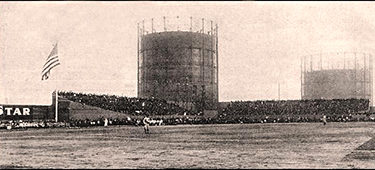
“All Newark was baseball ‘crazed’ today. The fans were on edge for their first taste of big league baseball.” That was a UPI dispatch from Harrison Park in Harrison, N.J., on Friday, April 16, 1915. The occasion was the one and only major league home opener played in the state of New Jersey.
The Newark Peppers of the Federal League were playing their first game in the brand new, $100,000, 20,000 seat stadium in Harrison, just across the river from downtown Newark. 25,000 squeezed in on opening day.
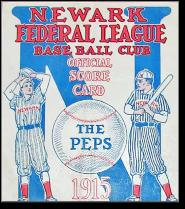
The Federal League was beginning its third season. It started in 1913 as an independent minor league circuit, but declared itself major league in 1914. The Indianapolis Hoosiers won the title that year. Owned by banker and oil magnate Harry Sinclair they then moved east and became the Newark Peppers.
The Peppers, aka the Newark Federals, had opened the season one week earlier, sweeping a three-game series from the Terrapins. The Baltimore team, not unlike the present-day major league club in that city, would go on to have a 100+ loss season, finishing dead last with a 47-107 record. That opening series caused Baltimore Sun sportswriter C. Starr Mathews to observe: “Bill Phillips (Peppers manager) took his team away from here last night, and, to tell the truth, we’re glad of it. They used the broom on us with telling effect, taking three straight games and were entitled to all of them. Newark has a corking ball club, and if the fans of that city do not rave over it I’ll be greatly disappointed.”
No need for such disappointment when the teams met again in Newark. The April 17 New York Times described the atmosphere on opening day: “The opening was a howling success, with a pippin of a warm afternoon, a crowd which bulged out the fence around the park, an exciting ball game… Everybody in Newark and its environs quit work when the whistle blew at 12 o’clock, put on their new Spring spangles, and got ready for the big parade. It was just like Fourth of July or circus day.” Hardly a mention of the fact that the Peppers lost the game 6-2. Modern day baseball fans will be interested in noting that the game took 1 hour, 54 minutes.
A week or so later, excitement over the Peppers spilled out onto the streets. The Buffalo Blues were in town for a three-series and on Sunday, April 25, after a 2-1 loss to the home team, Blues first baseman Hal Chase took a stroll down South 2nd Street in Harrison. There he encountered a heckling Newark fan named Billy Quinn. The ‘discussion’ between to two eventually came to blows and Quinn got reinforcements in the form of local tavern owner Paddy McGuigan. The brawl was broken up by police but when they tried to apprehend Quinn, other Peppers fans intervened and spirited him away. Chase was evidently not seriously hurt as he appears in the box scores for the next two games.
But alas, Peppermania did not make it through the full season. By mid-August, in an effort to boost attendance, the team announced a reduction in ticket prices. Bleacher seats, which had been selling for a quarter, were reduced to 15 cents. And the high-end seats in the grandstand went from $1 to 75 cents.
On the field the team could hold their own. This despite the fact that they had to give up their best player Benny Kauff, the 1914 league batting champion, at the start of the season. He was sent to the Brooklyn Tip-Tops as compensation for moving into their territory. For most of the season the Peppers were involved in a tight five-team race. A dismal September in which they went 12-20 dropped them to fifth place in the final standings, six games behind the pennant-winning Chicago Whales.
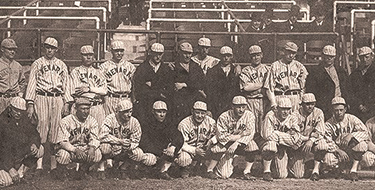
That was to be the last Federal League pennant race and the last major league baseball season in New Jersey. Long before the days of free agency the outlaw league provided players a rare opportunity to leverage the competition to increase their salaries. That pushed the costs for major league baseball owners and the National and American Leagues were anxious to make the Federals go away. The way they did this was to buyout half the owners, leaving the remaining four teams without a viable league. Sinclair pocketed a $100,000 buyout and somehow managed to retain the right to sell the players on the Newark Peppers roster to major league teams.
He told a New York Times reporter in December 1915, “I’m not out much. If I did lose anything, the fun was worth it. I’ve heard ridiculous statements that the Federal League lost $2,000,000 this year. That’s absurd, We came out alright.” By ‘we,’ I guess he means those owners who got the buyout.
On Feb. 16, 1916, the Times reported: “The final meeting of the Federal League has been called by President James A Gilmore for Chicago on Saturday, when the remaining club owners will wind up their affairs and officially declare the league a thing of the past.”
Was the Federal League a major league? Its proponents pointed to the fact that it paid major league salaries and had pinched several dozen major league and former major league players from the American and National Leagues. But the question remained unanswered until 1986 when Major League Baseball appointed something called the Special Baseball Records Committee, in anticipation of the publication of the first Baseball Encyclopedia. That supposedly esteemed group decided that yes the Federal League was a major league. End of discussion.
The Newark Peppers were a relocated team in an outlaw league playing in a city that was never before and has never since been considered major league. But they were not without their influence. Two members of the ‘Peps’ ended up in the Hall of Fame.

Bill McKechnie, the son of Scottish immigrants, was nicknamed ‘Deacon’ because he sang in a church choir. He left the New York Yankees after the 1913 season where he had a dismal .134 batting average and jumped to the Indianapolis Hoosiers. In 1915 he was the Peppers third baseman and batted .251 for the season. That’s not Hall of Fame numbers but what the Newark team didn’t know is they had a future Hall of Fame manager on their hands. He got his managerial start in Newark. Midway through the season, with the team in a slump, the Peppers fired Phillips and installed McKechnie as player/manager. McKechnie would go on to manage 3,600+ games with four major league teams. He won four National League pennants and won the World Series with two different teams, Cincinnati and Pittsburgh.
Edd Roush, the Peppers centerfielder, broke in with the Chicago White Sox in 1913 before jumping to the Federal League for two seasons with Indianapolis/Newark. He batted .298 for the Peppers. He later spent 10 years with the Cincinnati Reds, winning the national league batting title twice and leading the Reds to a World Series win, albeit a tainted one, in 1919. Roush always insisted that the Reds would have won that series even if the Black Sox hadn’t been bought. Overall he had an 18 year career with a .323 lifetime batting average. He was elected to the Hall of Fame in 1962.
The Peppers also helped bring into the vogue the Sunday single-admission doubleheader. In the early part of the 19th century most doubleheaders were played with separate admissions and usually on Saturdays. The Peppers played their first of nine Sunday doubleheaders on June 13, splitting a pair of games with Buffalo. The Sunday afternoon doubleheader would become a regular feature of Major League Baseball at least through the 1950’s.
There was no 1916 Federal League season. But there was still one more Newark Pepper. Their back-up first baseman was a local guy named Rupert MIlls. He had lettered in four sports at Barringer High in Newark. Mills then went on to Notre Dame where he played all four of the sports, baseball, football, basketball and track. He also graduated with an undergraduate law degree, something that would come in handy during his brief baseball career. After his graduation, the Peppers signed Mills to a two-year, $3,000 per contract. He appeared in 41 games, batting a paltry .201.
Sinclair made him a low-ball offer to buyout his contract. Mills refused. Since there was a provision in the contract that he would be paid as long as he showed up at the stadium, Mills reported to Harrison Park daily during the 1916 non-season and collected his salary. After a couple months of this, Sinclair relented and paid off Mills’ contract in full.
Mills played a couple years in the minors then enlisted in the Army and was stationed in France during World War I. After the war he went into politics and was elected a state senator. Unfortunately, Mills met a premature end when he died in a canoeing accident on Lake Hopatcong at age 35.
Harrison Park would only last for a few more years before it burned down in 1923.
And as for Harry Sinclair, who had since founded Sinclair Oil, he would make a name for himself as part of the Teapot Dome Scandal during the Warren Harding administration. He ended up going to jail for a few months for jury tampering, but he re-emerged prosperous and successful.