In writing this series of posts on the history of radio I came across several books that I used as primary sources. Some of them are listed below with reviews. None of these are new. I found a couple of them in my local library and the others I picked up in used bookstores. I have listed them in what I think is the order of interest.
 If you have any interest at all in the history of radio in America, this is the book to read. How could you not, after all, love an author who introduces Mitch Miller as the “fuddy-duddy host of the sappy ‘Sing Along with Mitch.’”
Douglas notes some of the dates and milestones of radio’s growth, but she is far more interested in what it is like and what it means to listen and how that fuels the imagination. This could well be considered a work of sociology as well as history as it delves into how radio has created communities and fueled youthful rejection of mainstream culture in the 20’s, in the 50’s and again in the 60’s.
Throughout its history radio is a medium that has been dominated by men. The author devotes considerable attention to what different trends in radio mean about men’s perception of themselves in different eras. For example she describes how the nuances of the language used by the radio comedians of the 30’s reflected a “feminization” as opposed the reassertion of maleness that emanated from the war correspondents of the 40’s.
One of my favorites parts of this history is how the author treats the emergence of television not as killing off radio but rather as reviving the medium with a new energy and youthfulness. In the 50’s radio provided the sound track for the flowering of teen culture, as it did a decade later for the 60’s counter-culture.
This is a bottom up history. Douglas has little to say about the captains of industry, the Sarnoffs and Paleys of the world. She is far more impressed by the guys who, working in their garages with a pile of wires and batteries, produced real innovation.
The book ends on a somewhat troubled note as corporate consolidation, advertisers, ratings services and radio consultants have combined to turn radio into a characterless vehicle for fixed playlist formats, leaving no room for experimentation or discovery. Since in the past every slide into corporate mediocrity has been met with a new wave of more imaginative radio, she ponders where that may come from. The book was written in 1999, so things like streaming, internet and satellite radio are not on her radar. While satellite has become as beholden to sterile formats as most of commercial radio, the internet opens up an opportunity for the innovators that’s not limited by bandwidth.
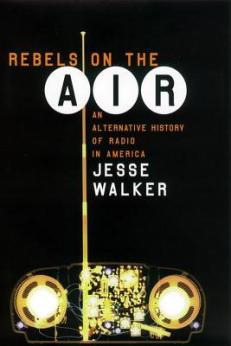 There’s no ambiguity about this author’s take on the state of commercial radio. “Most radio today is boring and homogeneous, chains of clones controlled by an ever-dwindling handful of focus-group-driven corporations.” He has nothing but disdain for radio consultants, fixed formats and tight playlists. But that’s not what Rebels on the Air is about. This is the story of the folks who hang out on the fringes of the radio dial. Starting with hams of the early 20th century, Walker provides a history of alternative radio: listener-sponsored, community radio, pirates and micro broadcasting included.
As someone who occasionally drifts over to the far end of radio frequency I enjoyed reading about the founding of the Pacifica Foundation and the constant turmoil and that surrounds its stations. Bob Fass, of Pacifica’s WBAI in New York, is anointed by Wallace as the father of freeform. I lost many hours of sleep in my teen years listening to Fass’ Radio Unnameable. I equally enjoyed reading about how WFMU freed itself from its bankrupt college owners. It is one station that to this day has carried on being diverse, unpredictable and free.
Set against a backdrop of corporate consolidation and government regulation, the book contains numerous anecdotes of the broadcasters who defied both. Some were creative geniuses, some were inspirational and some were just weird. This is the flip side of the radio history story line that starts with Marconi and moves on through the networks to the invention of TV. Makes you want to go figure out how to set up a transmitter in your garage.
 I’m in my 60’s, I live in the New York area and I’ve been a sports fan since I was a child. So I found this book fascinating. If you can’t check off at least two of those three boxes, you might be somewhat less enthralled.
Halberstam, who has worked as a play-by-play man himself, has put together a meticulously researched and thoroughly detailed account of sports on New York radio. Want to know how many Knicks games were live on radio in 1963? Probably not, but this book has the answer.
I particularly enjoyed his account of the heyday of sports radio (yes even before my time) and the marque events that have since lost some if not all of their luster: the Rose Bowl, heavyweight championship fights and New York City college football. The book is organized by sport, a chapter each for basketball, football, hockey, etc., and in the case of baseball, by team, the two current and two former New York teams.
The focus is on the announcers. That includes the superstars of play-by-play, Mel Allen, Marty Glickman, Red Barber and Marv Albert. They weren’t all the nicest of guys. But I was glad to read that wasn’t the case with my personal favorites, the trio that broadcast Mets baseball from day one and for the next 19 years, Lindsay Nelson, Ralph Kiner and Bob Murphy.
We have been conditioned to think of enjoying a game on a scale, the best of which is live attendance, followed by watching on TV. Radio is something we turn to when nothing else is available or when we’re doing something else like driving. But reading this book makes me think we might be missing something. These broadcasters didn’t give you 30 different camera angles but worked with nothing but words and the listener’s imagination. Maybe a lost art.
Contrast that with some of the guys you see on TV, especially if you happen to be watching the day’s 10th live college basketball game. You likely get a couple cheerful dudes doing little more than reading the PR blurbs that they’ve been fed by the teams’ SIDs.
I can’t imagine there is room for another book on this subject. Halberstam has pretty much covered the topic.
 A story of a Russian Jewish immigrant who moved from a ghetto on New York’s east side to a penthouse office in Rockefeller Center. (Are you listening Donald Trump?)
David Sarnoff started as an office boy for the American Marconi Company. When that company was swallowed up by Radio Corporation of America (RCA), they got Sarnoff as well and he was to lead RCA and its subsidiary NBC for decades.
Sarnoff was truly one of the founding fathers of modern consumer electronics and home entertainment. He was one of the first corporate players to identify radio for its broadcasting capabilities, rather than as a point to point messaging service. He conceived of the first broadcast network (NBC) and managed RCA to a leadership position first in the introduction of television and later color television. He was someone who was willing to overlook short term profits in favor of building an industry-leading long-term business, something that is woefully lacking in current day corporate America.
The “General” title comes from his work during World War II. Stationed in England he built the communications system that would be used by the Allies during the D-Day invasion. But the title also represents another characteristic of Sarnoff. He was seemingly not a greedy man, but he constantly sought adulation. He lobbied for years, all the way up to Dwight Eisenhower, to be named a two-star general. This guy wasn’t building private mansions in the Caribbean, but he was putting all the money into public relations, building his image and legacy.
Sarnoff was an incurable workaholic. This book has little to say about his private life. It seems to suggest that he barely had one. He was married, apparently happily, to the same woman throughout his adult life. And there is brief mention of the fact that he had three boys. The subject comes up only within the context of Sarnoff acknowledging that he was a pretty crappy father. His oldest son eventually emerges as part of the story, but only after he has himself become a senior executive at RCA.
Do you get to know Sarnoff by reading this biography? Barely. About as much as you might know a guy on the upper floors of your office building who you occasionally greet on the elevator. I found this book in a rather obscure corner of my public library. It’s from 1986. If you find a copy you might have to dust it off.
Others not reviewed here:












 I might well still think I had seen a documentary. Keatley also plays Ben, the main character in the movie. And the guy who plays the director in the ‘documentary’ is in fact the director of the movie. Have I lost you yet? The movie is about a man who sets out to find his biological parents. The search takes him to Dungeness, which honestly looks like the end of the earth. The movie drags us into the suspense of finding Ben’s real family. In the end what he finds is a different definition of what a real family is. I hesitate to say much else because spoilers will truly spoil this one. The title “For Grace” refers to Ben’s baby. The baby is played by a baby whose real name is Grace and the actress who plays the baby’s mother is really the baby’s mother. One member of the audience said after watching the film she felt “emotionally manipulated.” The rest of us just felt we’d watched a really good movie.
 popular in predominately African-American schools. The movie follows members of the step team at a Baltimore charter school, the Baltimore Leadership School for Young Women. While the film follows the team through to a regional competition in Bowie, Md., the inspiration comes more from their experience at the school. The three team members which the documentary follows are girls with at least one caring parent, but with no resources to speak of. One of them, in telling us how her mother has always taken care of her, comments that they were homeless for a little while and she didn’t even know it. 2016, when the movie is filmed, is the first graduating class at the school. One hundred percent of these girls went on to college. One of the subjects of the film achieved her dream of a full scholarship to Johns Hopkins. Another got into some sort of college with a 1.0 GPA. Talk about a great guidance counselor. It also makes for a great movie. And, as was the case last year when Life, Animated opened the festival, some 1,500 people filled the Wellmont Theater to watch a documentary.
 Jim Acosta of CNN said “the President has an unhealthy attitude toward the press. On the campaign trail he called us crooks and thieves. He’s doing real damage to the first amendment in this country.”