Most sports figures are reluctant to address social or political issues publicly. No so with sportswriters. Four of them did just that yesterday at the Montclair Literary Festival panel Sports and Social Protest. Their discussion turned out to be a comparative analysis of sports leagues and their players’ willingness to use their position as a platform.
And the leader is the NBA. Jay Schreiber, deputy sports editor of the New York Times, called the NBA “the MSNBC of sports.” Nobody disagreed with that. Since the NBA and the NFL are both African-American majority sports leagues, there was a lot of comparison between the two. Colin Kaepernick aside, NFL players are much more reluctant to speak out on issues.
Filip Bondy, who has had a 40-year career as a sportswriter at the New York Daily News and the New York Times, talked about how social protest by athletes was common in the 60’s, what he called the “Ali era.” He suggested that it stopped as more money came into sports, but has returned of late. “It used to be athletes were afraid to speak because of the money. Now they have so much money they don’t care.”
From left, Filip Bondy, Mike Freeman, Jerry Barca and Jay Schreiber.
Bondy suggested that the NBA has a tradition of liberalism that goes back to the Democratic Jewish owners of the 50’s and 60’s as opposed to the NFL where the owners are ‘like a country club.” The NBA has taken a stand against gun violence and supported gun control. It also pulled its all-star game out of North Carolina after that state’s legislators passed the so-called “bathroom bill” that discriminated against transgender people.
Jerry Barca, an author and film producer who has worked on ESPN’s “30 for 30,” talked about how in comparison to the NFL, the NBA is an open league. You can talk to the players daily, rather than just on “media days” like the NFL. “The players know they are the product,” Barca quipped, noting that Donald Sterling, former owner of the San Diego franchise, is no longer an owner because of the players.
Barca also pointed out that in the NBA it is the league’s best players and most visible personalities, guys like LaBron James and Steph Curry, who lead the way in addressing social issues, something that makes other players less reluctant to do so and something that hasn’t happened in the NFL.
Schreiber called San Antonio Spurs coach Greg Popovich “the most interesting critic Trump has.” Why? Because he’s a white professional sports coach, works in Texas and has a military background. He has spoken out repeatedly and passionately about Trump’s immigration policies and comments about immigrants.
As for baseball, a sport that is primarily white and Latin, Mike Freeman, who has covered the NFL for numerous newspapers and broadcast outlets, said “those guys say nothing.” Bondy said he has been trying for years to get a member of the Cleveland Indians to comments on the Chief Wahoo logo. With no success.
Los Angeles Dodger Adrian Gonzalez did choose not to stay in a Trump hotel during the playoffs in Chicago last year. And on the other side of the ledger, two white conservative Chicago Cubs pitchers, Jake Arrieta and Jon Lester, didn’t turn up for a visit to the Obama White House after they won the World Series. There are 5 or 6 New England Patriots who have announced they aren’t going to the Trump White House, according to Freeman. Two are no longer with the team. This is a team whose leader Tom Brady and coach Bill Belichick are avid Trump backers.
Hockey players didn’t even rate a mention at the panel. But soccer players did. Soccer is a sport with a lot of ethnic players. But it is white American team captain Michael Bradley who has led to way in denouncing Trump’s immigrant policies. So has the president of U.S. Soccer Sunil Gulati. Those immigration policies have placed in jeopardy the bid by U.S. soccer to host the 2026 World Cup as well as Los Angeles’ bid to host the 2024 Olympics. The U.S. women’s soccer team has led a very public fight for equal treatment, as has the U.S. women’s hockey team.
The only question that stumped this talkative panel of sportswriters was being asked who in sports they found to be inspirational. It took a minute but they came up with a good answer: Serena Williams.
This weekend was the first Montclair (N.J.) Literary Festival, a three-day event taking place at four venues in town. As someone who writes a lot of blog posts about history I started the day by heading to the session titled “Facing History and Ourselves.” Two authors of history and historical fiction and a history professor were on the panel.
When initially presented with the question of why they chose to write about history, the answer was pretty unanimous. There are just so many stories that haven’t been told. And I’d guess that many of those stories would be so much more interesting and relevant to us than a lot of the stories that do get told. It is hard to call the history that is taught in our schools a story. What we get is dates, names, wars, presidents, etc. History textbooks are generally horrible and one suspects that little research goes into them. Rather they are probably a rewrite exercise.
So we learn about slavery without learning what the slaves thought. We learn about wars without understanding the impact on the soldiers, other than a body count. We seem to celebrate Manifest Destiny but don’t hear from the Native Americans. It is a history of documents, based on PR, propaganda, government pronouncements and historical calendars. I’d like to think that’s changing, but I see no real evidence of it. My teenage son, who goes to a relatively progressive middle school, came home the other day complaining about his social studies class in which the current unit on American history consists primarily of the dates and names of colonial era legislation.
The authors on the panel brought up some other examples. Stephen Tolty, who is doing research for a book about the Vietnam War, described an instance in 1972 when the Nixon White House wanted to respond to a North Vietnamese initiative with an intensive bombing campaign. But the units on the ground in Vietnam ignored this for a few days and instead focused on trying to rescue one of their colleagues who had been captured. Why? Because the American soldiers hadn’t really bought into the narrative that led us to war and at this point assumed it was a lost cause anyway. Our history books tell us about Nixon and Kissinger, but not about these guys.
Author Ellery Washington raised a personal example. He noted how as a gay black kid growing up in Albuquerque, he felt completely left out of the historical narrative. He suggested the feeling of not being part of the story as a possible reason for the kind of top-down anti-intellectualism we are experiencing. Our history texts celebrate industrialization without much thought to the crafters and independent service providers who were put out of business. Do we likewise celebrate the march of technology without giving much thought to the factory workers whose jobs have disappeared and is that part of the explanation for Trump’s election.
Washington commented that “there is a difference between facts and truth. Truth speaks to something larger that includes facts.” I would add that there is also such a thing as untruths that can come from partial facts.
At a time when not only Americans, but Europeans as well, have decided that immigrants are the source of all of their economic and security problems, one of my favorite historical topics is the untold history of immigrants. About a year ago I wrote a series of posts on the history of beer in New Jersey. It was a history made by German immigrants in the city of Newark. And those German immigrants were looked upon in much the same way that Latino and Muslim immigrants are looked upon today. During World War I, some of these pioneer brewers had all of their assets confiscated because of their German heritage. Talty commented: “You can never be American enough if you are a newcomer.”
I came across another example when doing the research for my current History of Radio series of blog posts. The surface narrative about the history of radio starts with Marconi and goes through the U.S. Navy, RCA, David Sarnoff and the broadcast networks. But I came across at least a couple authors who dismissed that and talked about the real pioneers of radio, guys who set up in their garage with soup cans and tin fuel.
We also look to history to provide what Washington refers to as the “foundation of truth” for our society. History is written for people today, not the people who lived at the time that the story is about. That is why, as Montclair State University Professor Leslie Wilson commented, historians raise questions like “were the founding fathers really great thinkers?”
One of my favorite types of history that I think addresses this issue of the stories that haven’t been told is oral history. It is first hand history in the words of the participants. I recently read a great example of oral history in the book “Second Hand Time, the Last of the Soviets,” by Svetlana Alexievich. Oral history is mostly written by interviewing older people who lived through a certain era. Alexievich’s book is about Russia during the transition from the USSR to the post-Soviet republic. The panelists today noted the potential for a far richer range of sources for future historians because of self-publishing, the internet, bloggers like myself and social media. Think about the narrative created by people on the street during the Arab Spring as it was recorded on Twitter. Surely that gives us the opportunity to hear from voices who in an earlier time would be left out of the story. And it might also give us an even bigger challenge when it comes to figuring out the truth.
In doing the research for this series of blog posts on the history of radio I read several texts by a variety of authors. There was nary a kind word for the current state of commercial radio in the U.S. Jesse Walker (Rebels on the Air) sums this up best: “most radio today is boring and homogeneous, chains of clones controlled by an ever-dwindling handful of focus-group-driven corporations.”
Who controls commercial radio? iHeartMedia Inc. owns 860 stations. This is the company that used to be called Clear Channel and was sold to a private capital group headed by Bain Capital and Thomas H. Lee Partners in 2008. Cumulus Media owns 443 stations and Townsquare Media owns another 312 mostly small market stations. There are three other companies that each own more than 100 stations, CBS Radio, Entercom and Salem Media Group.
At one time the Federal Communications Commission established limitations on the number of stations a single entity could own as a way to assure some diversity on the radio dial. But in 1992 the FCC began to loosen those restrictions. The FCC policy had remained basically the same since that time. Here it is:
The rule imposes ownership restrictions based on a sliding scale that varies by the size of the market: (1) in a radio market with 45 or more stations, an entity may own up to eight radio stations, no more than five of which may be in the same service (AM or FM); (2) in a radio market with between 30 and 44 radio stations, an entity may own up to seven radio stations, no more than four of which may be in the same service; (3) in a radio market hosting between 15 and 29 radio stations, an entity may own up to six radio stations, no more than four of which may be in the same service; and (4) in a radio market with 14 or fewer radio stations, an entity may own up to five radio stations, no more than three of which may be in the same service, as long as the entity does not own more than 50 percent of all radio stations in that market.
I looked at iHeart’s list of owned stations and found that they do indeed own 8 stations in many, many markets, although some of those areas, like Poughkeepsie, N.Y., hardly seen to me to be major markets likely to have 45 or more stations. So it’s questionable how strictly even these slackened ownership limitations are enforced. Among iHearts’ holdings are many talk radio stations around the country and their standard fare includes Glenn Beck, Rush Limbaugh and Sean Hannity.
There is a parallel here with what is likely to happen at the FCC under the direction of new chairman Ajit Pai. Pai is intent of eliminating net neutrality rules. The result will be that large corporate interests will be able to buy themselves a preferred pathway to consumers, thus allowing the same type of consolidation of control of broadband that we have with bandwidth.
Radio has been a victim of big data long before anyone used that term. By making programming decisions based on ratings and ad sales, station programmers, who were given the control once enjoyed by DJ’s, generally adopted formats that minimized variety and focused on repetition of the most highly “rated” songs. I found this Infographic on Business Insider which claims that one song was found on 80% of radio station playlists. And the song was “Mrs. Robinson.” Being from a 1967 movie, I guess you can accumulate a lot of big data over five decades. This type of programming focus isn’t going to deliver any music that veers from what you’ve been hearing on commercial radio, over and over and over again.
One of the pioneers of this approach to music radio programming is a consultant firm named Drake-Chenault. They created the most widely used Top 40 format starting in the late 1950’s. It restricted music to a minimal number of songs that would be played repeatedly all day on all shows, interspersed with jingles, news updates and lots of ads. They usually achieved commercial if not artistic success. They later developed “jingle packages” as well as formats such as Solid Gold, Hit Parade and Great American Country.
A company called RCS, which is still in business, started making computer software to program music on radio stations some 30 years ago. On their web site they elaborate on what their Selector program has to offer: “Selector delivers consistency in the mix, variety in the flow, balance in the log and control in the entire music library.” Ho-hum.
Knowing that the program director is now the key person to determine what we’ll hear on these stations, I searched online and found this job description on the web site of the Houston Chronicle for a program director. I assume this is a fairly standard description of what commercial radio stations are looking for. “As a radio program director, your responsibilities are that of an administrator. You handle the business of the radio station and leave the voice and personality to the disc jockey. Disc jockeys have to follow your rules even if you may not see eye-to-eye. You may prefer to play safe and repeat music even though your disc jockey prefers to take a risk and make changes to the music. Nevertheless, the success of the radio station lies in your hands.” In other words, if some rogue disc jockey wants to play a song that’s different from what he played yesterday and the day before and the day before that, it’s your job to make him toe the line.
And just in case you can’t find a suitable program director to control this you can always turn to radio consultants. One of the larger firms Radio Programming Consultants, which has offices in North America, Europe and Asia, offers the following assurance: “In our consulting practice the artistic part in music scheduling comes AFTER the technical / applying science.” Not only are these guys admitting that they could care less about artistic considerations in selecting music, they’re trumpeting that fact in all caps! Who would want to listen to a radio station they programmed?
Throughout its history there has always been a response to consolidated conformist radio. Free spirits, pirates and rebels have always popped up snatching some small piece of bandwidth and showing what radio can be. The airways have been controlled by government and corporate owners by monopolizing bandwidth and squeezing the small players and independents to the margins of the dial. But the internet wipes away that limitation, makes the above FCC rules meaningless, and also strips away the limitations of geography and signal strength. Even the smallest operation can stream online and find listeners all over the world. So I think we have a lot more good radio ahead of us.
The first television programming appeared in the early 1940’s. No one saw it. It was wartime in America and we weren’t out buying new home entertainment devices. By the late 40’s, things had changed. Families were reunited, we were on the verge of an age of prosperity and the baby boomer generation was learning to walk. The radio set market was saturated and manufacturers shifted their focus to television sets. The networks did the same. By the early 50’s, NBC and CBS and ABC, the dominant radio program producers for the previous 25 years, abandoned radio. Gone were the comedians, the drama and the variety shows that fueled radio listening. Gone were the days when the family gathered around the radio after dinner.
Was radio, the medium that provided the soundtrack to imagine your own images, doomed? Nope. In fact, for every year in the decades of the 1950’s and 1960’s radio had increased ad sales. Radio reinvented itself and built new audiences, redefining American culture along the way. Turns out radio had some real advantages that the corporate manufacturers and network programmers might have overlooked.
Radio is mobile. In fact, after 1947 with the invention of the transistor, radio was even more mobile. You don’t have to sit around a piece of furniture at home to listen to radio. It’s in the car, you could bring to the park, shove it in your purse or pocket or stick it under your pillow.
Radio is cheap. Transistor radios were a few bucks. Kids probably only had to mow the grass or take out the garbage a couple times to get enough allowance to get their very own personal transistor radio. And access is free.
You can listen to radio while you’re doing something else and not miss a thing. Cook dinner, drive to work, sit outside on the patio, paint the walls; radio is there with you.
Radio is local. While we have been accustomed to thinking that the most important programming on the air is networked and national, many prefer and seek out local media and once the networks abandoned radio that’s what it became.
Between 1940 and 1960 the number of cars in the United States roughly doubled. And there have been radios in cars since the 1930’s.
(Image by Scott Webb)
But all of those things might not have led to a true radio renaissance were it not for one more thing. Teenagers. More of them than ever before, because all those baby boomers were becoming teens in the 50’s and 60’s. And these teenagers were intent on defining themselves. They did it with their clothes, their hairstyles, and their musical tastes. They in fact became the trendsetters for style in America. And they were an enormous new market.
There have been three waves of renewed interest in radio since the mid-20th century. Each was in part triggered by a rejection of the prevailing state of mass media in America.
Back in the 20’s radio was the only place where many young people, and especially young white people, could hear jazz, a musical form thought to be outright degenerate and subversive by many of their parents. The same scenario repeated itself in 50’s with rhythm and blues and rock ‘n’ roll, terms that initially were only distinguishable by the color of the skin of the artists making the music. And that was the music that teenagers were playing on their car radio and listening to on their transistors at the beach. Gone were Jack Benny and Ozzie Nelson and Red Skelton. Now we had Alan Freed, Wolfman Jack, Murray the K and Cousin Brucie.
Rock ‘n’ roll on radio caught fire. After all, it was cooler to be making out in a parked car listening to Elvis than sitting around the TV with your family watching Ozzie and Harriet. It eventually gave rise to Top 40 radio. But as station owners and advertisers gravitated to this format, they turned it into a jingle-laden ad fest in which just a few songs were played over and over again. And ultimately it led many, including the next generation of culturally rebellious teens to abandon the AM dial. AM Top 40 radio went from being the musical accompaniment of 1950’s teen rebellion to being part of the mainstream mass media that the next wave of radio would rebel against.
FM had been around for a couple decades but was of little consequence. Until the 60’s that is. Music aficionados were drawn to the higher quality sound. The FCC issued a ruling that required stations that had both an AM and a FM outlet to offer different programming on the two. And AM radio had become a commercial wasteland at a time when a new generation of young people were rejecting the commercialism of American society. As a result of all of these factors the number of FM stations in the United States increased from 570 in the mid-50’s to 3,700 by the mid-70’s.
FM was an almost blank canvas and it brought out a new form of radio. Stations like WNEW-FM in New York once again turned the programming over to the DJ and what we heard went by names such as progressive rock or underground music. It was the music by which to join a campus protest, grow your hair or burn everything from a draft card to a bra. And the fact that it enhanced the experience of the most popular recreational drugs of the time didn’t hurt either.
Like early rock ‘n’ roll radio before it, the success of FM attracted the same corporate owners and advertisers as before. And with them came restricted programming, fixed playlists, and narrowly-defined formats. And a complete loss of the vitality that FM had been built with.
In the late 80’s there was one more wave of new programming that brought audiences back to radio. And to the AM dial at that. Talk radio also emerged because of the general dissatisfaction with the prevailing norm of the nation’s mass media, and especially television. There were the so-called ‘shock jocks’ like Howard Stern and Imus who said things you supposedly couldn’t say on TV. There were the far right and seriously loud demagogues like Rush Limbaugh whose outrageous statements attract an audience that probably looks a lot like those who show up at Donald Trump rallies. Even sports developed a controversy courting contingent and most major cities eventually had a sports talk radio station or two where callers expressed outrage over the latest player trade or lack thereof. There were 850 talk radio stations in the mid 90’s compared to 200 a decade earlier.
At the same time, public radio in the form of NPR sprung up as an alternative to the increasing shallowness of other forms of broadcast news. NPR was a tag-on to the 1967 Public Broadcasting Act which was primarily focused on the creation of PBS television. But by the middle of the 70’s about 11 million Americans were listening to NPR news. Criticisms by right-wing politicians and an increased dependence on corporate sponsors have made NPR more risk-averse than it was initially and under the current administration it could well lose federal funding.
Susan J. Douglas (Listening In) comments that “talk radio and NPR led the way in opening up airwaves to a range of voices, some quite unwelcome elsewhere.” David Halberstam (Sports on New York Radio) defines some of those voices as “opinion mongers, political demogogues, holistic health advocates and scam artists.”
So did video kill the radio star? Definitely not. It changed radio, it changed who listened to radio and it changed the programming. But you can make the case that it made radio better. Now what happens with broadband? With streaming? And with smart phones?
Did Alan Freed invent rock ‘n’ roll? If he was still alive he might tell you so. For some the birth of rock ‘n’ took place at the Cleveland Arena one night in March of 1952 when Freed, a DJ on WJW, hosted his “Moondog Coronation Ball.” 25,000 people showed up at the 10,000 capacity arena. The cops shut it down.
One thing that Freed did was irrefutable. He took black rhythm and blues and played it on mainstream radio, thus introducing it to white audiences. That not only changed radio and music, it changed teen culture for at least a decade to come. In her book Listening In, Susan J. Douglas quotes Freed on his views on teenagers. “Teenagers, I’ve been dealing with them for thirteen years, and they’re the greatest, most wonderful age group in America. Since when has it become a crime to be a teenager?”
Freed was part of a new wave of DJ’s that took over the airways in the 50’s. With the drama and comedy of earlier era radio moving to TV, Freed and his colleagues brought a different approach to radio programming and cultivated a new audience, a large part of which were young people in their cars and with their transistors. In the beginning they controlled the music they played, and what they played was rhythm and blues and rock ‘n’ roll. Freed moved from Cleveland to WINS in New York and his show was later syndicated nationally. He continued to put on live shows in addition to his radio programming, one of which was a week-long event in New York that drew 95,000 people. WINS fired him after one of his shows ended in a riot, but he was quickly picked up by WABC, one of the most powerful stations on the AM dial.
But the influence Fried had also contributed to his downfall. Rock ‘n’ roll was still considered something of an outlaw culture in a conservative and conformist 50’s America. The government got involved partly through the urgings of ASCAP, the performance rights organization which was losing ground to rival BMI which had the majority of black and young artists. What they attacked was payola, something that was no secret in radio, but most believe their real target was rock ‘n’ roll. Freed like many, if not most other DJ’s, was in fact guilty. One of the ways he was rewarded for playing a record was by giving him writing credit and thus royalties. He is, for example, listed as co-author of Chuck Berry’s “Maybelline.” That was news to Berry.
Freed unabashedly admitted to this, declaring that “What they call payola in the disc jockey business they call lobbying in Washington.” He was fined $500 and given a suspended sentence. The authors of Last Night a DJ Saved My Life surmise “the real reason the U.S. government spent so much time pursuing him seems to have more to do with his success in promoting ‘degenerate’ black music to their impressionable white sons and daughters.” After his payola conviction, WABC fired Freed and the feds then turned the IRS on him.
His career went downhill from there, as did his health. He died in 1965 at the age of 43 due to complications related to alcoholism.
Bob Fass
Freeform radio was born in 1963 after midnight on an obscure non-commercial radio station in New York. That’s when an unemployed actor named Bob Fass who had been hired by WBAI as an announcer, convinced the station to give him a show during a time when the station was usually signed off the air. That was 54 years ago and this lifelong New Yorker is still on the air. There may be others who claim to have invented freeform radio, but Fass is surely the most influential of the pioneers.
Jesse Walker, author of Rebels on the Air, describes Fass’ show, Radio Unnameable, like this: “He played all kinds of records, he interviewed all kinds of people, he allowed musicians to jam, live, in the studio, he did news reports, took listener calls, and sometimes, his colleague Steve Post recalls, simply rambled.”
Bob Dylan, Phil Ochs and Ravi Shankar all showed up on Radio Unnameable. So did Alan Ginsburg, Abbie Hoffman, Wavy Gravy and Timothy Leary. He went to the 1968 Democratic Convention demonstrations and brought back recordings. His show was often used as a community forum to organize demonstrations. Fass cared about war, not just Vietnam in the 60’s, but also what he called ‘Bush’s war for oil.’ He cared about homelessness and about capital punishment. Once, upon getting a call from a listener who said he was going to commit suicide, Fass kept him on the air for two hours while the WBAI staff tried to trace the call and notify the police. When the police arrived the caller was unconscious (with the phone off the hook and WBAI on the radio) but alive.
He also brought several innovations to radio. He was one of the first to use sound collages and to program music in sets. He also had a call-in setup that allowed up to 10 callers to be on the line at the same time.
Once in the 70’s Fass was banned from the air for five years after being involved in an attempt to unionize the station. He’s back but he hasn’t been paid anything by WBAI since 1977. At one time listeners sent donations for his retirement fund. By 2006 he was down to one day a week and lately health issues have made his schedule sporadic. But the 84-year old Fass is still on the air, now on Friday afternoon from noon to 3, broadcasting from his home in Staten Island.
In 2013 a documentary called Radio Unnameable was released. I was fortunate enough to attend a screening that Fass himself attended, driving from Staten Island to northern New Jersey. Below is the theatrical trailer for this excellent movie.
Rosko
My favorite DJ. I can still here that rich, husky voice that at the same time was soothing and reassuring. I know Rosko, whose real name was William Mercer, from WOR-FM and WNEW-FM in the late 60’s. People who were my age at the time (late teens) were rejecting the narrow commercial AM stations and tuning to FM for what at the time was called progressive rock. Rosko called it “the mind excursion, the true diversion, the hippest of all trips” It wasn’t about one kind of music, you might be just as likely to hear a choral recording as the Beatles, and he also read poetry, with favorites including Kahlil Gibran and Yvegeny Yevteshenko. In her book, Douglas notes that Rosko didn’t put a record on the second turntable until he could listen to the one that was playing and decide what would be best to follow. How many on air DJ’s have had the confidence to do that?
Rosko’s started his career as a jazz DJ in Chester, Pa. Along the way he broke some racial barriers being the first black announcer at WINS in New York and the first black DJ at KBLA in Los Angeles. He was at WOR-FM in New York in 1966. He resigned when the station chose to go to a fixed format playlist. He made the reason for his resignation very clear to listeners on air. He was then at WNEW-FM from 1967-1970 in the prime time slot.
Rosko was a man of strong principles and he stood by them. Once, early in his career, he was blacklisted for six months after refusing to cross a picket line. He was a committed opponent of the Vietnam War and used his platform to campaign against it.
After some time in France with Voice of America, he left his last full-time radio gig with WKTU New York in 1985. Again it was a matter of principle for Rosko who accused management of racial discrimination. After that he did some occasional broadcasting but also wrote poetry. He was diagnosed with cancer in 1991 and passed away in 2006.
Mbanna Kantako
You’ve probably never heard of Mbanna Kantako. I never did either until I was introduced through Jesse Walker’s book Rebels on the Air. Like the other big voices in this post, Kantako, who original name was DeWayne Readus, inspired a whole new trend in radio: low power microbroadcasting.
Readus was partially blind from a childhood bout with glaucoma. Early in his career he worked as a DJ and he was DJing at a party that was raided by police. He was beaten in the raid and completely lost his site. So when he was approached by colleagues in the Tenant Rights Assocation of the John Jay housing projects in Springfield, Ill., about starting a newspaper for the tenants, he suggested that he was “not much into print” and opted for a radio station instead.
With little chance of getting an FCC license, Kantako struck out on his own, mail ordering a one-watt transmitter kit and launching WTRA out of his home. WTRA broadcast some rap and some reggae but it also focused on local issues, in particular police brutality. Victims of over-aggressive policing were invited onto the air to tell their story. Kantako believes his station helped reduce police brutality.
But making an enemy of the police has its consequences and eventually the FCC came after Kantako. Sort of. They ordered him off the air. He did but came right back on. They fined him $750. He failed to show up in court and never paid the fine. When he virtually invited them to come and arrest him, the FCC was a no show.
Eventually the John Jay projects were torn down. Kantako picked up his stuff, moved elsewhere and continued broadcasting as well as continuing the cat and mouse game with the FCC. The station went through several name changes eventually settling on Human Rights Radio. He broadcast under that name for 25+ years. Here’s a sample of what the program schedule looked like:
1:30a.m. — listen to the series we call ‘brothers and sisters at the real table’ where researchers from diff. parts of this country and others share notes
2:40a.m. — time for the series we call ‘america the criminal’ where notes on the struggle of America’s Afrikan captives are shared by researchers from all-around
The Springfield story was fairly widely told in the media and it inspired quite a number of similar micro-broadcasting operations. It’s pirate radio for landlubbers.
One polo field is as large as nine football fields
Polo was originally invented as a cavalry training exercise
Periods in polo are called chukkers and there are six of them
At halftime of a polo match, spectators are invited onto the field for a ‘divot stomp.’
You can only use your right hand in polo.
Will Rogers, Clark Gable, Walt Disney and Winston Churchill have all played polo.
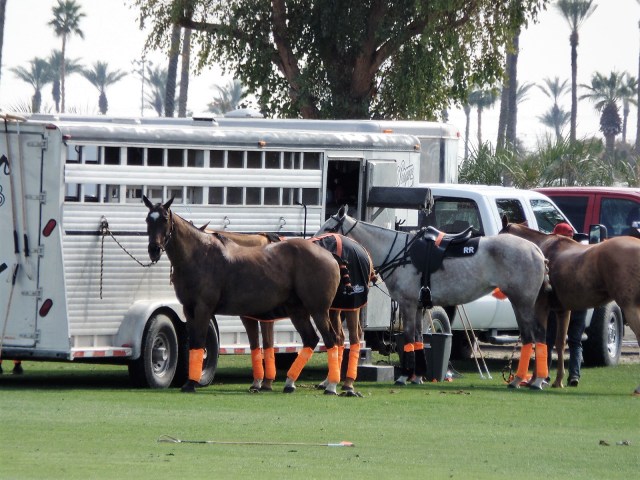
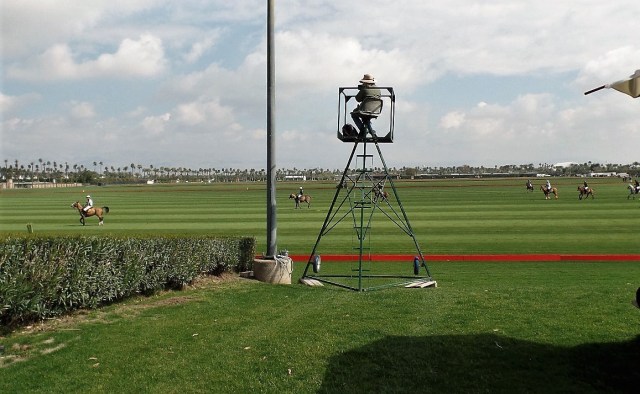
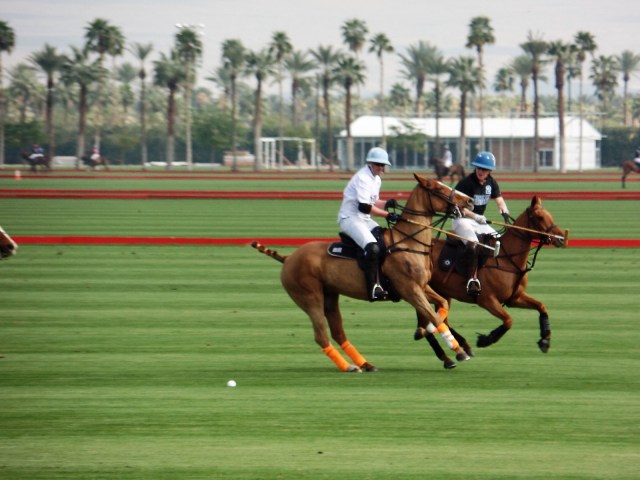
The Eldorado Polo Club in Indio, Calif., is celebrating its 60th anniversary this year. From January until the beginning of April there are two polo matches at the club every Sunday, one at noon and the second at 2 p.m. These photos are from a recent Sunday at Eldorado.
The very first words to ever be broadcast over network radio were uttered by Graham McNamee, his signature greeting “good evening ladies and gentlemen.” That was in 1926 and it was the inaugural program of the National Broadcasting Network (NBC). By that time the 38-year old McNamee had already won the Radio Guide 1925 Gold Cup Award for the World’s Best Radio Announcer. He had already called the 1923 World Series for WEAF in New York and had covered the 1924 Democratic National Convention.
Raised in Minnesota, McNamee came to New York with the dream of becoming an opera singer. While on jury duty he auditioned at a radio station during his lunch break and his career took off from there. He would cover both political parties’ national conventions and presidential addresses to Congress. He broadcast Charles Lindberg’s return from Paris after his trans-Atlantic flight. He was the straight man on comedian Ed Wynn’s show “The Fire Chief,” and in the 30’s he was the voice of Universal Pictures newsreels.
But McNamee’s greatest impact was as a sportscaster. He was repeatedly NBC’s man for the three biggest radio sports events at the time: the Rose Bowl, heavyweight championship fights and the World Series. He broadcast 12 World Series. McNamee has been called the inventor of play-by-play. He brought both color and excitement to his broadcasts, which had previously been handled mostly by journalists in an unemotional and dry manner. By contrast McNamee exclaimed during one boxing match (Carnera vs. Baer) “Oh boy! Oh boy! These boys are fighting!” In her history of radio, Listening In, author Susan J. Douglas described McNamee’s style: “What McNamee invented was the combination of the blow-by-blow or play-by-play with what came to be called color, the telling, visual details about how the event looked and felt. He reported the event as it occurred, but he also dramatized it, so listening to the broadcast was often better than going to the game or match itself.”
Posthumously McNamee was awarded the Baseball Hall of Fame Ford Frick Award for Broadcasting. He was entered into the American Sportswriters Association Radio Hall of Fame and has a star on the Hollywood Walk of Fame.
Father Coughlin
If you think angry demagogues making outlandish statements on radio to stir up their listeners is a modern phenomenon, consider Father Coughlin. This Roman Catholic priest turned political firebrand at one time in the 1930’s had 30 million listeners to a weekly show.
Charles Edward Coughlin was born in Ontario to Irish-Canadian parents. He bounced around a couple different religious trainings until he landed in Detroit where he was incardinated and assigned to a parish. Coughlin was on the radio in Detroit by 1926. Initially his show dealt with religious issues. He was signed by CBS in 1930 but the network later dropped him when he refused their request to screen his scripts in advance. Coughlin put together his own radio network and at the time his show became more and more political.
Like many people of his type it is much easier to identify what Father Coughlin was against than it is to figure out what he was for. He was a virulent anti-communist. But he was also a virulent anti-capitalist. He supported FDR when he was elected in 1932 but by 1934 he was railing against the President for his monetary policies. He founded an organization called the National Union for Social Justice. One of his slogans was “less care for internationalism and more concern for American prosperity.” Sounds a little like a certain recent Presidential inauguration speech.
During the latter half of the decade as American public opinion was beginning to shift toward intervening to support the Allies, Coughlin increasingly took a sympathetic view of the Nazis and his anti-Semitism became more and more obvious. He blamed Jews for both Communism and the excesses of Capitalism. A watershed moment in Father Coughlin’s decline was after Kristallnacht, the Nazi attack on German Jews, when Coughlin suggested “Jewish persecution only followed after Christians first were persecuted.” I found an even more outrageous and obnoxious quote on a Web site devoted to Coughlin (www.fathercoughlin.org): “When we get through with the Jews in America, they’ll think the treatment they received in Germany was nothing.”
By the end of the 30’s many had heard enough of Father Coughlin. Some stations dropped his show including his two New York outlets. Many in the church were anxious to get him off the air. After the outbreak of war in 1939 the Roosevelt administration forced his radio show off the air and made it illegal to distribute his daily newspaper via the mail. In 1942 Bishop Edward Aloysius Mooney of Detroit ordered Coughlin to cease all political activities and focus on his parish. He complied and continued as pastor of the Shrine of the Little Flower until he retired in 1966.
Edward R. Murrow
News was not an important part of radio programming in its early years. Up until the late 1930’s the radio networks did not even have news divisions. That all changed leading up to and during World War II when millions of Americans were glued to their radios awaiting news from the two fronts. Between 1940 and 1944 the number of hours devoted to news on radio went up 300 percent. No one is more closely associated with the emergence of radio as the nation’s primary news source than Edward R. Murrow.
Born to Quaker parents in a log cabin in North Carolina, Murrow moved west to Washington at the age of 6 and later attended Washington State. His first job at CBS was in 1935 when he was hired as director of talks and education (there was no news group until 1938). Two years later he was sent to London as head of European operations.
Murrow usually did his best to conform to CBS’ standards for objectivity. But being in London and witnessing first hand what the British were facing he increasingly became an anti-isolationist and anti-fascist. At one point he confided, “I am finding it more and more difficult to suppress my personal convictions.” Murrow would become the gold standard for foreign correspondents. Listen to the clip below and you’ll understand why. It is Murrow on a rooftop in London awaiting the arrival of German bombers.
During the war itself he went on a Royal Air Force bombing mission over Berlin. He laid his microphone on the ground so listeners could hear the sound of advancing tanks. He was one of the first to file a report from the Buchanwald Concentration Camp in Germany interviewing emaciated survivors. Of that experience he said “I have reported what I saw and heard, but only part of it. For most of it I have no words.” With his ever-present cigarette (he smoked three packs a day) and his signature sign off “good night and good luck” he was, according the Douglas “the apotheosis of American manhood.”
After the war Murrow got bumped up to a VP position but he was soon back on radio. He had two shows on CBS. “This I Believe” was a program that gave ordinary Americans five minutes to speak on the radio. The other was “Hear It Now” which later moved to television and became “See It Now.” It is on that program in 1954 that Murrow made a famous speech denouncing Sen. Joseph McCarthy. Murrow left the radio and became active in television news broadcasting but through the 50’s his relations with CBS started to sour. In 1961 he resigned and was appointed by JFK to head the United States Information Agency. He died in 1965 at the age of 57.
The Indian Canyons are a group of palm oases on the tribal lands of the Agua Caliente Band of Indians in Palm Springs, Calif. The canyons are home to wildlife, beautiful desert vegetation, scenic mountains and most importantly to the ancestors of the Agua Caliente, water in the form of mountain streams. They have been maintained in their natural state and are now an oasis for residents of and visitors to Palm Springs.
SAMSUNG CAMERA PICTURES
The Andreas Canyon is the ancestral home of the Paniktum Clan of the Agua Caliente Band of Cahuilla Indians. Andreas was one of the leaders of that clan. This is the second largest native California Fan Palm oasis. These photos were taken along the Andreas Canyon Trail.
Throughout its history, American radio reflected the racial attitudes of the society within which it operated. In the early days that involved a racism that was expressed in the racially demeaning characters of radio comedies like Amos ‘n’ Andy and Beulah and in the fact that blacks were shutout of jobs in radio. But radio has also been a leader in bringing black music and culture to a larger audience and making it part of the American culture. Radio was also well ahead of other entertainment and sports industries in providing black performers with a voice and an audience.
Throughout the 20’s there was nary a black face to be seen in the radio studios. It is telling that the radio show Amos ‘n’ Andy, two laughable and gullible Southern blacks who migrated to Chicago, were actually voiced by white actors. By the end of the decade it was the most popular show on the air. But the 20’s was also the jazz age and jazz is rooted in the African-American community. Young people of all ages were attracted to this music and for many young whites, their first exposure was on the radio. While you may not have found a black actor, a black announcer or a black manager in radio, listeners began to hear musicians like Duke Ellington and Paul Robeson. In 1929 WSBC Chicago introduced the “All Negro Hour” a variety show that featured music, comedy and drama by all black performers. Jack Cooper, the emcee of the All Negro Hour, is considered the first black DJ.
In the early thirties, the CBS radio network signed a three-year contract with the Mills Brothers, the first African-American act to receive a network contract. And one black man who was a hero to all Americans, was the heavyweight boxing champion Joe Louis. In her radio history Listening In, author Susan B. Douglas notes, “For African-Americans some of the most important broadcasts of the 1930’s were the matches of Joe Louis, whose victories over white opponents galvanized black pride and spirit and suggested that, even in a deeply racist society, black men could occasionally embody the national will.” Much like Jesse Owens in the 1936 Olympics, Louis’ 1938 rematch against the German champion Max Schmeling became a source of national pride for both black and white Americans. Hitler touted Schmeling as an example of the racial superiority of Aryans, but Louis knocked him out in a little over two minutes.
Joe Lewis and Max Schmeling
Back in 1922, ASCAP, the American Society of Composers, Authors and Publishers, had been formed to license songs and collect royalties on the music. One of their goals was to keep recorded music off the air as a way to protect record sales. Another of their goals was to exclude blacks. This was still the case in 1939 when the National Association of Broadcasters created the rival BMI. The new organization built its membership with young, ethnic and black musicians. In Last Night a DJ Save My Life, author Bill Brewster writes, “With BMI’s close ties to radio and its more ethnic membership, this was great news for the rise of black music.”
We even had Jim Crow record charts. In 1942, Billboard started compiling a separate listing which it called the “Harlem Hit Parade.” It later changed the name to “Race Records” which of course means records by black artists. Brewster credits Atlantic Records Jerry Wexler with the advent of a more acceptable name, rhythm and blues. Billboard adopted that name in 1949 and most of the rest of us have gone along with it ever since.
It wasn’t until after World War II that radio began to lose its whiter shade of pale. Two things prompted that. One was the beginning of the emergence of a teen culture that would set the nation’s trends in music and style. And it was a culture that was fueled by rhythm and blues and later rock and roll. Like the younger audiences of the 20’s, it included both blacks and whites, but the music had in roots in the African-American communities. The other factor was that as the country emerged from a decade of Depression and a half-decade of war, prosperity was just around the corner and blacks, like teenagers, were an as yet unexploited but large market that all kinds of advertisers were anxious to reach.
The 50’s and the 60’s were probably the time in the history of radio when the music, the audience and the guys introducing the music to the audience were most integrated. Douglas says “As America became more repressive in the 1950’s with the grip of conformity and McCarthyism tightening, black music became especially attractive to the young.” Young whites were listening to black artists on the radio, buying their records and going to their concerts. By the mid-50’s about one quarter of the records sold in the U.S. were by black artists.
(by Ron Pinkney)
White audiences embrace of black music coincided with the emergence of the DJ. One of the early star deejays, Alan Freed of WJW Cleveland, played an important role in bringing rhythm and blues to mainstream radio, and hence to the attention of white listeners. And there was just as much interest in listening to black DJs as well as black singers. Brewster reports statistics compiled by Ebony that in 1947 there were only 16 black DJs. By 1955 there were 500.
As a medium, radio was well ahead of its competitors in integrating. But it also should be noted that some stations, while recognizing the attractiveness of the black sound to their audience, chose not to hire black DJs but instead to hire white DJs and encourage them to sound black. One is again reminded of the radio comedies of an earlier era in which the black characters who were being presented for laughs were actually voiced by white actors.
During the same time a more authentically black version of radio was also emerging. By the late 40’s the African-American market was estimated to be worth some $12 billion. That caught the attention of advertisers and station owners. WDIA in Memphis, Tenn., was the first station to move to exclusively black on-air talent in 1948. And in 1949 WERD in Atlanta became the first black owned commercial station. According to Jesse Walker, author of Rebels on the Air, there were four outlets that offered black-oriented programming in 1943. Ten years later there were 260.
In the 50’s both the programming and the audience for radio were more integrated than they were for any other media or entertainment business. And this at a time when American society was very substantially segregated. But it didn’t last. One reason is that DJ’s lost their freedom. The choice of music on popular stations was taken over by station managers who, following the rating services, narrowed playlists on Top 40 stations to as few as 20 songs, played over and over and over again. During the 60’s, radio DJ’s not only were restricted to a fixed list of songs, they were often given scripts telling them what to say.
There was an all too brief flurry of free-form radio in the late sixties with the emergence of the FM dial as the preferred place for music. Some of these stations might have played blues and jazz as well as folk music and rock bands. A few of these stations still exist but not enough to fill up even half of the presets on my car radio. With the consolidation of corporate ownership of the FM as well as the AM stations, the FM DJ’s, like the AM guys before them, lost their influence and instead we got narrowly defined formats with tight playlists. The effect was to re-segregate radio.


 At one time the Federal Communications Commission established limitations on the number of stations a single entity could own as a way to assure some diversity on the radio dial. But in 1992 the FCC began to loosen those restrictions. The FCC policy had remained basically the same since that time. Here it is: