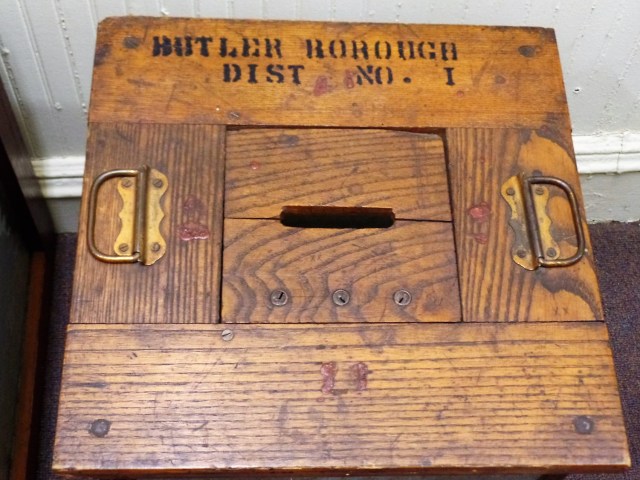
Old school ballot box. From the Butler (N.J.) Museum
Old school ballot box. From the Butler (N.J.) Museum
A few months ago I posted a story about Adami, a one-year old Korean Golden Retriever who was rescued from a meat market by an animal rights activist and sent to Los Angeles through an arrangement with the Southern California Golden Retriever Rescue. Adami arrived with some serious medical issues and has been undergoing treatment since his arrival in April
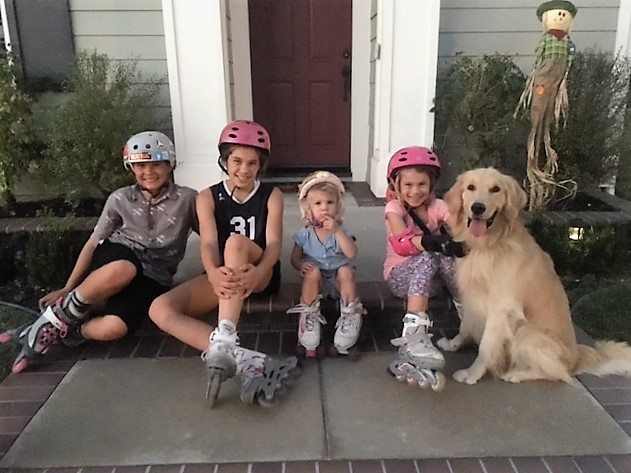
I am now pleased to report that this story has a happy ending. Adami, who has since been renamed River, has been adopted by the Ladera Ranch, Calif., family who fostered him since the Spring. Here he is with his new family.
River came to this country with a severe case of heartworm. He was originally treated with two injections of Immitricide. In May he was released to his foster family but his treatment required two additional hospital stays. In addition to his medical care, River had to be kept quiet, not an easy task considering he is a playful one year old and there are four children in his foster home.
In September, blood tests showed he was free of heartworm and he was put on heartworm prevention medication. One month later he was neutered and had a non-cancerous cyst removed from his head. He is also receiving training to socialize him with other dogs, something that became necessary because of his months of isolation. At this point he was ready for adoption and it was the foster family “won over with his beauty and sweet personality” that offered him a permanent home. Here’s what they have to say:
“After five months it’s a real treat to throw a ball in the backyard and be playful with our very own ‘River Boy.’ We didn’t know what we were taking on back in May but couldn’t be more thankful to have had this journey with him. We are so excited to officially make him a part of our family and finalize River’s adoption.”
The Tess McIntyre Foundation, of which I am a trustee, used funds contributed by donors to help pay the cost of River’s treatment. The foundation, a 501(c)3 charity founded last year, is dedicated to helping rescued dogs who need medical attention receive the care they need in order to be adopted. Contributions to the foundation can be made at the organization’s web site.
 Ever since the wave of prosperity that followed World War II, the American lifestyle has been defined by the house in the suburbs with a two-car garage. The vision assumes ownership of the garage, the cars that go in them, the house and its contents. But technology has been whittling away at that foundation of ownership. Software is replacing hard goods, the digital is replacing the mechanical and the cloud replacing the bookshelf. It seems somewhat inevitable that at some point we sacrifice ownership of our home environment. How much control over our lives is lost with that?
That is one of questions discussed this week in Washington at the Future Tense event “Will Technology Make Ownership Obsolete?” You can watch an archived video of that event here.
One of the first areas where this decline in ownership seems obvious is music. The recorded music industry has taken us through a progression of vinyl and tape in all its iterations, 45’s, albums, cassette tapes and CDs. But they lost control over the delivery of their product when technology companies like Apple began to offer the same product but in easier to consume chunks. Even with digital music, the first step involved purchasing files that were stored on your computer. Not exactly a stack of records or tapes, but a library for which you had some claim to ownership. Streaming services that offer on-demand music offer an alternative that completely eliminates the need to own you own library.

(Grendelkhan)
One of the most potentially consequential changes in ownership involves cars. The combination of the proliferation of ride sharing services and the development of autonomous cars suggests a future in which the personally-owned vehicle is no longer a necessity. And, as Lauren Belive of Lyft, pointed out at the Future Tense event, there are some compelling societal reasons to find alternatives to car ownership. She noted that 80% of the seats of cars driving down the highway are empty and that 96% of the time an average car is idle. There’s the amount of space that has to be dedicated to parking, the cost of car ownership (about $9,000 a year according to Belive) and the number of people who are killed or injured in motor vehicle accidents.
In many of our larger cities it is already the case that using ride sharing services is both more efficient and more economical that owning, maintaining, garaging and insuring a private vehicle. That may eventually become the case in suburbs as well, although we seem a long way from that scenario in more rural areas.
The potential elimination of the private owned auto would have substantial repercussions on the employment picture in the U.S. Susan Lund of the McKinsey Global Institute said there would be 90% fewer car sales if we stopped owning cars. The auto industry is estimated to be responsible for 7 million jobs. We probably won’t ever need 7 million Uber drivers, and even if we did, they’d likely fall victim to driverless cars. In fact, one of the things we might not own in the future is a job, at least not your classic 40-hour a week onsite job with its vacations and 401k’s and other benefits. More and more Americans are instead stringing together “gigs” like driving a rideshare vehicle, renting a home out short term or providing some other type of on-demand service. Lund claimed that 27% of the working age population in the U.S. doesn’t have a traditional job.
The question of whether or not to own is not entirely new. For example, on those few occasions when I need to wear a tuxedo I’ve always rented one rather than buying. A fair percentage of car owners are more precisely car leasers. Do we in fact own our homes if we purchased it with a bank mortgage that we are still paying off?
The influence of technology has muddied the idea of ownership of even some of the most straightforward household devices, your thermostat, your security system, maybe even your home lighting. If one of these devices contains a computer chip which stores information about your home in the cloud and is operated remotely by a device you may or may not own, it seems somehow less of an owned commodity. Do you in fact own your smart phone that you use to control these systems if that phone is part of a two-year contract with your carrier?
For those of us who are part of older generations (I’m a boomer), ownership has been equated with freedom. The private vehicle has historically had an enormous impact on American life, fundamentally changing our options of where we would live and how we would spend our time. Many people my age relished the freedom that cars gave us as teenagers, not just as a way of getting from place to place but as a private space as well.
The ability to own your own music freed you from having to listen to broadcast radio with its commercials and its sponsor or corporate generated playlists. Buy the records, tapes or whatever and you could listen to whatever you wanted. The same is true for movies. Buy and you can watch what you want, when you want to and where you choose.
But I wonder if for younger generations there is a perception of freedom from ownership, as in being free to hear what you want to hear without digging out the CD. Or, free from the need to make car payments, buy new tires and shop for the cheapest insurance. It has become clear that millennials are showing more of a preference for urban environments than their parents. Part and parcel of that is a decline in car ownership among that age group.
Lund suggested that people will cling to ownership of what they love. Evidence is the revival of vinyl despite the lower cost and convenience of streaming. Aficianados of exotic and vintage cars are not likely to trade them in for an Uber app. In my case, I can never envision myself letting go of books printed on paper, despite the fact that digital versions may be significantly cheaper and that I’ve got tons of books I’ve already read taking up an enormous amount of space in my house.
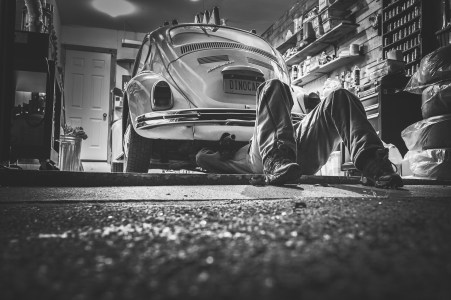
(Ryan McGuire)
There is no doubt that in many ways we have lost some control over our environment and lost some of our ability to interact with that environment. Nobody changes their own oil anymore. In fact most people don’t even wash their own cars. You used to be able to take apart and potentially fix pretty much any device in your home as long as you had a screwdriver and access to replacement parts. Try taking a screwdriver to your iPad. Each new model of appliances, electronics or devices takes them further from the owner’s control.
So if we no longer own our stuff, do we still own our future? My answer is a qualified yes. Qualified because I’m as wary as the next guy about the so-called Internet of Things. When there are sensors that can capture and communicate information about me out in public, like on utility poles, as well as in my car and in my home and when these mini-computers can wirelessly send information, can’t everything around me be hacked? What if some unknown enemy hacks my fridge and makes it continuously churn out ice cubes while I’m away for the weekend? But more realistically I’ve already had it up to here with “targeted marketing” based on tracking everything I do online. I can’t buy enough “leave me the hell alone” software whether its ad blockers or robo call catchers or online tracking eradicators.
The “gig” economy is okay with me, but only to the extent that people are doing it for the freedom it provides and not because traditional jobs are harder to come by, don’t pay enough to live on and are degrading. But I also think that many of the changes that are coming will make our lives easier and give us in fact more control to focus on what we choose to pursue, freeing us from mundane and time consuming tasks. I’m not nostalgic about pulling a map out of the glove compartment to try to figure out where I am rather than simply clicking my phone a couple times. I look forward to the day when I don’t need a car to get where I’m going quickly and conveniently. And maybe this is all going to make us a less consumption oriented society. I’m down with that.
(Future Tense, the organization that sponsored the event which inspired this post, is a partnership of Slate magazine, Washington D.C. think tank New America, and Arizona State University. Their focus is on how emerging technologies will impact our lives.)
Is it the baseball stadium that was dangled in front of the Yankees as far back as the 1970’s in an effort to get the team to pack up and move across the Hudson along with their Yankee Stadium cohabitants, the New York Football Giants? Nope.
Is it the result of the 1991 plan to build a Legoland Amusement Park, or maybe Sony’s proposed theme park to rival Disneyland? No, neither of those proposals ever got off the ground.
Is this the $50 million dollar amusement park that Donald Trump proposed to the New Jersey Sports and Exposition Authority in 1993? No, not that either.
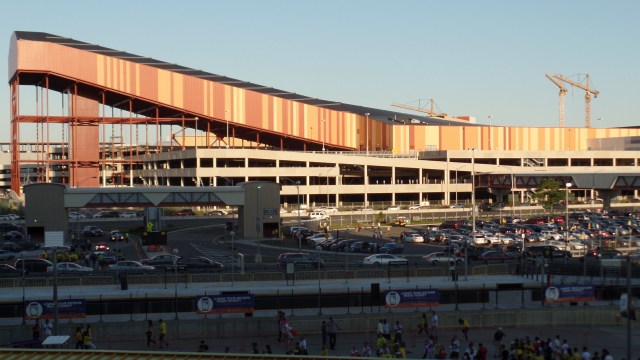
Is this Xanadu, a project that was awarded to Mills Corporation in 2003 with the initial completion date of 2006? A plan that included an indoor ski slope, a Legoland, a movie theater and a concert hall. A plan that prompted Star-Ledger columnist Phil Munshine to comment, “What were the guys from the Meadowlands who thought up our vision of Xanadu smoking? Crack?” We’re getting closer. This is the ruins of the never-completed Xanadu.
Is this the Hard Rock Café casino, plans for which were unveiled in June of last year? Definitely not, because casinos are not allowed in New Jersey outside of Atlantic City. And while the question of allowing two casinos in North Jersey is on the November ballot, polls show it is likely on its way to a resounding defeat.
Is this the American Dream? Well, this building, which has been called “the ugliest dam building in New Jersey and possibly in America” by Gov. Chris Christie, is in fact the planned site for the American Dream, an entertainment and shopping complex under the direction of Triple Five, the developers of Minnesota’s Mall of America.
The American Dream is perhaps the most grandiose plan of all. And could well be the biggest boondoggle of all. Here are just a few of the things that the developers say will be included:
You might imagine that would have a pretty hefty price tag, even with the state providing the land and waivers on tax collections. The first two developers spent $1.9 billion on the unfinished buildings in the image above. The second of those, Colony Capital, which took over after Mills went bankrupt, was cut off by its lenders and the property foreclosed. New Jersey taxpayers had kicked in with $80 million in road and infrastructure improvements to support the project. It was later turned over to Triple Five. The Christie administration then pumped in with another $1 billion in tax breaks and subsidies.
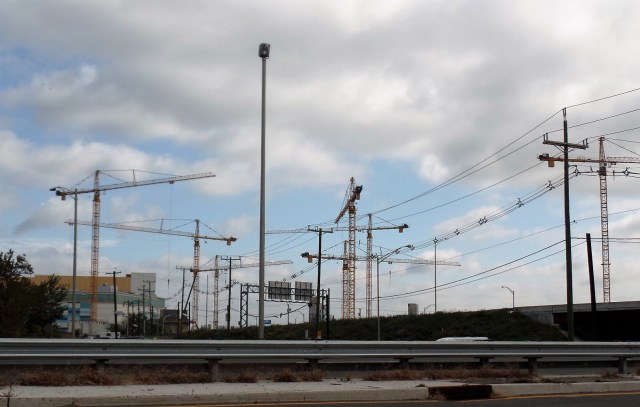
Is this a parking lot for giant cranes?
So you might think the American Dream is back on the road. And while there seems to have been some work going on in 2015 it all came to a halt last fall. Turns out Triple Five could use another billion or so and the New Jersey Sports and Exposition Authority is lining up a sale of that amount of bonds, backed largely by future sales tax receipts and payment in lieu of taxes. Triple Five, which now estimates the total cost of this now 13-year old project at $5 billion, is projecting a 2017 opening date. Whoops, that’s now been pushed back to 2018.
Here’s Uncle Floyd’s take:
Former Governor Tom Kean
Tom Kean was governor of New Jersey from 1982 to 1990. At Friday’s NJ Spotlight on Cities conference he talked about his experience talking to urban mayors and residents. They wanted three things: safe streets, jobs, and decent schools.
Just last month a Rutgers-Eagleton poll asked the question what is the “most important thing to make NJ cities better places to live.” The top three answers were jobs, public safety and quality schools.
Has nothing changed in the last three decades? Most think our cities are in somewhat better shape than they were when Kean took office. And there is some optimism fueled by the fact that Americans in their 20’s and 30’s are showing a distinct preference for living in more urban environments. That is what prompted Tom Byrne, the son of another former governor Brendan Byrne, to exclaim: “Thank God for the millennials!”
Another of the conference’s speakers, Kim Fortunato of the Campbell Soup Foundation, said of Camden, “we’re not as heartbreaking these days, there are a lot of bright spots.”
I lived in downtown Jersey City in the 90’s and the early 2000’s. I watched as the waterfront office buildings filled up with the back office operations of Wall Street firms. I then watched as they were circled with luxury apartments and condos. The restaurants, bars and coffee shops soon followed. By now downtown Jersey City has become an almost trendy place to live. The price tag has gone up accordingly.
The plan to build a world-class performing arts center in Newark (NJPAC) came to fruition while Kean was governor. Newark has since added a first class sports arena and gained an NHL franchise. Prudential, which has been in Newark for 140 years, built a new 20-story headquarters in 2014. Audible moved to the city in 2007 and Panasonic moved their headquarters there in 2013. Downtown Newark now has a Nike store and a Starbucks, and a brand new Whole Foods is on its way.

Newark Mayor Ras Baraka
But as Newark Mayor Ras Baraka pointed out, “there is a mixed view of the city depending on where you live.” Many of the city’s residents have no access to the finance and the commerce of the central business district. For both Newark and Jersey City, the downtown Renaissance has not been felt in other parts of those cities and has priced out residents of other neighborhoods.
So while there are many statistics that can be cited that show people migrating to instead of away from cities, Kresge Foundation Senior Fellow Carol Coletta, noted: “Outside the spotlight the number of people living in concentrated poverty is increasing.”
There was nary a person at the conference who didn’t think education was a key ingredient to any imrpovement in our cities. Yet current New Jersey Governor Chris Christie has advocated a change in school funding that would be based on providing the exact same amount of money for every student no matter where that student went to school. The result of that plan would be to pull millions of dollars in educational funding out of the city schools and into the suburban schools, many of which are already vastly superior to their urban counterparts. Christie’s goal is to reduce property taxes in the suburbs.
In a state that is already substantially segregated, the likely result would be a further separation. Baraka, who at one time was a school principal in Newark, believes that “funding schools through property taxes is inherently unequal.” When it comes to the cities he added, “You’re going to spend the money anyway. You can spend it on hospitals, on social services, on incarceration. Or you can spend it on education.” Fortunately, Christie’s approval ratings have fallen through the floor and there is likely no chance he could ever win an election in New Jersey again.
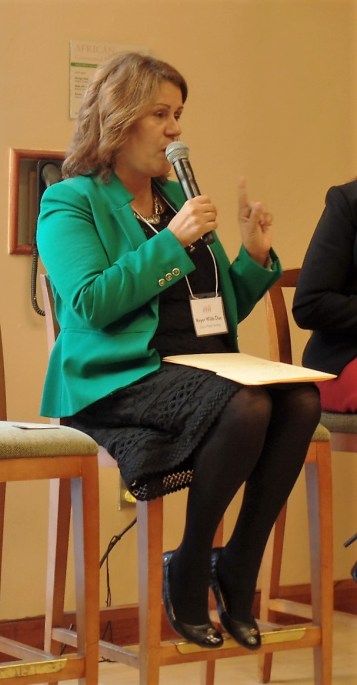
Perth Amboy Mayor Wilda Diaz
New Jersey is as diverse as it gets in the U.S. And most of that diversity is in the state’s cities. There are 2 million immigrants in New Jersey, out of a total population of 9 million. About 400,000 to 500,000 of those are undocumented. Jersey City alone has some 50 different ethnic groups. But if you look at the photo at the bottom of this post of the state’s gubernatorial hopefuls, they are all white men.
One of the conference speakers, Wilda Diaz, is the mayor of Perth Amboy, a city of 51,000 that is 70% Latino. She is the only Latina mayor in New Jersey, a state with 565 municipalities. Khader Ken Abuassab of the American Arab Civic Organization commented that while Arabs make up 25% of the population of the city of Paterson, they have no representation at the city or county level.
The conference ended with a panel of four gubernatorial hopefuls for the 2017 election. Refreshingly, there were no personal attacks. They talked about issues: jobs, schools and safety. The same issues the gubernatorial hopefuls of 1982 likely talked about.

Lee Keough of NJ Spotlight sits in the middle of four New Jersey gubernatorial hopefuls. They are, from left, John Wisniewski, Phil Murphy, Jack Ciattarelli and Tom Byrne.
A video of the NJ Spotlight On Cities event is available here.
What’s an environmental thriller? Climate change armageddon? Or maybe something along the lines of a serious version of Little Shop of Horrors?
 P.J. Lazos’ Oil and Water, an environmental thriller, is about big oil. If you’re not a fan of big oil, this book will only give more fuel for the fire. Think arrogant guys smoking cigars with their feet on their desks pooh-poohing the latest ecological disaster their corporation is responsible for. There are oil spills and oil leaks, but that’s only the beginning of the environmental issues Oil and Water raises. Even Saddam Hussein makes a cameo in this story as an enemy of Mother Nature.
The novel begins with seemingly random death and destruction. Four hundred and some odd pages later it is all tied together. That’s the thriller element.
I was super impressed with the author’s knowledge of oil rigs, underwater operations, spills, cleanups and rescues. It enables her to describe scenes like the near-fatal underwater leak repair in the Gulf in detail that you would think could only be provided by the divers themselves. She even seems to nail the male banter between the divers and their above ground support.
I was even more impressed with her ability to build suspense in the way she relates this and other tales. Little thrillers within the larger story. It is one of the things that makes this long novel a quick and engaging read.
Much of the story takes place in a household run by and for teenagers, give or take a couple years on either end. (Their parents died in the aforementioned death and destruction.) That in itself makes for an interesting tale.
After reading Oil and Water, you can’t help but long for the day when we might be able to leave what’s left of our fossil fuels in the ground. If only there was a real family of teens and pre-teens who could build a machine to convert trash to fuel at scale.
There is a sea of self-published authors these days. Many are skilled writers and storytellers. I wish I read more of them, but it’s hard to find the good ones amidst the amateurish and the flamingly self-absorbed. This is one of the good ones.
It’s 6 p.m. on Tuesday night on the 8th floor of the Chicago Merchandise Mart, an 85-year-old building on the city’s north side. Technologists, academics, data scientists, developers, researchers and just plain interested citizens begin filing in.

Merchandise Mart, Chicago
After a little socializing there’s a short presentation. Some recent presenters have included a couple guys from Microsoft talking about how to make sidewalks safe, representatives from the U.S. General Accounting Office and the Cook County Bureau of Technology introducing their new Web site. After the presentation, they split up into breakout groups. One group is focusing on police accountability. Another is mapping the demand for better transit, while another is approaching the problem of finding nursing homes in the city.
This is Chi Hacknight and it is one of the most active examples of civic technology. Civic tech is a grassroots, citizen-generated approach to building what I’ve been calling in these posts, the smart city. Hack nights like the one in Chicago now meet in several cities in the U.S. as well as in London and in Monterrey, Mexico.
Writing in Tech Crunch (Civic Tech Brings Power and Positivity to the People), Stacy Donohue comments: “in an era marked by political pessimism and ever-increasing frustration with government, civic tech can play an important role in empowering people to take action — as entrepreneurs, as public officials and as engaged citizens.”
Another pioneering civic tech group is Code for America in San Francisco. They describe themselves as “a network of people making government work for the people, by the people, in the 21st century. How do we get there? Government services that are simple, effective, and easy to use, working at scale to build healthy, prosperous, and safe communities.” One of Code for America’s projects is GetCalFresh. Intended to address the 2 million Californians who were eligible but not receiving this food assistance, GetCalFresh enables these folks to apply in about 10 minutes on their smartphone or tablet, get help via online chat and upload photos of documents that otherwise would have to be faxed or scanned. Another Code for America initiative, Clear My Record, is targeted at people who have committed low level crimes and who have served their time.
Some platform-based services that promote civic tech have also emerged. Neighborly describes itself as “modern public finance.” It allows users to invest in municipal bonds to support projects in their neighborhood. The bonds can be purchased in small denominations using the Neighborly platform. It recently sponsored a Neighborly Bonds Challenge. One of the winners was the city of Burlington, Vt., which hopes to use the financing for its Sustainable Action Plan.
SeeClickFix purports to “help hundreds of communities resolve millions of issues.” Through this app you can report a pothole, a broken streetlight or a vandalized playground. The app also gives government entities the ability to organize and track citizen-reported, non-emergency issues, potentially making them more efficient. Among the cities that use the app are Houston, Minneapolis and New Haven, Conn.
In discussing the future of cities and how they can use technology to become “smart,” civic tech has some significant advantages that suggests it should play a large role.

(Dawn Hudson)
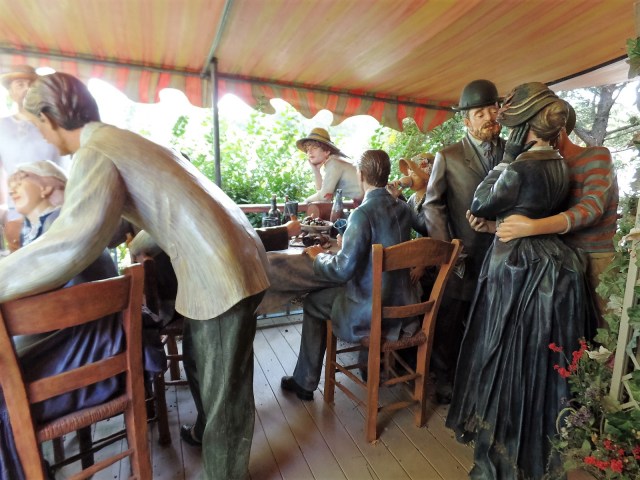
Were You Invited?

Seward Johnson chatting with guests at the Grounds for Sculpture
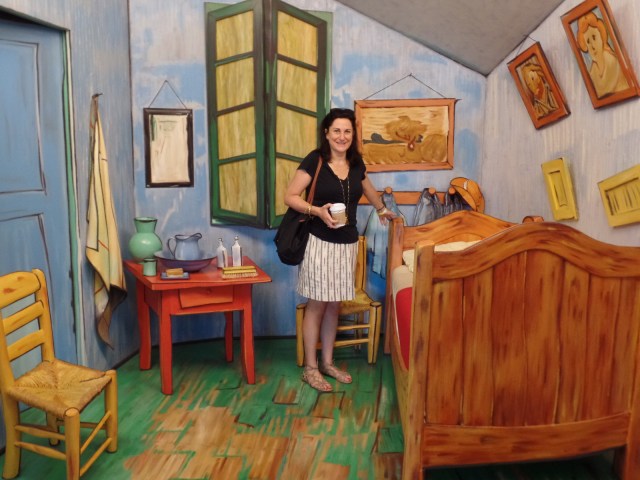
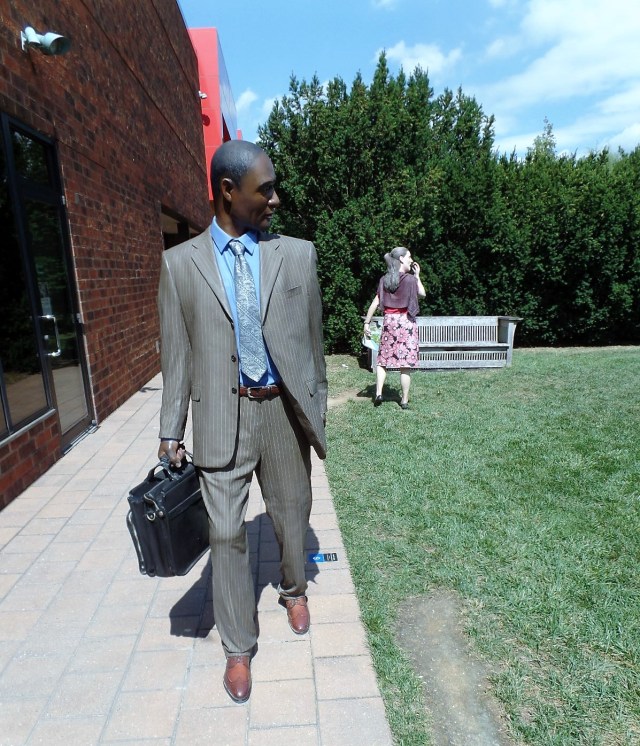
The 86-year old New Jersey native is best known for his painted bronze statues of iconic people and iconic works. These include Unconditional Surrender, based on the news photo of a returning midshipman kissing his sweetheart after the end of World War 2. Twenty-five foot high versions of this statue are on display in Sarasota, Key West, San Diego and Snug Harbor. And there’s the 17-ton “Forever Marilyn” which adorns downtown Palm Springs. Johnson is sometimes treated with disdain by the snobbier folks in the world of sculpture, either because his works are painted or because of his copies of famous pieces from other mediums. Personally, I’m a big fan of his work. And for all of us who went to college not having a clue what we wanted to do with our lives, take note that Seward Johnson’s time at the University of Maine was spent majoring in poultry husbandry. Johnson founded the Grounds for Sculpture in Hamilton, N.J., where many of his works are on display. Here are just of few of them.

The Nature of Obsession
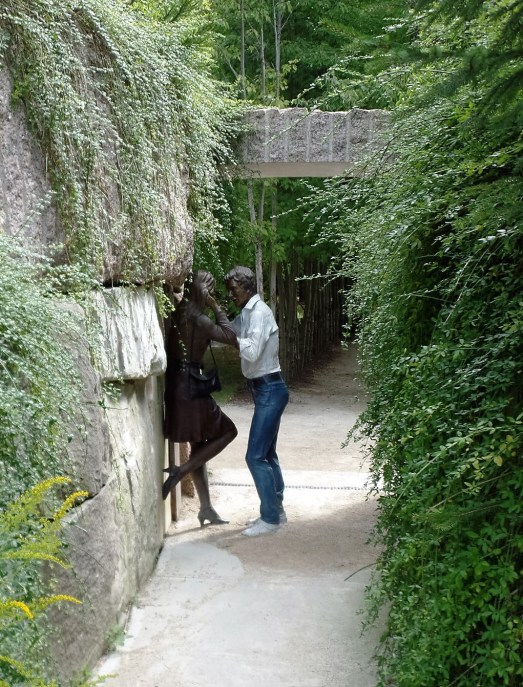

Testing Togetherness

Has Anyone Seen Larry?


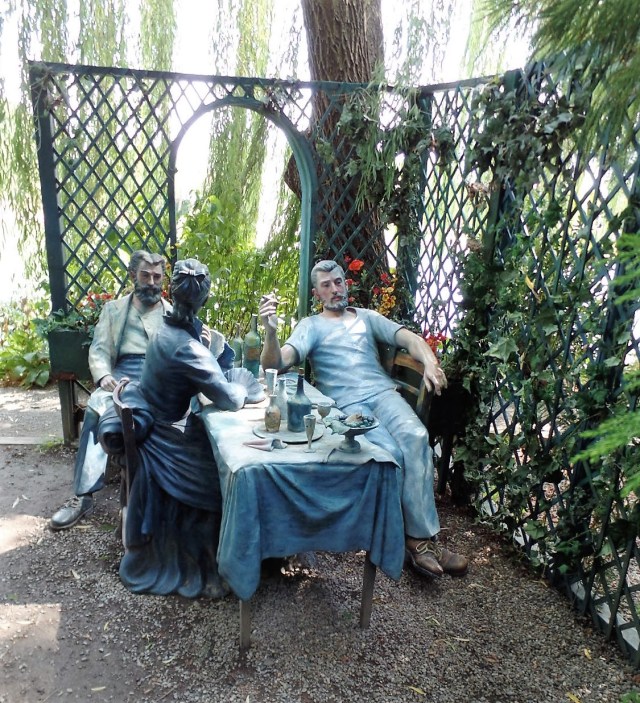
Pondering the Benefits of Exercise


A Reason to Smile with French Guards
The promise of the smart city is one that runs more efficiently, more cost effectively and more sustainably. But that all comes with a cost and it is a cost that may be over and above the dollars spent. It’s for that reason that some have questioned whether or not the smart city would actually be a place where we would want to live.
 While the internet of things may offer a vision of a tech-fueled utopia to some, to others it suggests an omnipresent Big Brother that goes far beyond anything envisioned by Orwell. We all have seen how easily and thoroughly we are tracked online. Imagine when that tracking occurs in public places and in our homes because sensors are everywhere, sensors that record video and sounds not just info we choose to input. At minimum that suggests a virtual bombardment of so-called personalized marketing pretty much everywhere we go.
But there may also be some less benign ramifications. The internet of things, and hence the smart city, runs on wireless technology. The security vulnerabilities of wireless technology have been repeatedly demonstrated. Friendly hackers have shown how they could take control of a connected vehicle’s brakes, steering and acceleration. They even have a name for a terrorist attack of hackers that would, for example, disable the brakes on all connected vehicles in a given area. It’s called a “zero day” attack. And there’s no reason to assume that the sensors that might manage a water and sewer plant, a nuclear power stations or a medical device are any less vulnerable.
Technology has already begun to be adopted as a way to improve police effectiveness. “Shotspotter” identifies the location of gunfire. Predictive analytics are being used to determine deployment of policing manpower and a cell phone tracking technology called “Stingray” is used to predict crimes. A civil rights group in Baltimore recently filed a complaint with the FCC about the use of Stingray in a racially discriminatory manner. Do the analytics lead to the appearance of racial or ethnic profiling. One can argue that the data is the data, but the perception alone could lead to the kind of social disruption that we’ve experienced as the result of discriminatory policing.
Aside from the hackers, terrorists and rogue law enforcers, we would also have to be comfortable with turning over certain areas of governance to private concerns, since cities do not, and are not likely to get, to level of expertise and resource necessary to implement a smart city operating system. What happens when the board of your town’s technology provider decides that their first priority is their shareholders? That is the same thing that happens in many corporations now. We get lower quality product, diminished customer service and higher prices (think banks or airlines), all in the name of enhancing shareholder value by increasing profits. The Chicago Tribune warned “it’s wise to remember that the driving force behind smart city endeavors should be the civic benefit they provide — not the profits they create for the Ciscos and IBMs that get billions from smart city contracts.” Writing in the Guardian Stephen Poole asks “And what role will the citizen play? That of unpaid data-clerk, voluntarily contributing information to an urban database that is monetised by private companies?” That’s a little like what we all do on Facebook now.
A few weeks ago, one of the world’s largest airlines, Delta, was brought to its knees and shutdown by a system outage. What happens if Chicago or Milan or Beijing is being run on a single operating system. Will it be immune to crashes?
And finally, there is the question of what the smart city does to the social and economic inequality which already plagues so many of our systems. If all city services and citizen information is online, what does that mean for the unconnected? According to the New York Times, one out of every five Americans does not have internet access. In households with income of less than $20,000, half have no access. Many of those folks live in cities and putting our cities online creates an even more disadvantaged class, one without equal access to education or job opportunities.
In her article The Too Smart City in the Boston Globe, Courtney Humphries suggests that as opposed to the high tech vision of the smart city, “…there’s an equally compelling vision of the city as a chaotic and dynamic whirl of activity, an emergent system, an urban jungle at once hostile and full of possibility—a place to lose oneself.”

Depression Breadline, George Segal

The Grounds for Sculpture is a 42-acre contemporary sculpture park in Hamilton Township, N.J. It was founded by New Jersey sculptor Seward Johnson whose works I will feature in a later post. Opened in 2000, the park is adorned with beautiful grounds that could make it a botanical garden if it wasn’t for all the sculpture. There is also an outstanding restaurant on the premises with the unfortunate name of Rat’s.

Schatz’s Spaceship (Inspired by the Obloid), E. Caldor Powel


This is the view if you’re dining at Rat’s Restaurant


Henry Moore in a Sheep Meadow, Red Grooms

Rattle, Paul Henry Ramirez


Van Gogh Cafe