(Nearly) Live at Internet Week NY — The Future of Transportation

Three companies were part of the Internet Week panel, discussing what they are doing that may change how we drive, what we drive and how cars are owned.

Elio Motors is building a three-wheeled car. It will be made in Shreveport, La. The retail price is expected to be $6,800 and it promises to deliver 84 miles per gallon. Elio CMO Tim Andrews says cars are “inefficient because they are fat and heavy.” The Elio will be neither. They hope to launch in the 3rd quarter of 2015.

Ulrich Quay, managing director of BMWi Ventues, discussed that company’s new line of electric vehicles. Unlike the Elio the BMWi represents the premium sector of the market. They are made of carbon rather than steel, the former being 50% lighter. They just unveiled the BMWi8, an electric vehicle with the look of a sports car. The starting price of this one is $137k, roughly the same as 20 Elios.

Dash is a startup that promises to link your car computer to your smart phone. “We can make any dumb car smart,” says co-founder Jamyn Eclis. The early iterations of the Dash device offers services like diagnostics on your car’s performance, location of the cheapest nearby gas and information of road conditions.

Posted in Technology | Tagged , , | Leave a comment

Growing Up in the 50’s: School

Memorial School, Totowa. I went to kindergarten and 8th grade here.

Memorial School, Totowa. I went to kindergarten and 8th grade here.

A lot of planning goes into preparing for my 10-year-old’s school year. It may start in February when we have the chance to tour other schools in the district and decide whether to stay put or switch schools. We will usually communicate to the school our preference of teacher and then await the end-of-summer notification as to his assignment. We likely get an email from his teacher with supplies he needs and we head out to Staples. His mother is in school usually the first or second day of classes and there are innumerable opportunities to volunteer for classroom help, fund raisers or PTA gigs.

My mother needed one piece of information about school. When does it start and what time should I be there. Having nailed that down her next involvement came on back to school night which she attended religiously, met my teacher, listened to what he or she had to say, talked to me about it and that was it till next year. I don’t believe my father ever set foot in a school I attended.

While it is not necessarily a bad thing to be on your own in dealing with school, when your parents are not actively involved, your teachers assume an even more important role. Your teacher is probably the 3rd most important adult in your life and since my elementary schools were strictly one teacher/one class affairs you spend possibly more time with your teacher than with your parents (both of my parents worked).

The ultimate authority in the school is the principal. Given that as a single-digit aged child I was not dealing with the president, the governor or even the mayor, the school principal was the highest level of adult human being I encountered. Mr. Giancola was the principal of my grammer school for all 7 years I was there. I remember him as a pleasant man who seemed pretty fair minded and generally someone to look up to.

Looking back on it I suspect he was a pretty good principal. While I haven’t a clue what kind of administrator he might have been I do remember that I had a black teacher in second grade and a teacher in a wheelchair in third. As I have pointed out before this was in a town with absolutely no diversity and this was a time before the Americans with Disability Act and the Civil Rights Act. So it is reasonable to assume that unlike most of the adults I encountered at the time, Mr. Giancola judged people by their capabilities only and in retrospect I’d like to think he appreciated the diversity he brought to the teaching staff.

One Friday night I am with my mother in a pharmacy in a neighboring town. Mom picks up whatever it is she was there to buy and we head over to pay. There behind the register is Mr. Giancola. As always he smiled and greeted me while I must have stood there dumbfounded with my mouth open. The most important person I knew was moonlighting behind the register at the drug store.

So one thing hasn’t changed since the 50’s. The people who we entrust with one of society’s most important tasks, educating, mentoring and caring for our children, often don’t get paid enough to comfortably raise their own family.

Posted in Growing Up in the 50s | Tagged , , | 5 Comments

The Commoditization of Technology

I spent most of my career in the media, publishing and public relations businesses. For the last decade or so I looked at and tried to figure out some use for dozens and dozens of new communications platforms, systems and technologies.

There is an almost unlimited number of tech companies emerging and an even more unlimited number of geeky sorts of solutions that all fall into the same general bucket of automatically capturing data, adding some structure to it and then generating conclusions for questions ranging from what should I write about to who would buy my stuff. Rarely did I find the technology to be truly unique. The appeal of these companies was based on how clever and unique their application of the technology.

Most of this innovation comes from start-ups. The nature of the financing that is driving start-ups is such that success doesn’t seem to be predicated on successfully building a profitable business.  That is something that established organizations can’t compete with since they have pricing structures and profit margins to maintain.

The image that Silicon and the other copycat Valleys project is one of a couple bright guys come up with a bright idea, attach a UI to it, tell their friends who in turn tell their friends, followers and connections and suddenly you’ve got it – BUZZ. (Sounds easy but keep in mind that it is estimated by Mashable that 90% of startups fail.)

Once you’ve got buzz that means there will be 10 other “companies” touting a very similar idea the next day and the following day there will be another 20 or so mashing up your new idea with their new idea (which may have already gotten stale). Because the reality is that when a smart young guy codes something in his garage there are hundreds and hundreds of smart young guys who can replicate it. So the logical goal for these fledgling organizations is to create enough buzz to sell before the market discovers that their technology isn’t so unique after all or that their solution really doesn’t solve anyone’s problem. And between Saleforce and Yahoo! and Facebook and Google and Oracle the buyers are there with millions in their pockets.

blinkJust this week Yahoo! bought a one-year old company with seven employees called Blink. They are a self-destructing messaging service. Sound familiar? That’s because a few weeks ago Facebook offered $3 billion and Google reportedly offered $4 billion for a self-destructing messaging service called Snapchat. GAFA (Google Apple Facebook Amazon) has always been a monkey see, monkey do kind of group. And now Frankly, Confide and Wickr have emerged offering, you guessed it, self-destructing messaging. (So if you can’t have anonymity you can at least be assured of non-accountability.)

Are we reaching a point where all tech solutions become commoditized before many of us have even heard of them? Having spent years thinking that the way to differentiate your business is to hire tech guys who are smarter than your competitors’ tech guys I now wonder how valid this is as a strategy. Are there really solutions in the areas of optimization, geo-tagging, natural language processing, etc., that are so unique and clever that no one else can do it, at least for a while? Well there probably are but there are so many people devoted to chasing these solutions that it is rarer and rarer that something can be delivered that will have lasting competitive advantage.

Within that mindset we look down our noses at manual solutions. Legacy! How backward. And yet what impresses me as truly unique in many businesses is having people. Artificial intelligence is terrific but if I want a business with a difference I’d rather have some real intelligence exercised by real people.

For example, think of the banking business. Personally I love online banking and not having to write out checks or make in-person deposits. But what happens if you call your bank? You get an auto-attendant with one menu of options after another. The options are always for things that are so simple (What is my balance?) that you probably wouldn’t have phoned to begin with if that was what you wanted to know. So after the frustration of going in circles through these automated menus without finding anything that fits my query I start banging away on whatever button, * or # or 0, that I think might somehow bypass this system and connect to a real person.

If I managed a bank or, for that matter any other type of service business, and I really wanted to differentiate myself from my competition I’d build my image around having a real person answer the phone when my customers call. There’s a real good chance that your customers are going to like that a whole lot better than a platform that can analyze their data.

Having a staff of smart, personable people who know their business inside out and actively interact with a company’s customers and prospects is something that can’t be replicated cheaply and quickly. Artificial intelligence is ubiquitous. I’ll take more of the real thing.

Posted in Technology | Tagged , | Leave a comment

Growing Up in the 50’s: The Gym

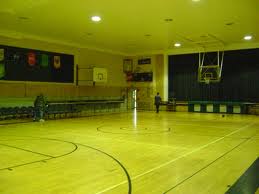
Then...

Then…

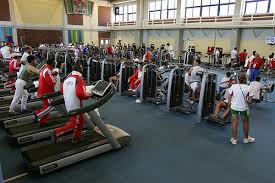
...and now

…and now


“The gym” had a completely different meaning in the 50’s than it does in the 21st century.

First of all, in the 50’s exercise was free. There was no gear or equipment of any type, you didn’t need a special outfit and there were no memberships involved. You could do sit-ups, jumping jacks and push-ups on your living room carpet. If you wanted to walk, there weren’t any treadmills about, you put on your coat and went outside. Want to up the pace? Walk faster.

No one was riding stationary bikes. They used the kind that get you from place to place. And they weren’t wearing spandex. T-shirts and shorts seemed to work. If you wanted to know how far you ran, walked or biked, your best bet was to follow up your workout by getting in the car, retracing your route, and making the calculation from your odometer.

There were gyms. They were open spaces of various sizes with hardwood floors and at least two basketball hoops. Most commonly you found them in schools. My grammar school had a gym with a low ceiling. I think that curtailed most of our basketball careers because we all starting taking jump shots with no arc.

The school gym was also the site of a 50’s favorites, dodge ball. If you are unfamiliar with this game it involved dividing the participants up into two teams and having them throw a ball at each other. If you hit someone, that person was out. If they caught your toss you were out. My gym teachers livened up the game by throwing three of four balls into the mix simultaneously.

There weren’t any other rules. If you hit someone in the head it wasn’t thought to be foul play, it was their fault for being inattentive. Aiming for the head wasn’t, however, good dodge ball strategy because it was too easy to duck away. I always went for the legs.

You could also reliably find a gym in a YMCA. And Catholic churches often housed gyms. The Catholics had already learned that a good place to play basketball was the most compelling thing they had to offer for a certain demographic. As with other areas of the church, the door was always open. No member card of guest fee required.

Posted in Growing Up in the 50s | Tagged , , , | Leave a comment

Of Bullets, Germs and ‘Numbing Pomposity’

Most Americans, even if you exclude those who don’t read at all, don’t read American history. It’s a result of their upbringing. They were subjected to enforced exposure to some of the dullest, ugliest, least imaginative textbooks in existence. James Loewen has written a detailed account about just how bad our history texts are (Lies My Teacher Told Me: Everything Your American History Textbook Got Wrong).

Despite having a Master’s Degree in History, I’m no exception to that. Through six years of college as a history major I largely avoided American history, taking European and Latin American classes instead.

But every now and then a book comes along that reminds it doesn’t have to be that way. I read two of them recently. Both are well-written, can’t put it down stories that you probably haven’t heard.

destinyDestiny of the Republic is about James Garfield. Garfield was elected president in 1880 and was assassinated during his first year in office. Two things stand out about Garfield’s story.

First of all he never positioned himself to be a candidate and never acted in a self-promotional manner. Freed from that kind of egotistical bent, he was likewise free to do what he thought was best, not what was best for his career, his image or his legacy. And he was beholden to no one. We may never have another president like that. Garfield was a smart, thoughtful and compassionate man who I am convinced would have been a brilliant president had an assassin’s bullet not put an end to his term after 200 days.

The other thing that is remarkable about this story is that in the author’s view the best medical care available at the time was probably responsible for his death. The medical establishment of that era thumbed their noses at the relatively new theories about germs and infection. So they plundered his body in search of the bullet and were likely more responsible than the bullet for his demise.

1927One Summer America 1927 recounts a fascinating few months in 20th century America. That summer, Lindbergh made the first cross-Atlantic flight, Babe Ruth hit 60 home runs, Sacco and Vanzetti were executed and “The Jazz Singer” made its debut. As a social history Bryson portrays the American public in the 20’s as obsessed with celebrities, lurid murder trials, the Red Scare and almost unthinkable bigotry.

Whether it’s truth or just cynicism, I enjoyed Bryson’s alternate view of some of the big personalities of the time.

For example:

Calvin Coolidge — “no one has ever more successfully made a virtue out of doing little.”

Henry Ford — “defiantly narrow- minded, barely educated and at least close to functionally illiterate.”

Lou Gehrig – “suffering from an almost total absence of personality.”

Herbert Hoover — “there was no matter too small to escape his numbing pomposity.”

Not the kind of stuff you found in your high school textbooks.

Posted in Book reviews, History | Tagged , , | 2 Comments

Growing Up in the 50’s: Groceries

Groceries in my house happened once a week on Friday night. My father came home with his pay and handed my mother some cash. Before making dinner that night, since there was absolutely nothing left from last week’s shopping excursion, my mom took the cash and headed to the supermarket. There she bought one full week’s worth of food.

soup cansSome of the staples included:

Fish for dinner that night, usually mackerel (which I hated) or flounder. Since a large percentage of the people who lived in our town were Catholic and at that time weren’t allowed to eat meat on Friday we sort of just went along with the custom.

There was a Sunday roast, usually beef or pork. It was eaten mid-afternoon, around 3 p.m. Sunday was also the only day we had dessert, often involving a baked apple.

A couple cans of frozen orange juice concentrate.

peasFrozen vegetables, seven packages of them, one for each day of the coming week. Peas, corn, carrots, green beans, lima beans, all frozen and sealed in plastic. I don’t think we really had salad but if there was lettuce around it was always iceberg.

Several cans of soup, usually Campbell’s. Each day’s lunch included a can of soup.

The rest the week’s meals included one night of some type of moderately priced steak, like a sirloin. One night of chicken, either fried or broiled. Some type of ground beef concoction like meatloaf. And a spaghetti dinner with either meatballs or sausage.

It is amazing that my mom could come home from work, head out, buy the whole week’s food and make dinner and have everything she needed for the rest of the week. She always took me along to the grocery store. I wanted to be the one to grind the one pound of Eight O’Clock whole bean coffee she bought. My dad’s main contribution, other than bringing home the cash, would be to help freeze the meat we weren’t using until later in the week. We had a milkman who delivered fresh milk in bottles and could be tapped for other dairy products like eggs and butter, as needed. We also had a breadman who brought one loaf of white bread every Thurday.

In an era where many of us are focused on buying fresh locally-sourced produce this may not sound too appealing. But in the 50’s the focus was on modern conveniences. The boil-in-a-bag frozen vegetables were a staple at a time when the infrastructure wasn’t in place to preserve and transport fresh fruits and vegetables from whatever places they grew. They were a substantial improvement over the canned variety. The supermarket itself was a modern convenience of the 50’s growing ever bigger, more numerous and more diverse. And unfortunately keeping us away from the butcher, the farmer and baker.

Juice from concentrate kind of sucks but in the 50’s we were satisfied with our ability to have seemingly fresh juice sitting in the freezer. We were fascinated with modern food handling and processing technology. It enabled us to buy food grown or raised in other parts of the country and the litany of chemical additives extended shelf life to heretofore unthinkable lengths. We didn’t ask whether that meant better.

Aside from the impressiveness of the logistics of the whole thing, there are two things I am thankful for in the way my mother managed meals.

We ate together as a family every night. We all sat down together at the same time in the dining room with no TV, radio, phone, etc. It is a habit that I have continued with my own family. While there are times when one of us are out, five or six nights a week the three of us sit down and eat dinner together achieving at least 20 minutes of freedom from the plethora of devices we own.

And secondly, there was never any soda or candy in our house. Even though our choices may have been limited off-season we always had enough fresh fruit to last through the week and that is what we had for snacks. And there were always those cans of juice concentrate. To this day I don’t drink soda or eat candy because of the way I was brought up.


Posted in Growing Up in the 50s | Tagged , , | Leave a comment

Growing Up in the 50’s: My First Concert

steel pierMy first concert was at the Steel Pier in Atlantic City. The Steel Pier was an entertainment complex, with various shows, including an aquatic show of some type at the end of the pier. At one time I think that involved a horse that dove into a wading pool from a high platform with a rider on his back. That was featured in the movie “Wild Hearts Can’t Be Broken.” But by the time I went, it was a more mundane dolphin or sea lion show.

The Steel Pier originally opened in 1898. It was a turn of the century version of what we now call a theme park. You paid one admission and went to all the shows and on all the rides. There was an auditorium in the middle of the pier where music acts performed. Acts ranging from Al Jolson to Frank Sinatra to the Beatles had performed there.

bill haleySo the family was spending a summer day at the Steel Pier sometime in the mid-50’s. My mother took me to see Bill Haley and the Comets. They sang “Rock Around the Clock.” Then they did this long instrumental thing in which each member of the band was introduced and played a solo. Then they sang “Rock Around the Clock” again and it was a wrap. Couldn’t have been more than a half-hour show and they probably did it every hour on the hour.

Cool of my mom to take me. No clue where my father was. This was pre-gambling Atlantic City so good chance he was in a bar. My next rock concert was more than a decade away when I saw the Beach Boys at Newark Symphony Hall in the 60’s.

The Steel Pier still exists and still exists as an entertainment complex.  During its century plus of existence it has been destroyed numerous times by storms and fires and is in a constant state of renovation. But Atlantic City has been described as a place for dreamers and one of those always pops up with plans to restore the Steel Pier to its former glory.

Posted in Growing Up in the 50s, History | Tagged , , , , , | Leave a comment

Rockwell as Chronicler of the Civil Rights Movement

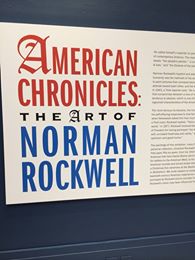
Rockwell exhibit

If you are in the New York/New Jersey area you have a couple more weeks to catch the Norman Rockwell exhibit at the Newark Museum. I would encourage you to do so.

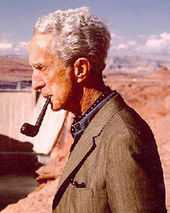
Norman RockwellI found the exhibit to be a revelation. If you had asked me to name one of Rockwell’s works the first thing that would have come to mind is Bottom of the Sixth, the baseball painting of three umpires trying to decide if it is raining too hard to go on. I had thought of Rockwell as an illustrator of Americana, of God and country and apple pie. Of someone whose images easily fit on T-shirts or plates or mugs. Instead what I found at the Newark Museum was a powerful chronicler of the Civil Rights Movement.

There are three works that stand out. Perhaps best known is The Problem We All Live With (1964) depicting the scene as 6-year-old Ruby Bridges becomes the first black child to enter the William Franz Public School in New Orleans. The little girl makes her way to school accompanied for four huge marshals. In the background is a wall adorned with racial slurs and the drippings of a tomato thrown in her direction.

The Problem We All Live WithThe Newark exhibit has a section devoted to Southern Justice (Murder in Mississippi) (1965). It shows the evolution of the painting with some early sketches, photos of the models Rockwell used and news stories about the murder of civil rights workers Michael Schwerner, James Chaney and Andrew Goodman, abducted and shot by Klansmen in Philadelphia, Mississippi in 1964. The painting itself shows the murderers only as shadows.

The third piece, New Kids in the Neighborhood (1967), was inspired by the integration of the Park Forest neighborhood in Chicago. Two black children stand beside a moving truck and come face-to-face with three white neighborhood children. A interesting touch that Rockwell adds is that the black children are holding a white cat, the white kids a black dog. There is no trepidation or hatred on the faces of these children, instead their look is one of curiosity. The image conveys the hope of a better future as a new generation overcomes the attitudes of their parents.

Rockwell has not always been critically acclaimed. Fine arts critics dismiss him as an illustrator. Some question the commercial influence on his work. Most of his paintings were sold as magazine covers, most notably for the Saturday Evening Post, which implies editorial and possibly advertiser approval. For others the bulk of his work is seen as too sweet and fanciful.

My formal art training consists of bluffing my way through a 100 level art appreciation class as a college freshman. But I can tell that Rockwell is brilliant. He is brilliant because he can paint emotion. At times in his career that emotion might have been fulfillment and contentment, but in his 70’s as he painted these civil rights inspired works, he painted bravery and hatred and hope. One critic has called him America’s Dickens. He has with his brush built an emotional connection to his characters the way Dickens did with his pen.

Posted in Art, History | Tagged , , , , , , | 1 Comment

Requiem for the Newark Bears

Even the pretzel warmer was up for grabs at today's liquidation sale.

Even the pretzel warmer was up for grabs at today’s liquidation sale.

The heads of Rupert the Bear, team mascot.

The heads of Rupert the Bear, team mascot.


The last of the Newark Bears baseball team was up for grabs earlier today. The bus, the lawnmowers, the mascot’s costume, the nacho cheese dispenser, all offered up in a liquidation sale, the proceeds of which might put a dent in the team’s debt.

Fifteen years of mostly sub-.500 baseball, seven different ownership groups, two leagues, two championships, and ultimately ending in a fire sale.

Newark_Bears_(logo,_2005-2008)But the Bears did leave some memories. Originally owned by former Yankee and Newark native Rick Cerone, the Bears were a brief and tentative home to some fairly recognizable baseball names like the Canseco brothers, Ricky Henderson, Jose Lima, Jim Leyritz and Carl Everett.

None was a bigger name than Jose Canseco. I watched Canseco as a Bear in 2001. These were still relatively good times at Riverfront. There were several concession stands open, a rooftop bar atop the first base stands, an outdoor grill behind home plate and a picnic area in left field hosting after-work parties. Those amenities gradually slipped away as the years went on.

Perhaps still accustomed to Madonna-caliber accommodations, Canseco apparently wasn’t too happy with Riverfront’s ambience. This is a guy who made a name for himself by publicly ratting out teammates for drug use. As a Bear he ratted out less fortunate teammates for sleeping in the clubhouse. His one really significant contribution to the 2001 squad was to buy a refrigerator for that clubhouse.

On the night I saw Canseco he was, to my surprise, in center field. Independent minor league teams are usually woefully short on depth and the Newarkers had more guys suited for the DH spot than center field. I don’t recall any of his at bats and suspect they weren’t very memorable. But I did get a good look at why he shouldn’t be in center field. Late in the game, the Bears ahead by a run or two and a couple of the visitors on the basepads, a wicked line shot was hit toward Canseco in center. He ducked and let the ball go past him to the wall, clearing the bases. Clearly at this level of minor league baseball they are playing for the name on the back of the jersey, not the front. That’s assuming your team has names on the backs of its jerseys. (The Bears didn’t.)

I came back in 2002 and saw a real power hitter. Jimmy Hurst’s muscles were bulging out of his uniform and when you saw him swing you suspected he might send a ball across the river to Harrison. Before the night was over he caught hold of one, hitting a towering shot that sailed out of the stadium, over the high fence in left field, and presumably out onto Route 21. Hurst hit 35 homers for the Bears that season and had 100 RBI’s, awesome numbers for an independent minor leaguer.

I couldn’t imagine why a guy like that was playing for the Bears. Did he wither away when faced with a curve ball? Was it a drug test result issue? I was curious about his career and did some research. He was a draft pick of the Chicago White Sox in 1993. His major league career consisted of 17 at bats as a September call-up for the Detroit Tigers in 1997. After his big season in Newark he signed with the Hiroshima Carp in Japan. A year later he was back in the U.S. and bounced around the independent leagues for a few more years, the last in 2008 with the Fargo-Moorhead Redhawks.

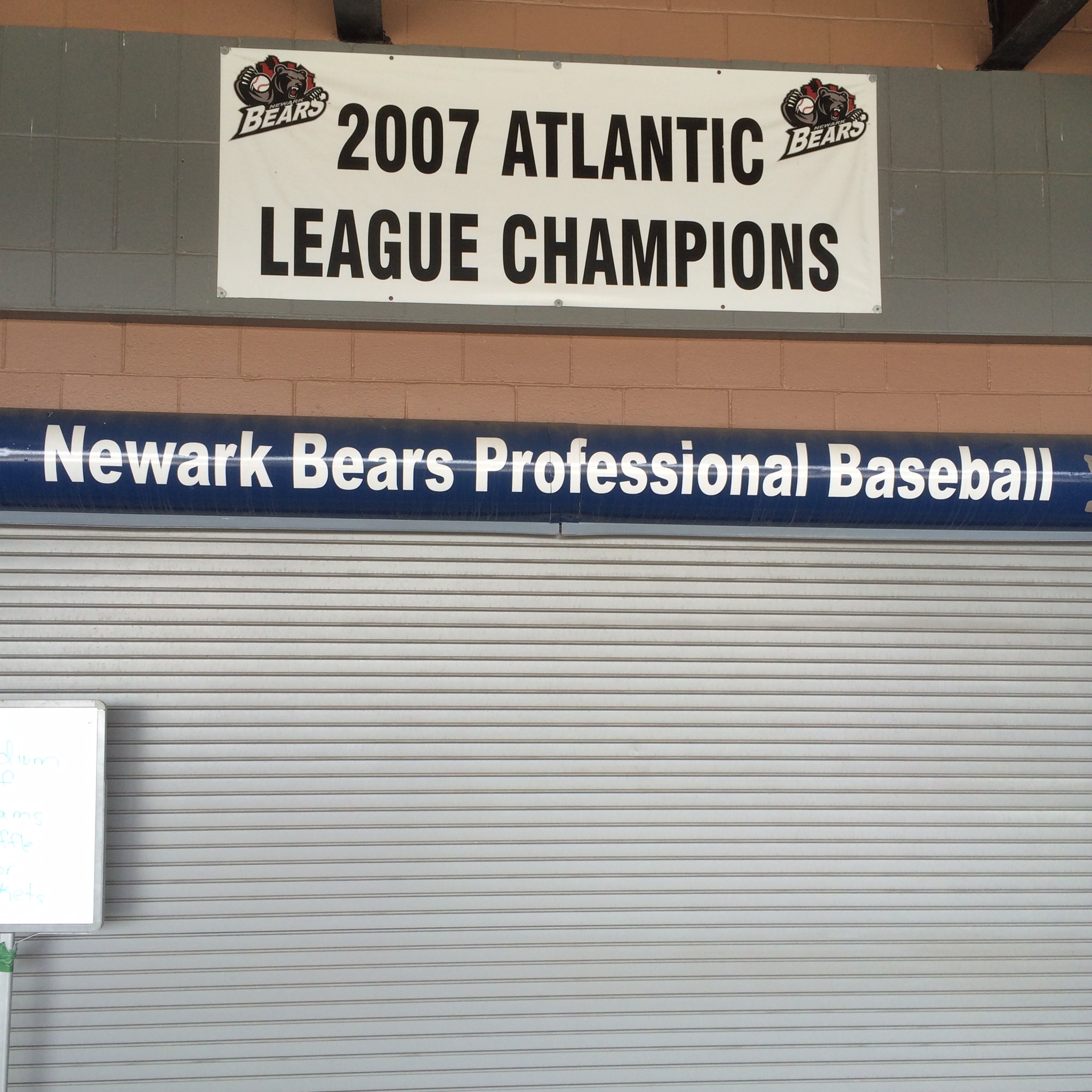
0181075ade8c881469e9e255abd26a876261fe85bfIn 2007 I had the privilege of watching the Newark Bears win one of their two Atlantic League championships. On a Sunday afternoon in September, the Bears beat the Somerset Patriots in game four of the five-game championship series to win the title three games to one.

But there was a sad note to this championship that portended to the limited future of this team. A significant part of the crowd at a minor league baseball game is usually there because of a group outing, a promotion or because sponsor tickets have been dished out. These folks usually aren’t there for the playoffs since they are scheduled spur of the moment. There were only a few dozen fans at Riverfront for what promised to be the title-clinching game of the 2007 Atlantic League championship series. Most gathered behind the Bears dugout and cheered and chanted for their team as if it were the World Series. As the Bears made the last out, the team celebrated on the field. The fans celebrated in the stands. They saluted each other. It’s just that there weren’t very many more fans than there were players.

What's missing from this picture? Fans. Bears vs. Fargo-Moorhead Redhawks, June 24, 2013.

What’s missing from this picture? Fans. Bears vs. Fargo-Moorhead Redhawks, June 24, 2013.

My last Bears game was last summer. I went to a mid-week day game. Most of the area’s minor league teams have a couple of these games each season and start them at 10:30 or 11 in the morning. The goal is to draw large groups from summer camps and town recreations programs. I’ve been to these late morning games in Little Falls and in Trenton and both the Jackals and the Thunder are able to pack their stadiums. But Riverfront Stadium on this day was a ghost town. I couldn’t help thinking as I left the stadium that the end had to be near. It was.

According to the league statistics, the Bears drew an average of 453 fans per game in 2013. Based on the games I attended, I suspect that was an overestimate. So the team had its last intimate gathering today at Riverfront Stadium where the most optimistic of attendees could bid on not just the equipment but intangibles like the naming rights for the dance team, the Honey Bears.

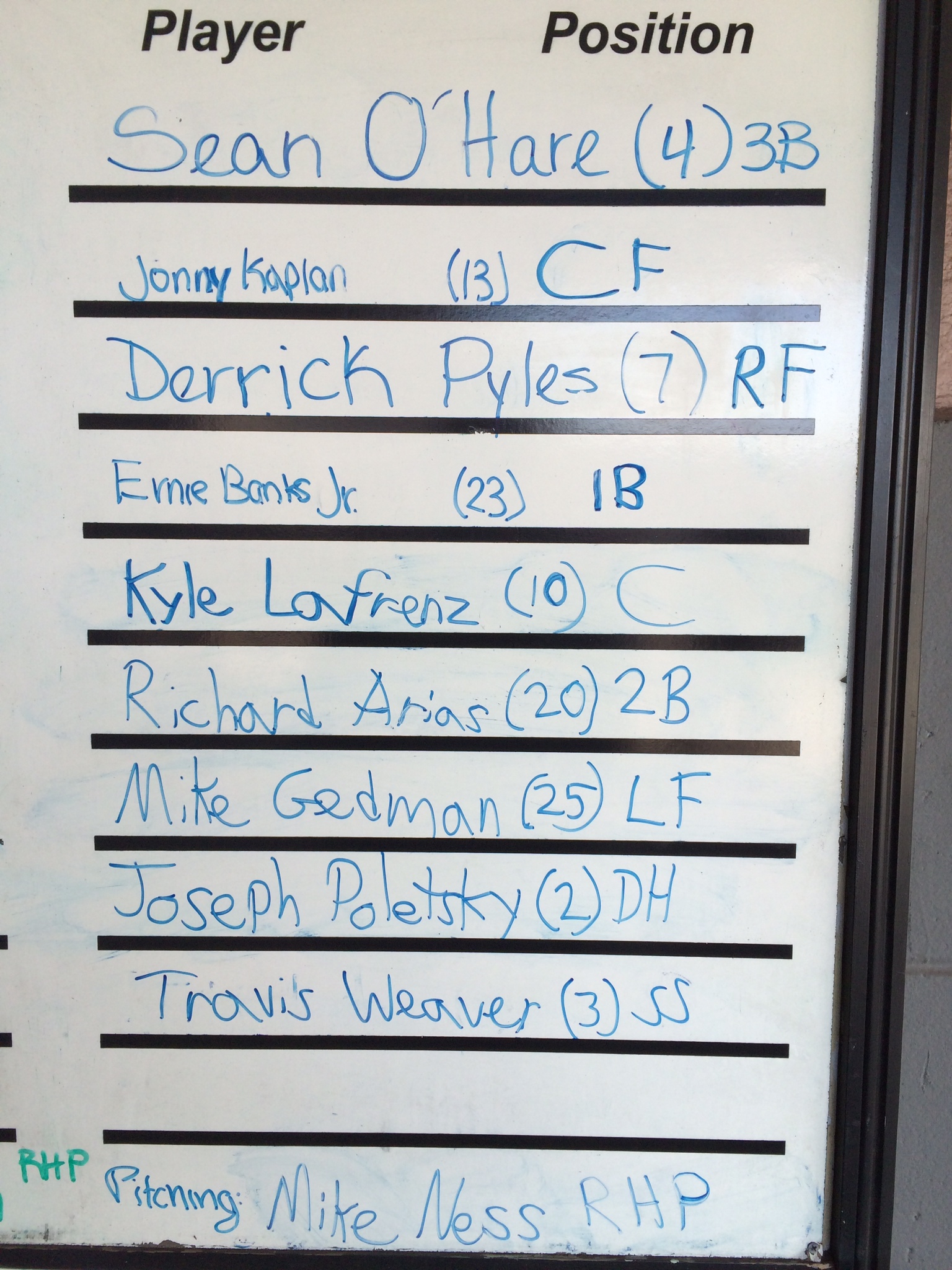
The last Bears lineup at Riverfront. With ace Mike Ness on the mound, this group beat Trois Riveres 5-4 on Aug. 30, 2013.

The last Bears lineup at Riverfront. With ace Mike Ness on the mound, this group beat Trois Riveres 5-4 on Aug. 30, 2013.

Posted in Baseball, Sports | Tagged , , , | 7 Comments

A Growing Up in the 50’s Book Review: Ike and Dick

Prior to reading Jeffrey Frank’s book my opinion of these two men was that Eisenhower was probably a decent man and fairly good president. Nixon, on the other hand, was Tricky Dick. I was half right.
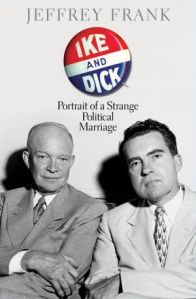
Ike and DickIf your image of Eisenhower is of a conquering hero, a general returning from a victorious war as a national hero and assuming the role of commander in chief, you’ll be surprised at Frank’s portrayal. For one thing, Ike couldn’t make decisions. This was so frustrating to those around him that his normally obedient and submissive vice president once crudely encouraged him to “shit or get off the pot.” He also tended to avoid speaking his mind directly to the parties concerned, especially if bad news was involved. One gets the impression that what he said publicly and what he really believed were not necessarily in line. The author notes that “now and then Eisenhower would offer a bit of military wisdom disguised as double talk.”

But despite his military background, Ike was, to his credit, a man of peace. He pulled us out of the Korean War shortly after taking office, an act which Frank notes could only have been accomplished by a revered war hero without getting backlash from his own party about getting out without victory. He also wanted no part of what he saw was going on in Vietnam. “No one could be more bitterly opposed to ever getting the United States involved in a hot war in that region than I am,” Ike said.

Nixon, on the other hand, was anxious to get involved in Vietnam as early as 1954, an eerie sign of what was to come later in his career.

Ike seemed to downplay issues. When the Soviets launched Sputnik, prompting a round of consternation amongst politicians of the time, Ike is said to have joked at a National Security Meeting, “Any of you fellows want to go to the moon? I don’t.” While he was right to not attach too much importance to Sputnik, in his case you get the feeling that he consistently minimized the importance of issues because of some reticence to deal with them.

What Eisenhower really liked to do was to head over to the country club, play a round of golf, and then spend the day hob-nobbing with a select group of affluent and elitist cronies (that never included Nixon).

As for Nixon, it is easy to have some fun with the man. As early as 1949 he was described in an article in The Nation magazine as a “dapper little man with an astonishing capacity for petty malice.” In the late 50’s when as vice president he was meeting with Nikita Khrushchev, he is reported to have told the Russian you may have beat us into space but we have more color TV’s.

While seeking the Republican nomination in 1968 he said in a National Review interview “They still call me Tricky Dick. It’s a brutal thing to fight.” This was only a few years after he was quoted as saying “anybody who thinks I could be a candidate for anything in any year is just off his rocker.” And then there’s the story about when he finally became president he would send memos to his wife Pat with the heading TO: Mrs. RN; FROM: The President.

I tried to find something good to say about Nixon and I thought I found something. During the 50’s and early 60’s he seemed genuinely committed to civil rights. I thought he was, based on the author’s description, as color blind as white Republican politicians got. He seemed to truly admire the era’s civil rights leaders and understood the need for the government to take action to assure equality for all.

But alas by 1968 he is running for president and sees the white Southern vote as a key constituency. He then becomes, in the words of one-time ally Jackie Robinson, a “double-talker, a two-time loser, an adjustable man with a convertible conscience.” And that, my friends, is why we call him Tricky Dick.

Eisenhower was, by the way, no champion of civil rights. In the early 60’s, after his term in office, he is shockingly quoted as saying of segregationists, “They are not bad people. All they are concerned about is to see that their sweet little girls are not required to sit in school alongside some big, overgrown Negroes.”

The sub-title of Frank’s book is “Portrait of a Strange Political Marriage” and the theme of his narrative is that they are an odd couple. He points out as an example of how different they were the 1954 mid-term election campaign. Nixon traveled 25,000 miles, visiting 100 cities in 30 states. Eisenhower spent the first month of the campaign in Denver where, according to Nixon, “after a few hours of work in the morning, he would golf in the afternoon.”

Eisenhower in general looked down on men who were full-time politicians. He probably didn’t have much respect for Nixon. From reading Frank’s account I suspect he would have preferred a different running mate both in 1952 and 1956 and would rather have seen a different GOP candidate to succeed him in 1960. Typically, however, he never directly expressed that opinion.

It is hard to know what Nixon’s personal feelings were. He said and did what best advanced his career. Thus in all public pronouncements he venerated Ike. He was an insecure and paranoid man and constantly sought a nod of approval from Ike which more often than not wasn’t directly forthcoming. The author notes that Eisenhower, while president, was fond of drawing up lists of successors and that “no one knew better that Nixon that he was never first in any of those lists.”

There is one amazing quote that stands out from the 1960 presidential election campaign when Eisenhower was nominally campaigning on behalf of Nixon’s unsuccessful candidacy. One of the issues in that campaign is whether Nixon’s term as vice president gave him the experience required for the step-up job. During a TV interview Eisenhower is asked “I just wondered if you could give us an example of a major idea of his (Nixon’s) that you had adopted in that role.“ Ike answered “If you give me a week, I might think of one.”


Posted in Book reviews, Growing Up in the 50s, History | Tagged , , , , , , | Leave a comment