
What is our prevailing image of the 19th century immigrant to America? It’s about the Statue of Liberty inscription, the tired, the poor, the huddled masses and wretched refuse. They crowded into our cities and became the workhorses of industrialization here.
But there is one group of primarily German immigrants, or you can call them refugees, who have a very different profile. The Forty-Eighters were neither poor nor uneducated. They were supporters and in some cases active participants of the revolutions that swept through Germany and some other European countries in 1848. In their homeland they had advocated for unification and a republic. When their revolution failed, they were persecuted and for many their choice was jail or America.

The Forty-Eighters generally settled in places that had a substantial German population. Most went to New York, Cincinnati, St. Louis, Philadelphia, Baltimore, and Milwaukee. They had a lasting influence on the culture and politics of all of these areas. While German immigrants are known for their contributions in the areas of education, the military, and of course, beer making, the Forty-Eighters brought their ideals with them and their contribution was in the area of social justice at a time when the U.S. was being torn in half.
Slavery had been abolished in Germany in 1794. The Forty-Eighters became avid abolitionists.
Like other immigrants they came to this country and took up low-level jobs, on the railroad, on the farm or in the cities. But they quickly moved into the types of roles they had in Germany, many becoming journalists, educators and artists. It is in these roles that they exerted their influence. Many founded or worked for German language newspapers. Others formed political clubs known as Turner societies. These groups were active advocates of abolition. In some cities they provided bodyguards for visiting abolitionists.
In Texas, the Forty-Eighters, many of whom had come in through the port of Galveston, fought against and voted against that state’s secession from the Union. In St. Louis, they were part of a volunteer group that fought against Confederate forces in what is known as the Camp Jackson Affair. They were strong supporters of the Republican Party. Lincoln’s victory in the 1860 election owes much to the vote of immigrants and in particular the Germans in states like Wisconsin, Ohio, Indiana and Iowa. Some 200,000 German born soldiers fought for the Union in the Civil War, about 10% of the total. The Forty-Eighters both enlisted themselves and used their influence to encourage others to do so.
Here are a few prominent Forty-Eighters:
Harold Raster.
Raster was born in Anhalt-Dessau. After graduating from the University of Berlin in 1848, he became chief stenographer for the revolutionary Erfurt Union Parliament. After the failure of the revolution, he was given a choice of leaving the country or facing trial. In 1851 he moved to New York where he initially found work as a wood chopper. A year later he moved to Buffalo for a job with a newspaper and by 1853 he became editor of the influential German language New York Abend-Zeitung. He was an active member of the Republican Party, pro-Union and anti-slavery and he used his newspaper to sway other German-Americans in that direction. After the Civil War he remained active in politics and in journalism. He was a delegate at the 1868 Republican Convention and chairman of the platform committee, He was later appointed Collector of Internal Revenue by President Ulysses Grant. At the same time he maintained his position as editor of the Chicago Staats-Zeitung.
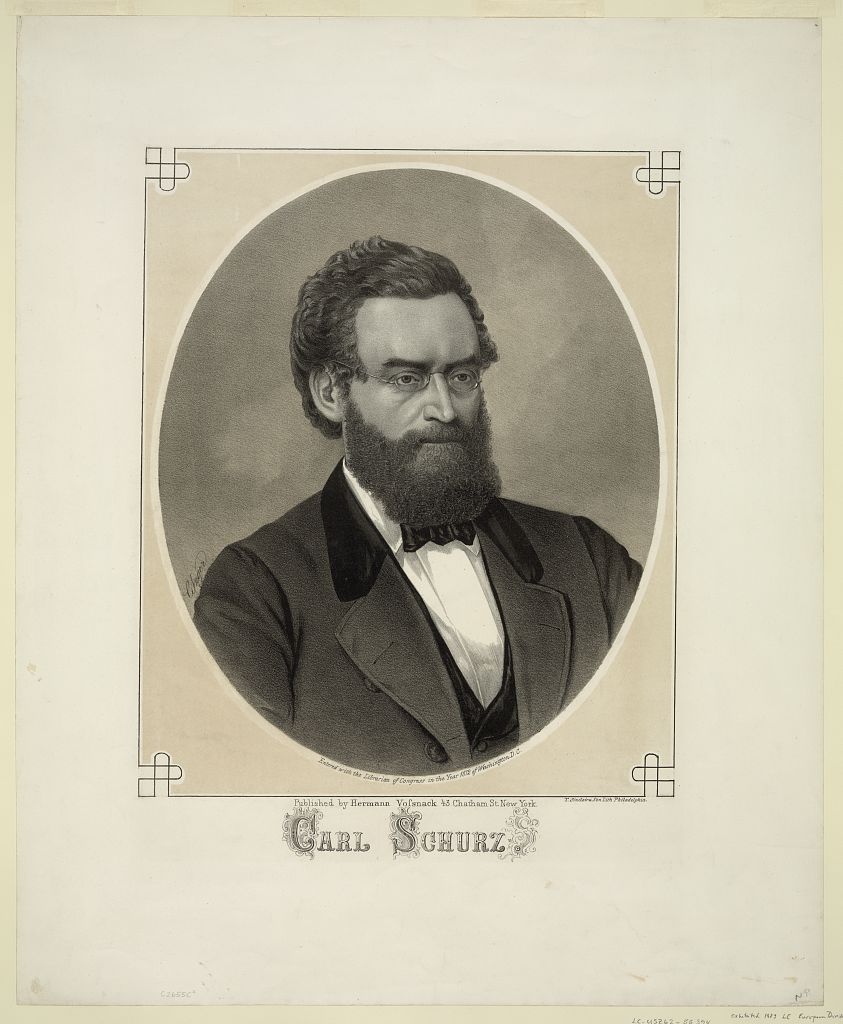
Carl Schurz
Schurz came from Prussia. He was an active supporter of the 1848 revolution, working with an academic fraternity association that advocated for democratic reforms. He fought in the revolutionary army that was defeated in 1849, Schurz fled to Paris, then London and in 1852 arrived in Philadelphia. Shortly thereafter he moved to Watertown, Wis. There he was admitted to the bar. He was active in the Republican Party and the anti-slavery movement. He made speeches on Lincoln’s behalf in German. He became a general in the Union army, fighting in the Battle of Gettysburg, amongst others. He would go on to have a distinguished political career. His first elected position was lieutenant governor of Wisconsin. He would later become a senator from Missouri, the first German born member of that body. He was appointed Secretary of the Interior by President Rutherford B. Hayes. Along the way he became editor of the German language newspaper in St. Louis. After Hayes left office he moved to New York where he had stints with the New York Evening Post, the Nation and Harper’s Weekly.
Karl Daniel Adolph Douai
Douai was the son of a school teacher in Saxon-Altenburg. His family had little money and he worked as a newsboy during his childhood. But he was well educated. He lived in Russia for a time but returned to Germany with the promise of a more democratic country in the air. His efforts to organize workers and students landed him in jail in 1848. When released he was encouraged to leave the country and headed to Texas. He launched a newspaper in San Antonio which he used to rail against slavery. He advocated the creation of a slavery-free state in western Texas. That didn’t go over well in a slave state and he ended up selling the paper and moving to Boston, where he resumed his teaching career. In 1959 he established a three-classroom school there which is credited with having the first kindergarten in the U.S. He later moved to New York and then Newark and was a prominent member of the Workingman’s Party of the United States, which later became the Socialist Labor Party of America.
And then there’s this guy named Breitenbucher. My grandmother had some sort of certificate that showed he fought in the Civil War. I think he was my great, great grandfather. (I might need one more great in that description.) I don’t know too much about Herr Breitenbucher and there is no one left in my family that has any knowledge of him. Ancestry.com shows some 20 Breitenbuchers who fought in the Civil War, several from New York, which is where that side of my family lived. I have no idea if Grandpa Breitenbucher was a Forty-Eighter, but I like to think he had the same ideals and the same commitment to social justice.






































































































 off the leash