
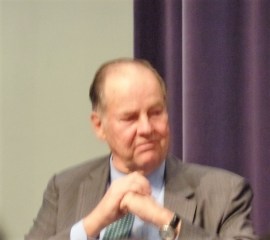
Former Governor Tom Kean
Tom Kean was governor of New Jersey from 1982 to 1990. At Friday’s NJ Spotlight on Cities conference he talked about his experience talking to urban mayors and residents. They wanted three things: safe streets, jobs, and decent schools.
Just last month a Rutgers-Eagleton poll asked the question what is the “most important thing to make NJ cities better places to live.” The top three answers were jobs, public safety and quality schools.
Has nothing changed in the last three decades? Most think our cities are in somewhat better shape than they were when Kean took office. And there is some optimism fueled by the fact that Americans in their 20’s and 30’s are showing a distinct preference for living in more urban environments. That is what prompted Tom Byrne, the son of another former governor Brendan Byrne, to exclaim: “Thank God for the millennials!”
Another of the conference’s speakers, Kim Fortunato of the Campbell Soup Foundation, said of Camden, “we’re not as heartbreaking these days, there are a lot of bright spots.”
I lived in downtown Jersey City in the 90’s and the early 2000’s. I watched as the waterfront office buildings filled up with the back office operations of Wall Street firms. I then watched as they were circled with luxury apartments and condos. The restaurants, bars and coffee shops soon followed. By now downtown Jersey City has become an almost trendy place to live. The price tag has gone up accordingly.
The plan to build a world-class performing arts center in Newark (NJPAC) came to fruition while Kean was governor. Newark has since added a first class sports arena and gained an NHL franchise. Prudential, which has been in Newark for 140 years, built a new 20-story headquarters in 2014. Audible moved to the city in 2007 and Panasonic moved their headquarters there in 2013. Downtown Newark now has a Nike store and a Starbucks, and a brand new Whole Foods is on its way.

Newark Mayor Ras Baraka
But as Newark Mayor Ras Baraka pointed out, “there is a mixed view of the city depending on where you live.” Many of the city’s residents have no access to the finance and the commerce of the central business district. For both Newark and Jersey City, the downtown Renaissance has not been felt in other parts of those cities and has priced out residents of other neighborhoods.
So while there are many statistics that can be cited that show people migrating to instead of away from cities, Kresge Foundation Senior Fellow Carol Coletta, noted: “Outside the spotlight the number of people living in concentrated poverty is increasing.”
There was nary a person at the conference who didn’t think education was a key ingredient to any imrpovement in our cities. Yet current New Jersey Governor Chris Christie has advocated a change in school funding that would be based on providing the exact same amount of money for every student no matter where that student went to school. The result of that plan would be to pull millions of dollars in educational funding out of the city schools and into the suburban schools, many of which are already vastly superior to their urban counterparts. Christie’s goal is to reduce property taxes in the suburbs.
In a state that is already substantially segregated, the likely result would be a further separation. Baraka, who at one time was a school principal in Newark, believes that “funding schools through property taxes is inherently unequal.” When it comes to the cities he added, “You’re going to spend the money anyway. You can spend it on hospitals, on social services, on incarceration. Or you can spend it on education.” Fortunately, Christie’s approval ratings have fallen through the floor and there is likely no chance he could ever win an election in New Jersey again.
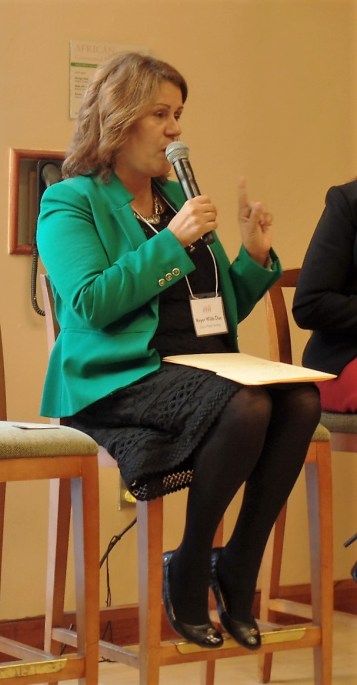
Perth Amboy Mayor Wilda Diaz
New Jersey is as diverse as it gets in the U.S. And most of that diversity is in the state’s cities. There are 2 million immigrants in New Jersey, out of a total population of 9 million. About 400,000 to 500,000 of those are undocumented. Jersey City alone has some 50 different ethnic groups. But if you look at the photo at the bottom of this post of the state’s gubernatorial hopefuls, they are all white men.
One of the conference speakers, Wilda Diaz, is the mayor of Perth Amboy, a city of 51,000 that is 70% Latino. She is the only Latina mayor in New Jersey, a state with 565 municipalities. Khader Ken Abuassab of the American Arab Civic Organization commented that while Arabs make up 25% of the population of the city of Paterson, they have no representation at the city or county level.
The conference ended with a panel of four gubernatorial hopefuls for the 2017 election. Refreshingly, there were no personal attacks. They talked about issues: jobs, schools and safety. The same issues the gubernatorial hopefuls of 1982 likely talked about.

Lee Keough of NJ Spotlight sits in the middle of four New Jersey gubernatorial hopefuls. They are, from left, John Wisniewski, Phil Murphy, Jack Ciattarelli and Tom Byrne.
A video of the NJ Spotlight On Cities event is available here.












 While the internet of things may offer a vision of a tech-fueled utopia to some, to others it suggests an omnipresent Big Brother that goes far beyond anything envisioned by Orwell. We all have seen how easily and thoroughly we are tracked online. Imagine when that tracking occurs in public places and in our homes because sensors are everywhere, sensors that record video and sounds not just info we choose to input. At minimum that suggests a virtual bombardment of so-called personalized marketing pretty much everywhere we go.





 That in a nutshell explains why the vision of a smart city is still just that, a vision. Almost all of the operating budget for most cities is being spent on the day-to-day operation of the city, meeting the payroll, keeping the schools running, paying and equipping the police and the firemen, filling the biggest of the potholes, collecting the trash.
 It was generally agreed that the higher education system is not producing enough graduates. Those that do graduate might not be able to secure a job that enables them to pay down the debt that they have been left with. And they might not graduate with the skills they are going to need to be successful.
 Amy Laitinen of New America discussed competency based education, schools that award degrees based upon what you know rather than how many credit hours you’ve accumulated. While the traditional approach of colleges is to treat students as if they all know the same thing, the competency based approach credits the student for what he or she already knows. Often done in conjunction with an employer, competency based programs are more flexible and more affordable, according to Laitinen. She cited Southern New Hampshire University as a good example of an institution offering this type of approach.





 off the leash