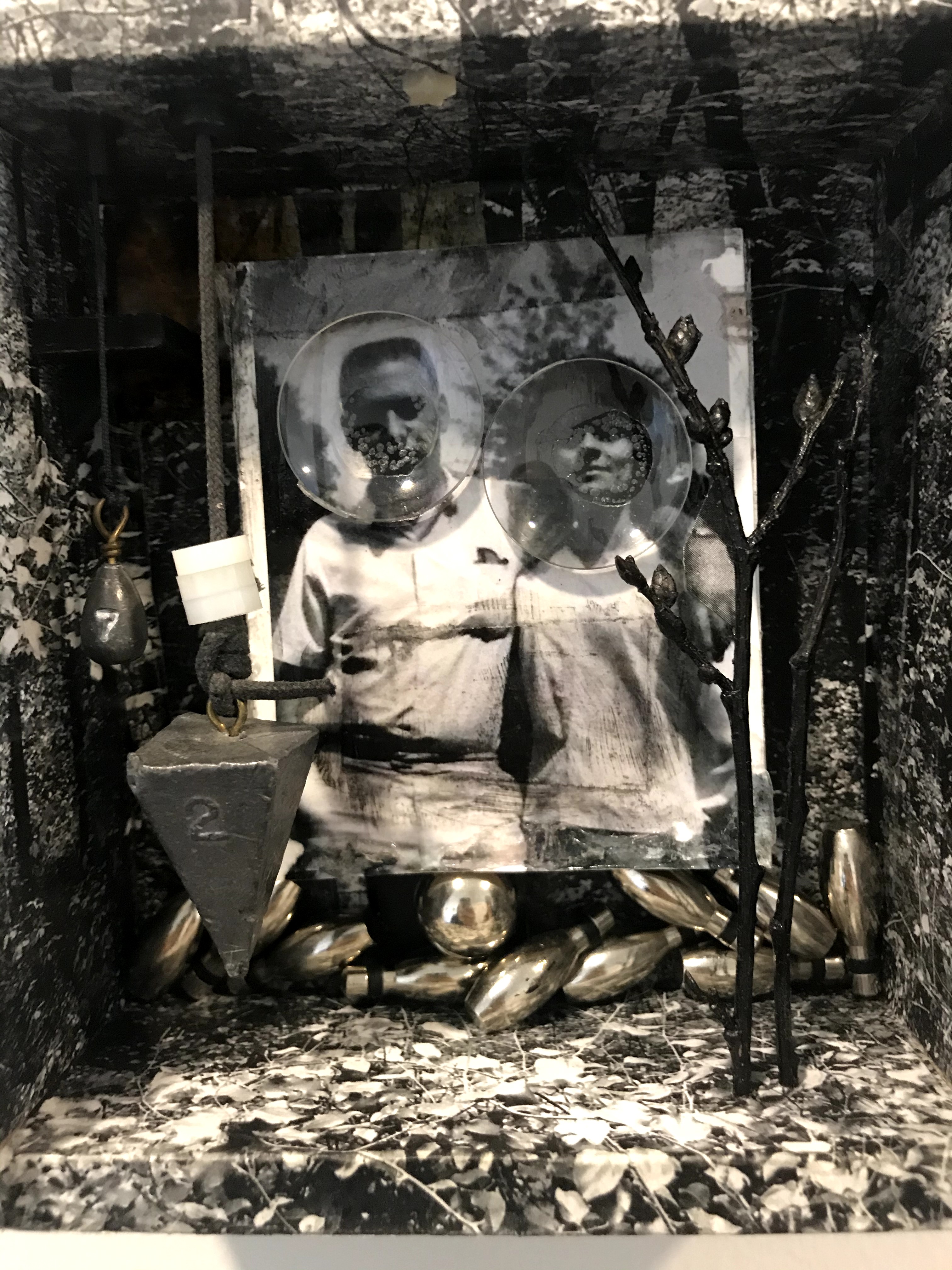
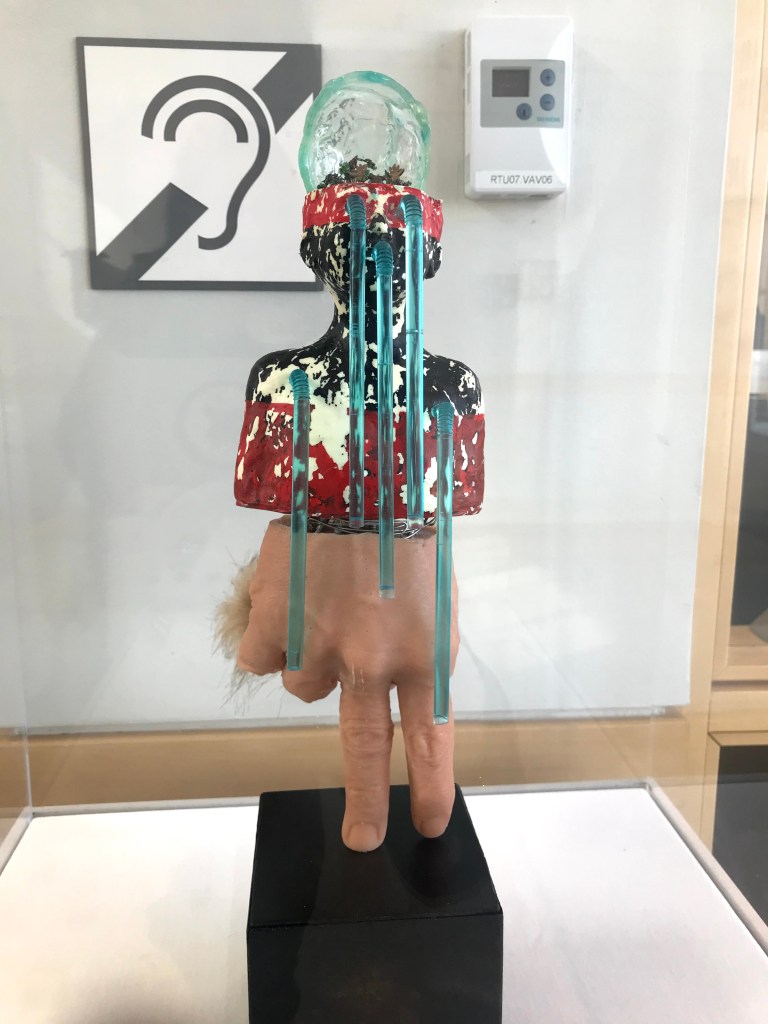
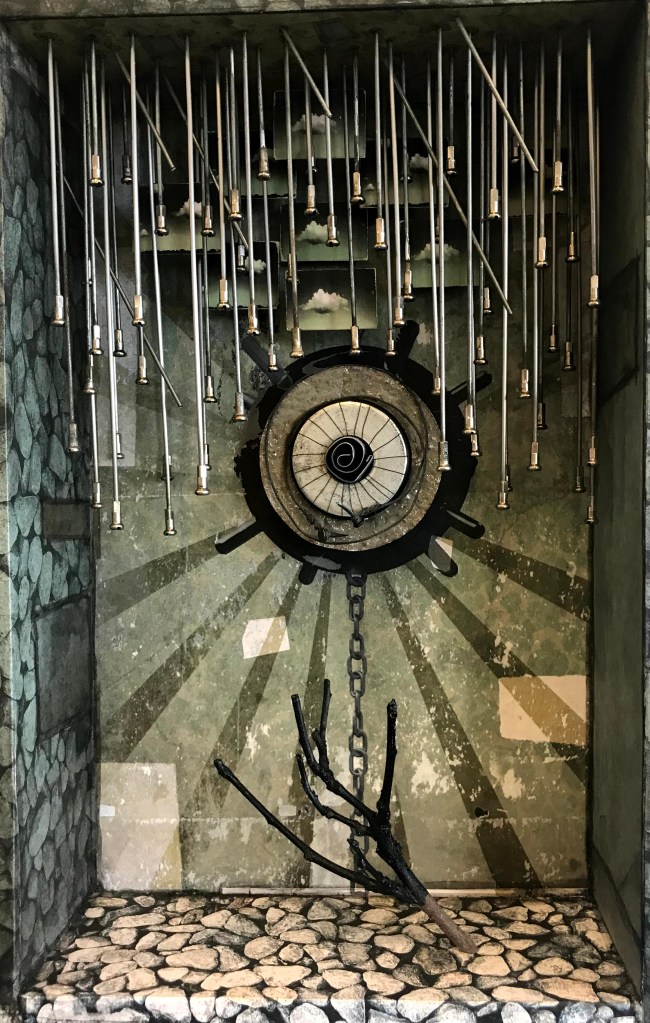
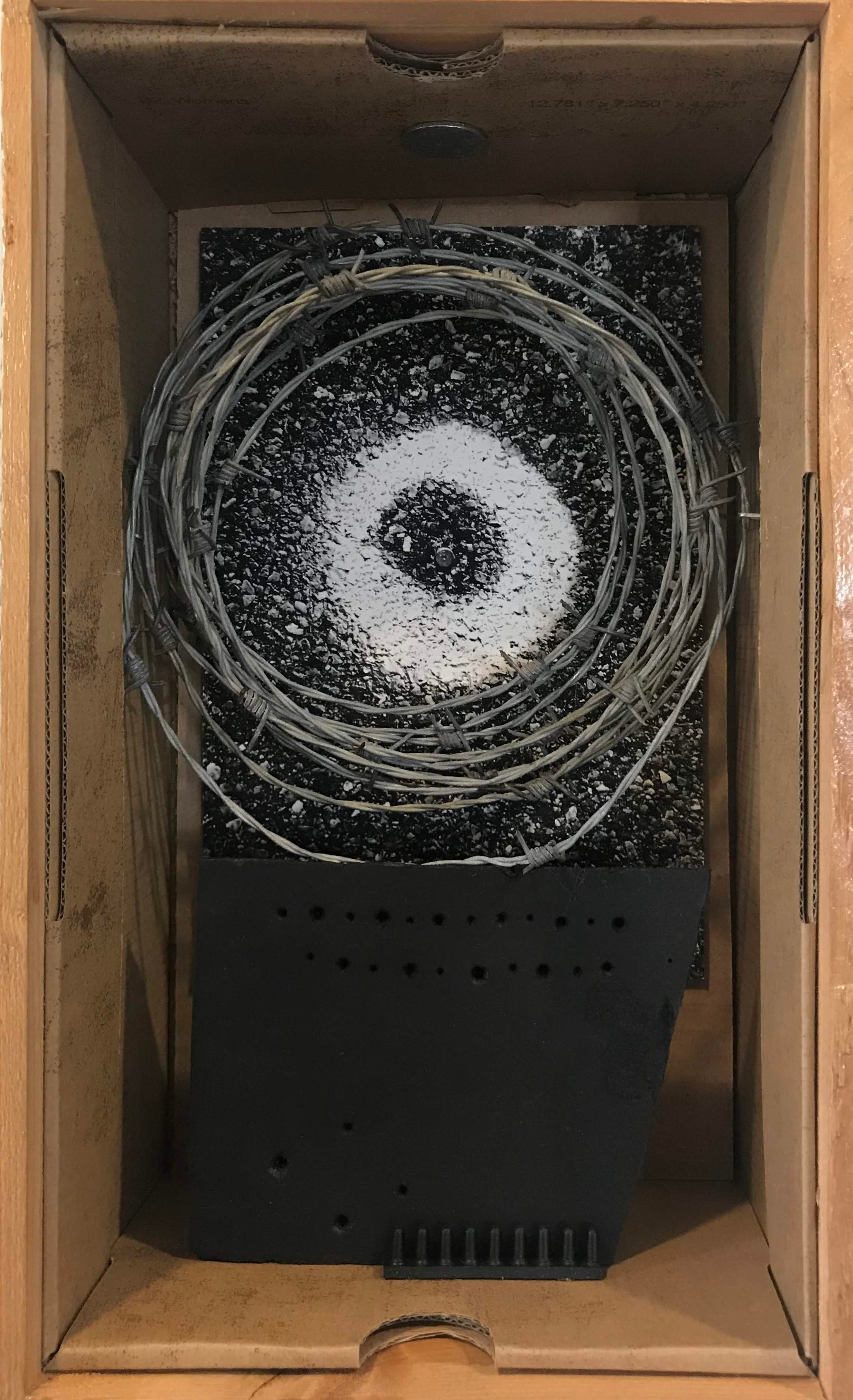
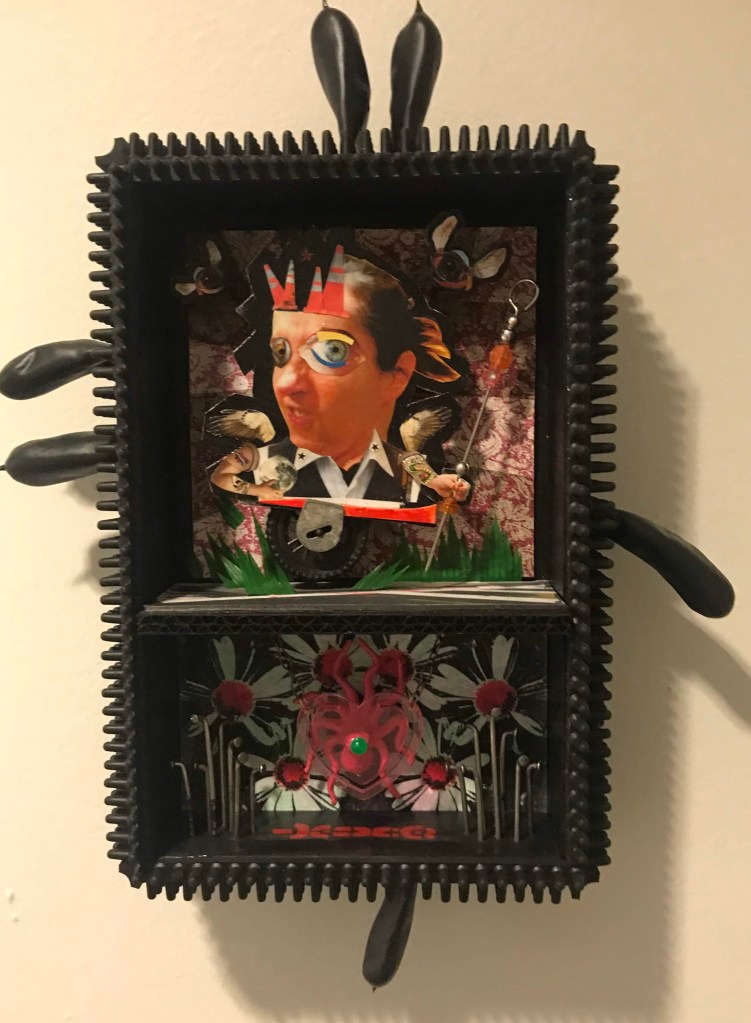
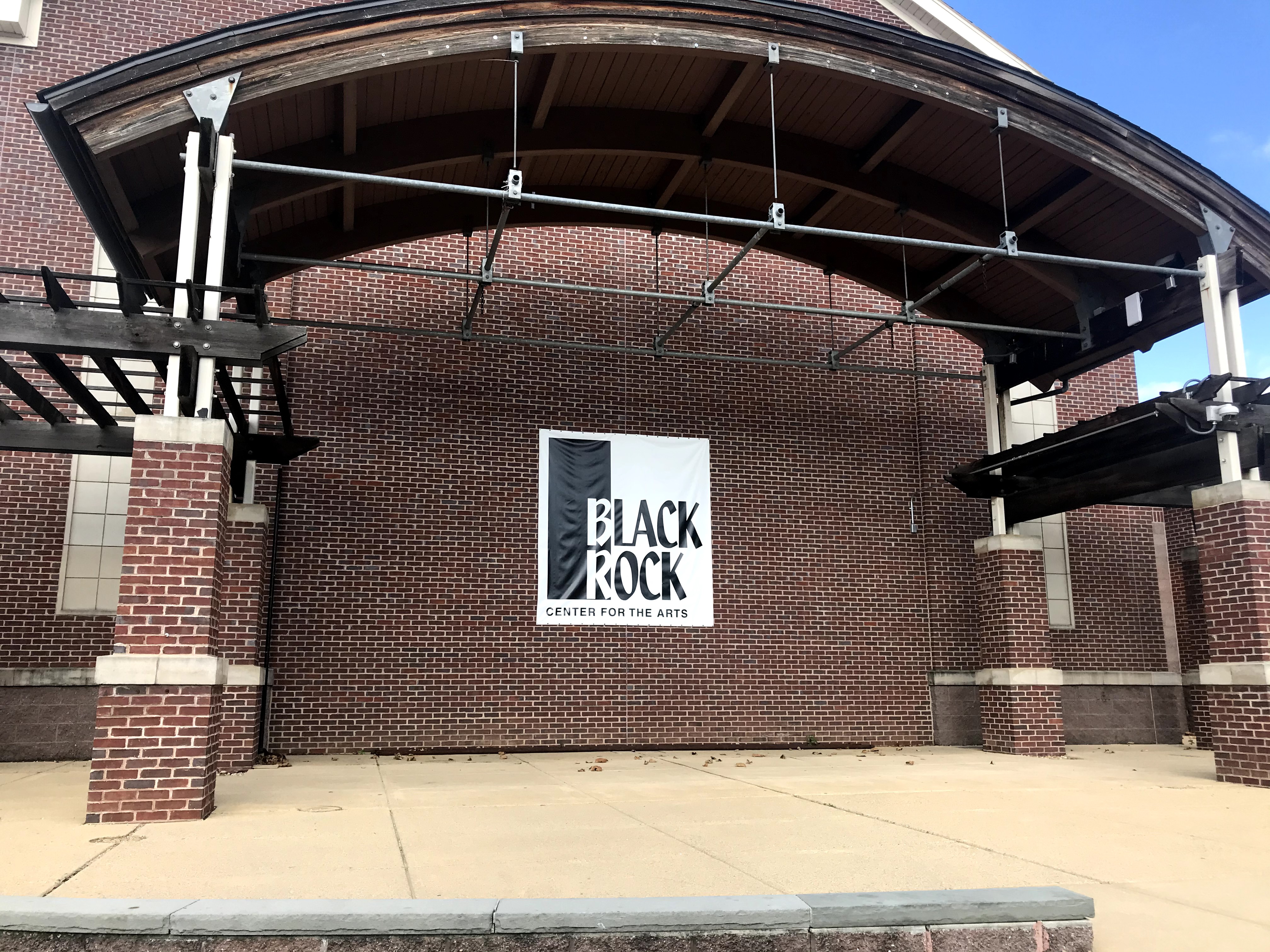
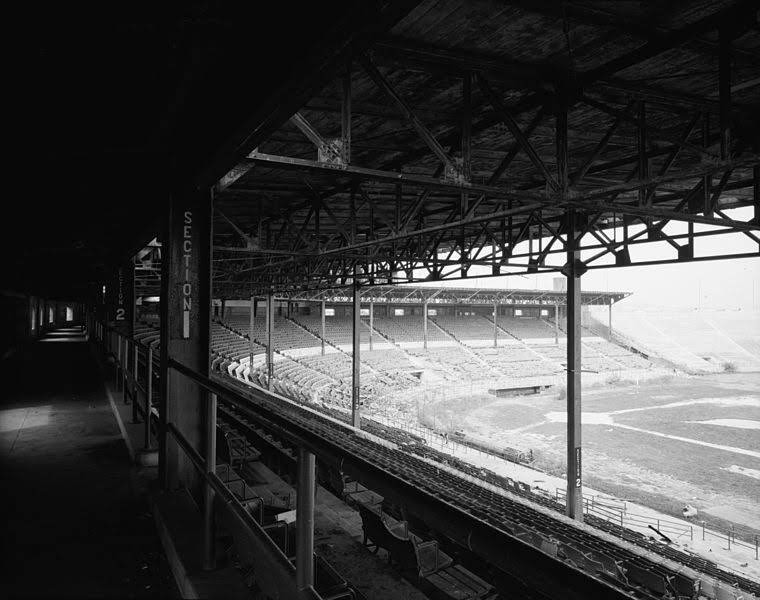
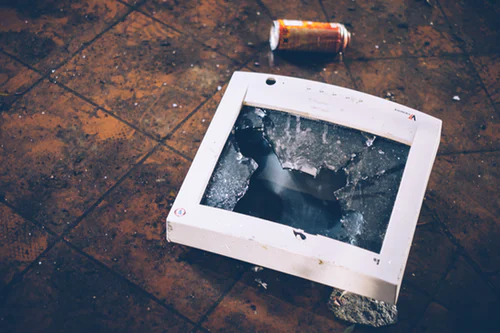
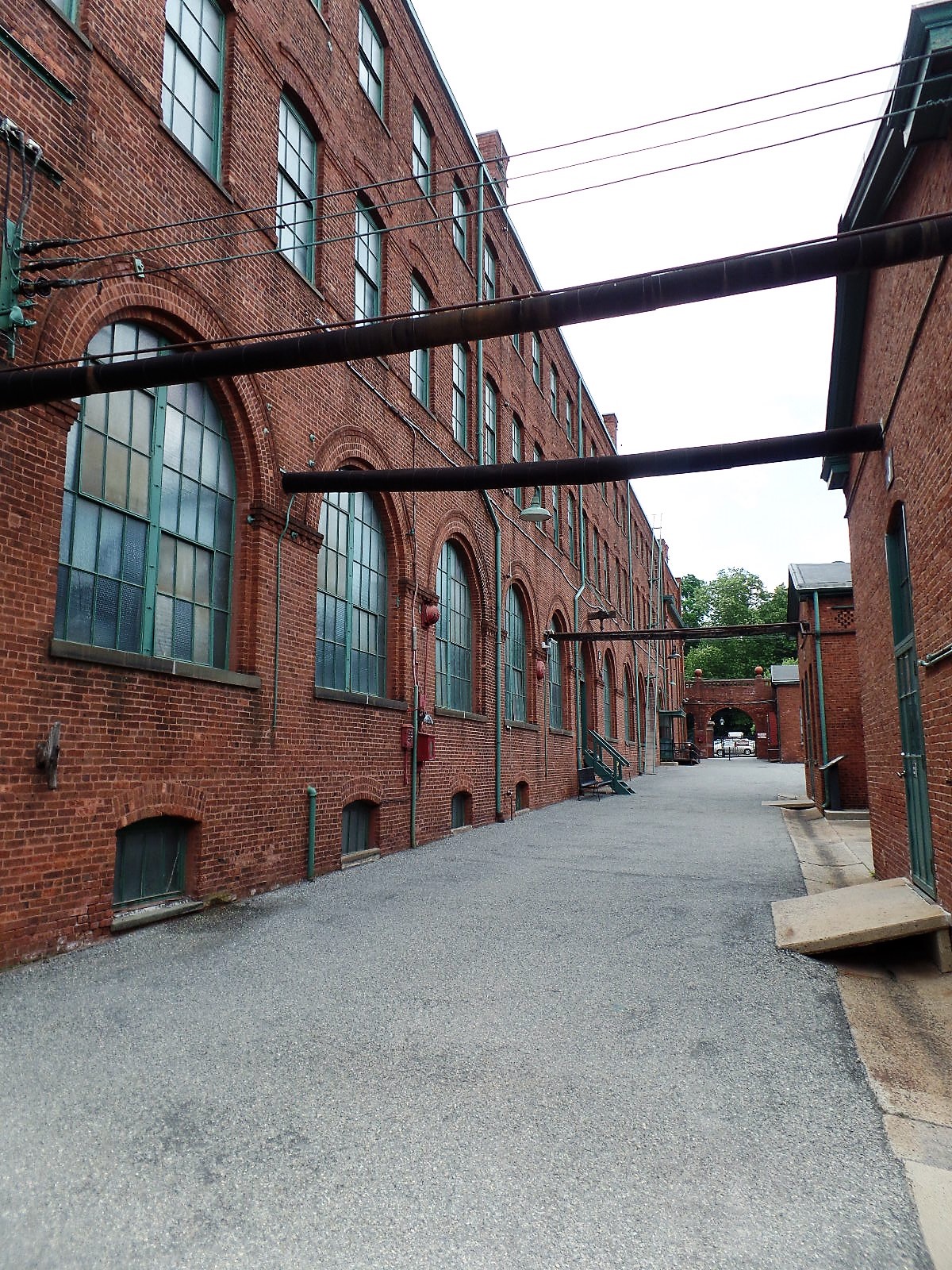
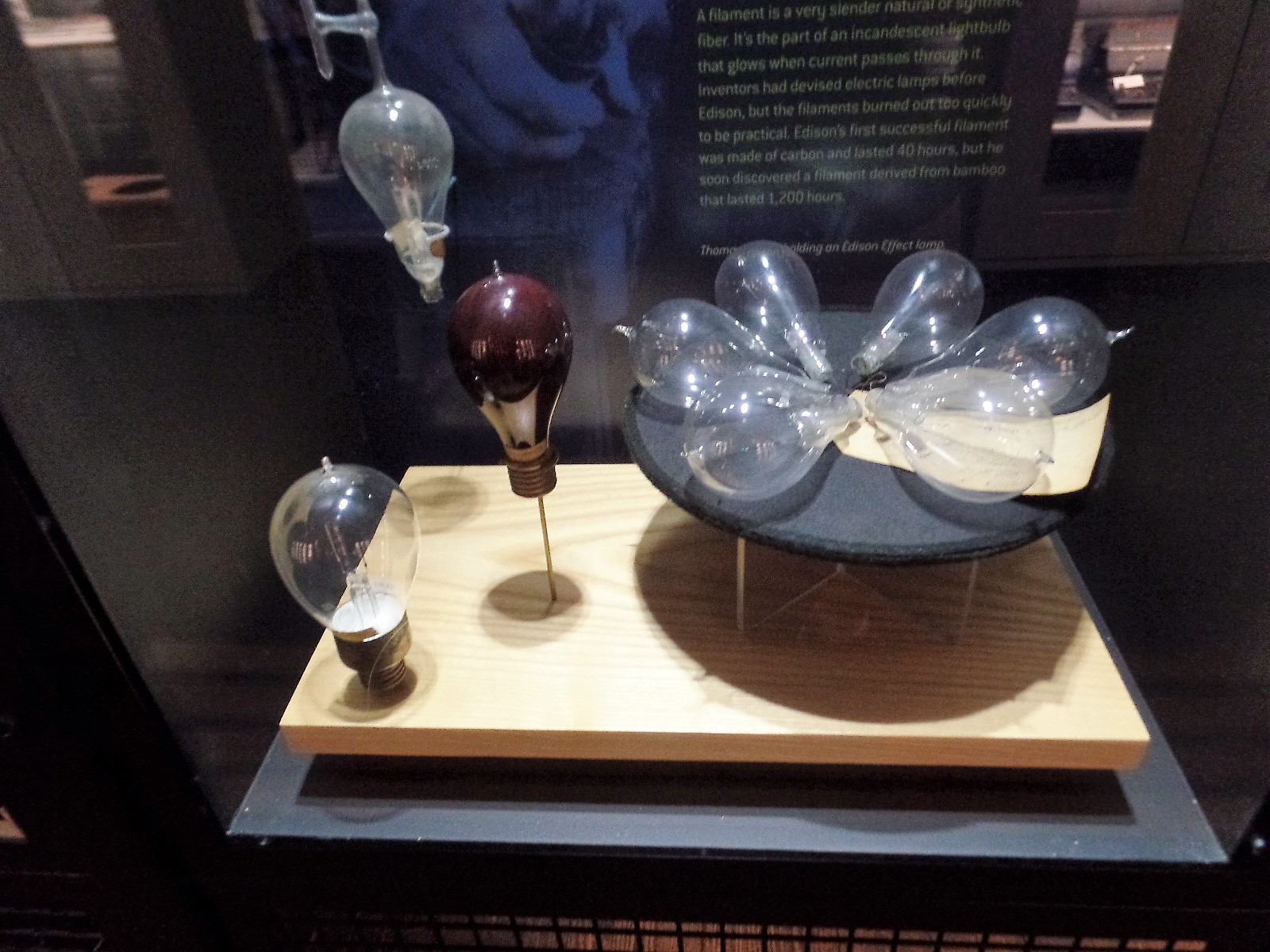
A(1). Middlemost Daft. An exhibition of the works of Washington, D.C., artist Tom Greaves at the Black Rock Center for the Arts, Germantown, Md., October 2019.
A(2). Middlemost Daft. Assemblages of collected objects depicting the middle of an unfinished short story.
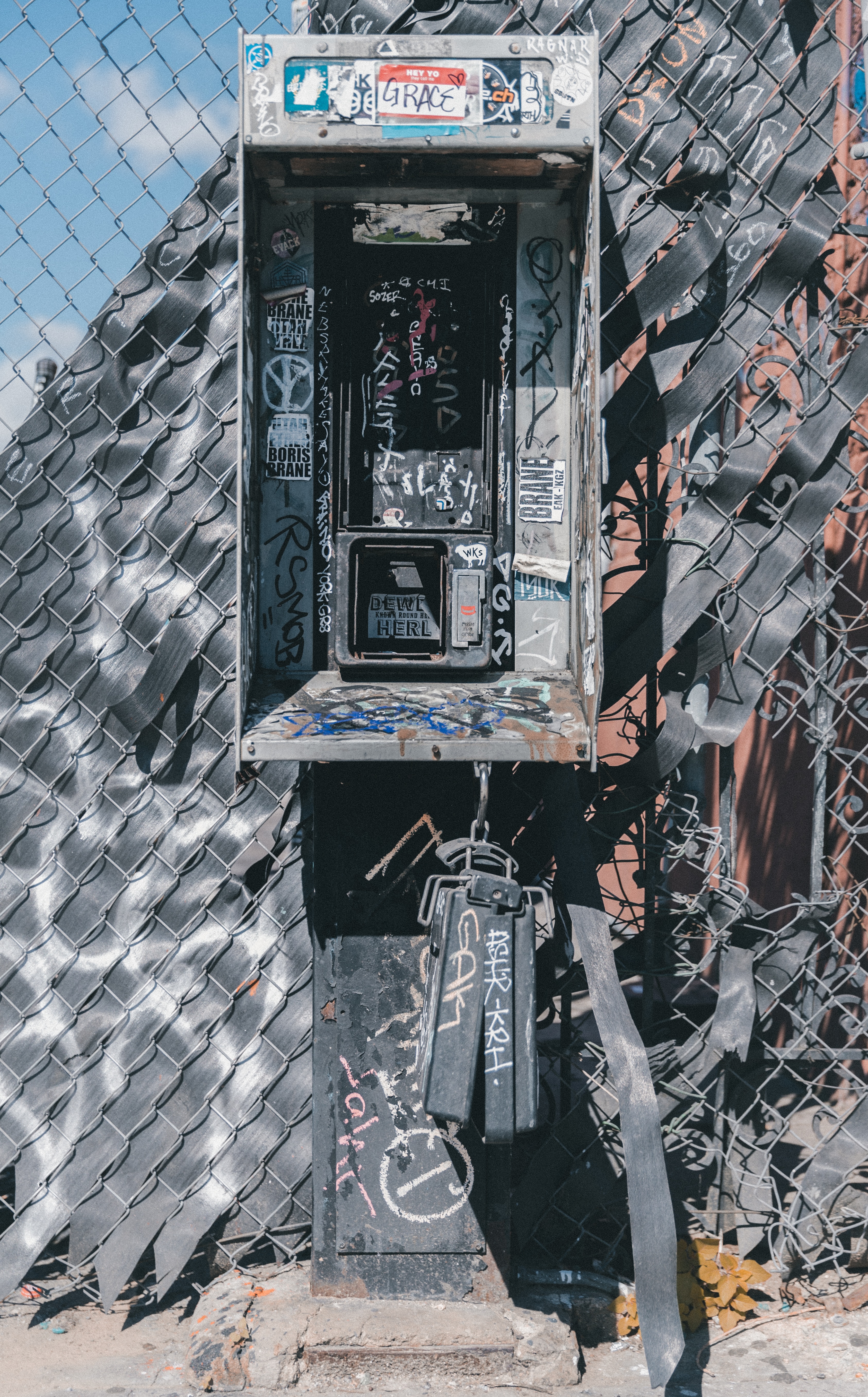
I still have a hard-wired phone (for reasons I’ll get to later). Don’t bother to call me on it. I likely won’t answer. And if you leave a voicemail, I probably won’t ever hear it.
Here’s what happens when my house phone rings. I don’t respond to the first ring because I am using a software (NoMoRobo) that will answer robocalls and then hang up after one ring. Then, if it rings a second time my phone (Panasonic) announces the caller by reading the caller ID. Unfortunately they use the worst text to voice technology I’ve ever encountered so unless the caller has a name like Bob Mark, it is generally unintelligible. That doesn’t stop me from waiting two or three rings to try to figure it out. At this point I may decide to wander over to the phone, but by the time this happens and I get there, the call has already gone to voicemail. So, having gotten to the phone too late, I may try to check voicemail. But after finding out that there are two dozen voicemail messages, even though I cleaned it out earlier in the week, and that I would have to go through each one to get to the most recent, I don’t bother. The voicemails are all about two seconds long, left by a spammer, and with no message.
So why do I still have a hard-wired phone? Good question. I actually called my provider, Verizon, and asked to disconnect it. But they advised that if I did, my bill would actually go up since I’m getting a promotional rate for a bundled service that includes internet, TV and phone. Thus it turns out that in order to get a marginally reasonable rate on what I really want, which is wifi and a handful of TV stations I might actually watch, I must also get not only several hundred TV stations I will never watch in my lifetime but also a nuisance landline phone service that has been taken over by spammers..
This problem, of course, is not limited to my hard-wired phone, nor to me personally. In November of 2019, 5 billion robocalls were placed. That’s 167 million each day, an average of more than 15 calls per person. (YouMail Robocall Index.) Most of these calls are focused on selling some type of crappy health insurance or a useless warranty. Some are more dangerous: scammers looking to trick you into providing information that will give them access to your money or your identity. It is apparently a very successful business with a high profit margin.
(Image by Christian Buehner)
How did this pile of garbage explode into our phones? According to Google Phone App Product Manager Paul Dunlop the enabling technology is VoIP or Voice over Internet Protocol. (Google Expert Explains Why You Get So Many Robocalls.) By using VoIP you can make a phone call over the internet rather than through a wire. By doing so, you don’t have to make the call from a specific phone number and can instead make it appear to be coming from any number you want. Thus we have spoofing. Spammers generally are using computer generated programs to spit out an unlimited number of phone numbers.
These numbers will show up in the caller ID on your phone and will usually be accompanied by the name of a town that the phone number’s exchange is in. That has led to a practice called neighbor spoofing. So I might get calls that identify the location as the town I live in or the town where my son goes to school or works. Thus I answer. They also may have access to other personal data (is that you Zuckerberg?). For example, I have gone to a medical appointment in Hackensack, a town where I know nobody, and the following day got spoofed calls from a Hackensack number. You may also find that it’s your phone number that’s being spoofed and you may get an angry return call.
So where do we look for help with this? First of all it is the carriers who should be doing something to control this. According to TechCrunch, “spoofing happens because the carriers don’t verify that a phone number is real before a call crosses their networks.” (How to Stop Robocalls Spamming Your Phone.) The same story notes that a technology exists to stop it. That technology, called STIR/Shaken “relies on every phone number having a unique digital signature which, when checked against the call networks will prove you are a real caller. The carrier then approves the call and patches it through to the recipient.”
The carriers have been told by the FCC to implement this technology at no charge to the customer. There is also legislation that has passed both houses of Congress requiring that the carriers do this. Have they? Nope. But they have instead charged customers for some half-assed solutions. AT&T will charge you $3.99 a month for “Call Protect Plus”; Sprint charges $2.99 a month just to allow customers to block calls and for $2.99 a month Verizon offers a ”risk meter.” My Verizon phone will occasionally identify a caller as spam, maybe one in ten.
How about the FCC? The FCC chairman Ajit Pai is a former Verizon employee who has in his role largely done the bidding of the major carriers. One of his first moves as FCC chairman was to roll back net neutrality regulations, thus opening up a revenue stream for the major carriers by allowing them to charge large content providers for a faster pathway to their users, thus slowing down everyone else and making us a secondary priority.
Nonetheless Pai insists that stopping phone spam is a top priority. Occasionally somebody gets nabbed. In September of 2018 a sleazeball by the name of Philip Roesel was fined $82 million for illegal caller ID spoofing, including 21 million robocalls to market health insurance. This was under the Truth in Caller ID Act which prohibits falsifying caller ID info to disguise one’s identity. But, according to TechCrunch, the “FCC has fined robocallers more than $200 million in recent years but collected just $6,790 because the agency lacks the authority to enforce the fines.”
So, for the most part, we’re on our own to deal with this. I started by listing my phone number in the federal Do Not Call registry as soon as I became aware of it. I assume that somewhere there is an honest marketer who doesn’t call me because my number is on that list. But for the folks who are behind the 5 billion a month robocalls, they could care less about the Do Not Call Registry.
So then I discovered that if you let the robo-message play to the end you would get the option to click on a number to tell them never to call again. Turns out that is the worst thing your can do. By answering, clicking or otherwise engaging you are confirming for the spammer’s system that you are a live wire and now you’ll get even more calls.
My iPhone gives me the option to block callers and I found the same option in the Verizon app for my hard-wired phone. One observer compared trying to keep up with this to playing Whack-a-Mole. You might be able to stop a few repeat calls but with spoofers generating one number after another it quickly starts to become a waste of time. Unfortunately I also created some ill will by accidentally blocking my mother-in-law.
A further look at the Verizon app uncovered a feature called “block anonymous calls.” With no explanation I assumed this would stop the occasional spam call I get where the caller ID reads “unknown caller.” I enabled that and have found absolutely no evidence it has ever blocked anything.
(Image by Icons8)
So then I looked at outside services to try to get a handle on this. As mentioned earlier I use NoMoRobo on my hard-wired phone. I installed it about three years ago and at first it worked pretty well. The software can identify robotic calls. It then ‘answers’ the call and hangs up after one ring. NoMoRobo blocks a call or two to my number just about everyday, but it struggles with spoofers and at this point far more get through than are stopped. The software is free for hard-wired phones for certain carriers. There is a charge to use it on a mobile and it isn’t working well enough for me to pay for it.
On my mobile, I installed Hiya. This is something of a crowd-sourced spam fighter. It depends on its users to report spam, then it blocks the number and identifies it as spam for other users. Much like NoMoRobo, it stops some calls. But it also can’t deal that well with spoofers because they are using legitimate numbers that belong to real people and businesses, just not to them. No matter how many numbers you block and report, the spammers are generating new ones all the time. Hiya is also free.
Most recently I started a one week trial of RoboKiller (not free) on my mobile. So far, so good. Three days and I haven’t gotten a spam call on my mobile. RoboKiller also gives you the option to have their system answer the call and play a pre-recorded message, often humorous (mine is a woman seeking the robocaller’s advice on what to do about her boyfriend’s bad breath). This supposedly ties up at least one line of the spammer’s system. Who knows whether it really impacts them but it does give you the feeling of satisfaction that you are fighting back.
But the larger picture is that either the unwillingness or the incapability of our government agencies and the phone companies to deal with this has nearly destroyed telephone service in the U.S. (Apparently things are much better in Europe where both the government and the carriers have been active in stopping spammers.) I have missed many a call I would have wanted to get because every time my phone rings, I assume it’s garbage. So, as I said in the beginning, if you want to reach me, don’t waste your time calling the phone.
Jersey City once had a modest sized minor league baseball stadium on the shores of Newark Bay that lasted for 50 years before being demolished. But Roosevelt Stadium had a much larger role in baseball history than that description would suggest.
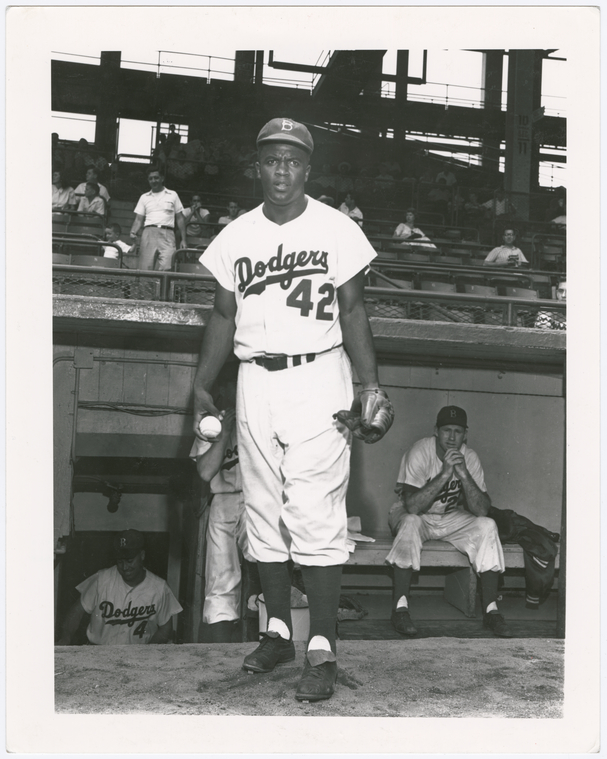
It was there in 1946 that Jackie Robinson broke through organized baseball’s color barrier. April 18 was opening day for the Jersey City Giants, AAA affiliate of the New York Giants. And they were hosting the Brooklyn Dodgers AAA team, the Montreal Royals, at Roosevelt Stadium.
Daily News sportswriter Gene Ward was there that day and he described the scene in the next day’s paper:
“Mayor Hague opened Jersey City’s 1946 baseball season with all his typical fol-de-rol and flourish before 25,000 constituents in neat, bunting-draped Roosevelt Stadium yesterday, but a young Negro ball player named Jackie Robinson stole the show! Making modern diamond history with this debut for his race in organized baseball, Robinson performed prodigious feats as he led last year’s flag-winning Dodger farm club from Montreal to a 14-1 triumph. Seldom has a ball player found himself in such a spot, or in such a spotlight, but the cool colored lad who first rose to athletic prominence as football star at USC, was the sensation of the day.”
Specifically Robinson had four hits, including a three-run homer. In addition to his three RBIs, he scored four times and had two stolen bases.
Roosevelt Stadium also plays an oversized part in my own baseball history. In 1956 and 1957, the Brooklyn Dodgers played seven or eight of their home games in Jersey City. The arrangement was part of a ploy by Dodgers owner Walter O’Malley to try to pressure New York City into building a new stadium to replace Ebbets Field, which he thought was too small and had virtually no parking. The implication was that if city officials didn’t come through he could pop across the river to Jersey City. As we know, he instead popped across the country to Los Angeles.
One of those games was against the Cincinnati Redlegs, as they called themselves at the time. My father knew somebody who knew somebody who knew the brother of Redlegs second baseman Johnny Temple. So not only did my six-year-old self get tickets to the game, but I found myself in the visitors clubhouse after the game. Johnny Temple shook my hand and probably ruffled my hair or some such thing. I also remember first baseman George Crowe going out of his way to offer a cheerful greeting.
I have no idea who won that game. And I have long since lost whatever momento they no doubt gave me, likely an autographed ball. But I never forgot shaking hands with a four-time all-star second baseman. It is one of my most vivid baseball memories. It is also an example of a connection with kids that Major League Baseball lost when they decided to start letting games run past midnight, choosing to accommodate the television networks and advertisers rather than its young fans.
In researching this post, I was dismayed to find out that after retirement Temple lost everything in a bad business venture and was later arrested and charged with larceny of farm equipment.
Named after FDR, Roosevelt Stadium was a product of the New Deal. It was built as part of the Works Progress Administration. During its four years of construction between 1934 and 1937 it provided 2,400 badly needed jobs in Depression era America.
Under construction
Opening day was April 24, 1937: the Jersey City Giants vs. the Rochester Red Wings. Mayor Hague, who controlled Jersey City for some 50 years, was said to have twisted the collective arms of his vast constituency into buying 50,000 tickets. Seating capacity at Roosevelt was 24,500. Here’s how the Paterson Morning Call reported on the stadium opening:
“Rochester Red Wings spoiled what otherwise was a grand and glorious re-entry into the International League by Jersey City at Roosevelt Stadium today when they defeated the Jerseys, 4 to 3, in a 12-inning battle. Jersey City fans packed the immense $1,500,000 ballpark in the rafters and overflowed onto the field back of the center field fence and established a new minor league attendance record with 31,234 paid admissions.”
The Giants were a fixture at Roosevelt Stadium until 1950. A decade later the stadium hosted another International League team after the Cuban Revolution sent the Havana Sugar Kings into refugee status and they landed in Jersey City for a two year stint.
There wasn’t much baseball after that. My personal memories of the stadium included seeing my first international soccer game there. I was a 16-year-old high school soccer player at the time and a volunteer who helped with the team took me there to see Glasgow Celtic. He was of Scottish descent, so he had no interest in whoever it was Celtic were playing and I have no idea who it was. A decade later I was back at Roosevelt Stadium for a Pink Floyd concert.
Near the end
My last experience with the stadium was during the 1977 baseball season when the Cleveland Indians put a AA Eastern League team there. I went to a few games that summer, but it was a fairly dismal season of baseball. In addition to Cleveland’s minor leaguers, the Jersey City Indians had a few Toronto Blue Jays prospects. Toronto had just entered the American League and didn’t have a fully flushed out farm system yet. At age 40, the stadium was showing its age. And to make things worse, the Indians were a terrible team, finishing dead last with a 40-97 mark. Seems to me that every time I went they got hammered. Yet they managed to draw 60,000 fans that year, which was fourth in an eight-team league. Under the circumstances that seemed to confirm that Jersey City was a pretty good minor league baseball market. Yet after two seasons, the Indians folded shop and that was the end of minor league baseball in Jersey City. And, by 1985 that was the end of Roosevelt Stadium.
Two fairly widely followed technology conferences took place simultaneously this week (because who wants to go to technology conferences during the holidays). Amidst the usual parade of folks touting the next big idea was the continuing underlying theme of ‘what do we do now that the internet has gone south.’ No one seems to be too sure of how to clean up the toxic pit of content that continues to rear its ugly head online. Nor is anyone too sure of how to rectify the fact that their monetization strategy, which involves selling their users personal data, is not proving to be that popular with those very users.
(image by Julia Joppien)
Both events were held in California, Techonomy 2019 in Half Moon Bay, and Recode Media in Los Angeles. I followed both in the cold rainy Northeast on my laptop. There were some common themes.
There are the Silicon Valley apologists who consider all the problematic content, ranging from organized government disinformation campaigns to revenge porn, as the unintended consequences of the technology industry’s goal to bring people together and put a world of information at their fingertips. They are quick to point out that the poisonous content is but a small percentage of what’s online.
No one really trusts the big technology companies nor believes they have to ability to get this under control. Thus government regulation is broadly seen as both inevitable and desirable.
The drive for growth and revenue of these industry giants has laid low their seemingly altruistic goals from what one observer called the ‘golden age of technology’ at the beginning of the 21st century. (Remember when Google’s tagline was “don’t be evil.”)
David Kirkpatrick is the founder of Techonomy and he once wrote a massively flattering book called “The Facebook Effect.” Nine years later he opened the conference talking about the role greed plays in the way Facebook and other large tech giants are run. He noted that despite the fact that Mark Zuckerburg has far more money than he would ever be able to spend in multiple lifetimes, it is revenue that has driven Facebook to act the way it does, including their widely unpopular decision to allow politicians to post anything they want irrespective of either the truth or the consequences. He also noted the influence of Wall Street with its focus on short-term results and continuous growth.
Veteran media analyst Tim O’Reilly, also speaking at Techonomy, used Google as an example of the corrupting influence of money. Whereas Google earned its place on our devices as the dominant search engine by responding to our queries with the best possible results, O’Reilly said that 50% of all Google searches now end with Google. Sometimes you have to scroll down before seeing the first organic link. “Instead of serving users better, we’re doing things that make us the most money,” O’Reilly said.
He suggested that Silicon Valley is a parable for what is wrong with the U.S. economy. The algorithms that manage Google’s search or Facebook’s news feed or Amazon’s recommendation engine have all been steered toward one thing, make more profit for shareholders.
(image by Geralt)
Hence the focus on government regulation. But what can we really expect from that. The U.S. has an administration whose only motive is self preservation. The FCC chairman Ajit Pai has generally advocated on behalf of the large internet providers (he came from Verizon) and has eliminated regulations intended to guarantee net neutrality. And then there’s the Senate. How comfortable would we be having the likes of Mitch McConnell setting internet policy.
Fadi Chehade was a member of the UN Secretary-General’s High-Level Panel on Digital Cooperation and President and CEO of Internet Corporation for Assigned Names and Numbers (ICANN). So he has some first hand knowledge when he says “most governments do not know how the internet works” and “government structure is inadequate to address the digital economy.” His suggestion is that there needs to be an independent institution to create “guardrails.” That of course requires both the tech companies and government to surrender some authority to such an institution.
A little further south in Los Angeles, the call for government regulation came from a surprising place. Facebook was represented at Code Media by Carolyn Everson, vice president of global marketing solutions. Whatever it was she may have had on her agenda, she was on the firing line for questions about why Facebook is running political ads untouched irrespective of whether they violate the company’s rules or contain content that would cause other Facebook users to be censored or blocked. “We should not be the arbiter of truth,” Everson said, adding “there should be government regulation to assure truthfulness.” She went on to comment “we want help with regulation about privacy, election integrity and data portability.”
I’m a little skeptical about how much Facebook would actually welcome regulation. Everson, who as an ad salesperson and surely not the best person to comment on these issues, sounded to me like someone whose bosses are trying to dodge accountability.
(image by Mohamed Hassan)
The outlier in the room (back at Techonomy) was Andrew Kessler, a Wall Street Journal contributor, venture capitalist and avowed free market advocate. He described calls for regulation as “misguided” and suggested that the impact of regulation is to lock in the incumbents and shut out new voices. He described a sort of free market natural selection process, noting that the dominant players now likely won’t be in 20 years. According to Kessler the “seeds of destruction” are already present, citing as examples Apple where the iPhone has peaked and iPad numbers are declining, and Facebook where subscriber numbers have peaked (Everson would challenge this) and they face new competition from companies like Fortnite and TikTok.
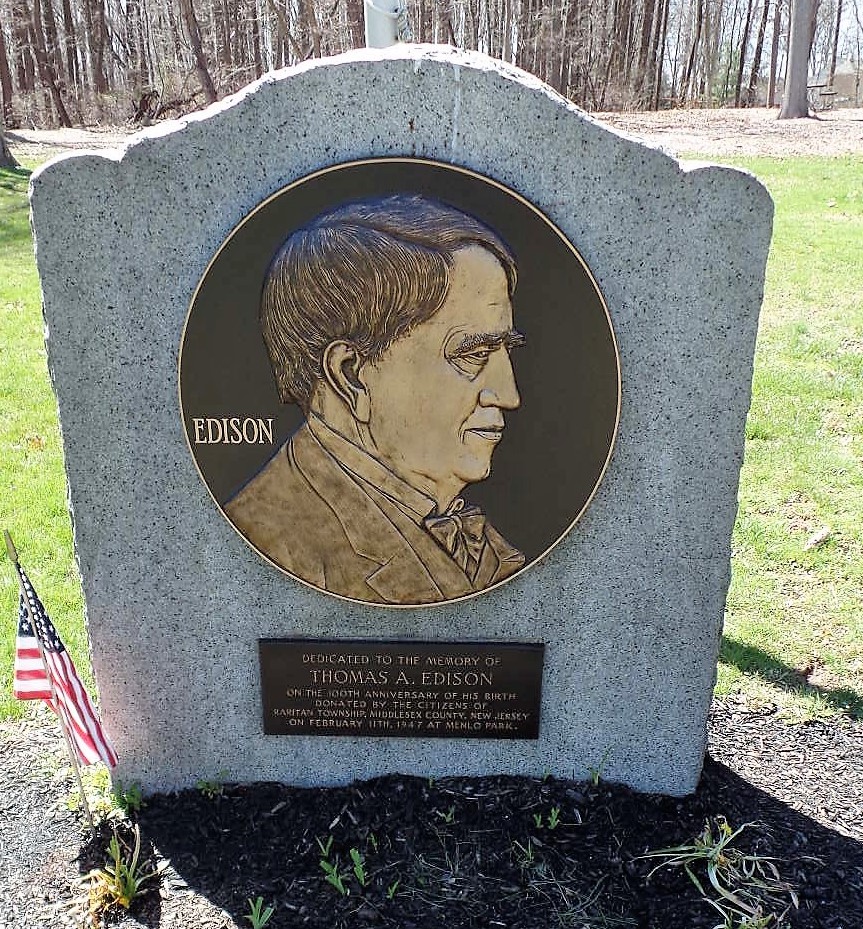
I grew up in Northern New Jersey and I currently live within five miles of Thomas Edison’s laboratory, a national historical park in West Orange, N.J. (Oh the Things Thomas Edison Thought Of.) It’s a fascinating place, all full of vials, test tubes and filaments, machines and contraptions, tools of every kind, as well as all of the finished products, ranging from motion picture cameras to a waffle iron.
As school kids, we all went there on field trips. As a sort of historical homeboy, Edison is as revered as any historical figure. So you can imagine my shock when, upon reading Graham Moore’s The Last Days of Night, I found Edison portrayed as an outright scoundrel. Intensely jealous, disrespectful of anyone who could be construed as a rival or a critic, unethical and a second-rate inventor at that. Then I saw Alfonso Gomez-Rejon’s movie The Current War. Added to the above we now see Edison as a torturer of innocent animals and likely a crappy husband and father.
Keep in mind that both the book and the movie are works of historical fiction. Both are supposed to be based on true events, but Moore isn’t writing history and Gomez-Rejon isn’t filming a documentary. Both have the same themes. There is a lawsuit ongoing between Edison and George Westinghouse in which Edison is suing Westinghouse for violating his patent for the light bulb. The Last Days of Night is narrated by the attorney representing Westinghouse in this legal case. Edison, by the way, didn’t invent the light bulb, but he created and received a patent on a certain type of bulb whose cost and longevity made it viable.
Then there is the current war that gave the movie its name. As Edison and Westinghouse competed for contracts to electrify the country, Edison used direct current. Westinghouse used alternating current which was cheaper and could cover longer distances. Edison sought to portray AC as dangerous. Thus in the movie we see Edison electrocuting a horse to prove his point. And in The Last Days of Night the suggestion is floated that Edison paid someone to set fire to Nicola Tesla’s lab, a fire that almost killed him. Tesla was the founder of alternating current. He was a former Edison employee who later hooked up with Westinghouse.
Moore portrays Tesla as an erratic, nearly incoherent, unstable genius. I suspect the film understates his importance and Nicholas Hoult is unconvincing as a guy who probably truly was a genius. Tesla is the only one of the three who didn’t come away with a pile of money.
Nicola Tesla statue at Niagara Falls State Park. Tesla designed the first hydro-electric power plant at Niagara Falls.
The other theme that is central to both of the stories involves capital punishment. New York State is unveiling an electric chair as a more ‘humane’ method of execution. They are using alternating current (with Edison’s encouragement?). Edison is prepared to use this as proof that AC is lethal. Westinghouse sues to prevent it.
Moore’s book is a real page turner. It is very similar in style and tone to Eric Larsen’s popular histories. The movie has been panned by critics and ratings services. It’s not that bad. I viewed it with low expectations but found it surprising interesting.
There are however a few things about the movie that I’m pretty skeptical about. I think its doubtful that Westinghouse was beyond reproach as he is portrayed. And for all the photos I’ve seen of Edison, I just can’t come to grips with him looking like Benedict Cumberbatch. There’s also a courtroom scene which involves the Westinghouse suit to prevent the adoption of the electric chair based on the constitutional prohibition of “cruel and unusual punishment.” For some reason the ax murderer who is set to be the first victim is in the court. After the session is over, the criminal comes out the same door as Edison. When someone asks Edison for his autograph, the ax murderer bends forward and Edison leans on his back to sign. Then they take him away. Please!
It is also contrived and melodramatic to present the flip of the switch on the electric chair and the flip of the switch turning on the lights at the Chicago World’s Fair as if they were happening simultaneously.
I understand that it’s not unusual for men who have made history, who have made major advances that benefited society, to not always be the most pleasant chaps to be around. More often than not they are arrogant and obsessive. And especially at the end of the 19th century, ruthlessness was how you did business. But I would at least like to be left with the thought that Edison was indeed a brilliant inventor and that all of the amazing things you can see in the West Orange lab are a result of that.
Mention women’s baseball and what most of us think of is the movie A League of Their Own. Geena Davis behind the plate and Madonna is center field. The movie was based on a real women’s professional baseball league. The All-American Girls Professional Baseball League was formed in 1943, at a time when men’s teams were losing players to the war effort.
The AAGPBL was the only professional women’s baseball league of any significance. It lasted until 1954. But women’s baseball goes back to at least the mid-19th century. Vassar College fielded the first women’s collegiate baseball team in 1866. Beginning in the late 1800’s and continuing until the 1930’s there was a professional baseball option for women in the form of barnstorming teams. Traveling from city to city, sometimes lugging their own grandstands with them, these barnstorming baseball women took on mostly men’s teams, minor leaguers, semi-professionals and local club outfits.
These players would become known as Bloomer Girls. The name came from the style of uniform, featuring loose blousy pants. Bloomers were a regular part of the women’s suffrage movement of the 19th century. They drew their name from Amelia Jenks Bloom, a women’s rights advocate who campaigned for less restrictive clothing for women.
We can get an idea of what some of the Bloomer Girls games were like as they were regularly covered by the local newspapers where they played. It doesn’t appear as those the Bloomer Girls won most of these games, although they generally impressed. At least that’s how the no-doubt all male reporters presented it, usually in the most patronizing of ways.
Aug. 24, 1910
Western Bloomer Girls 4, Balliets 4
Allentown, Pa.
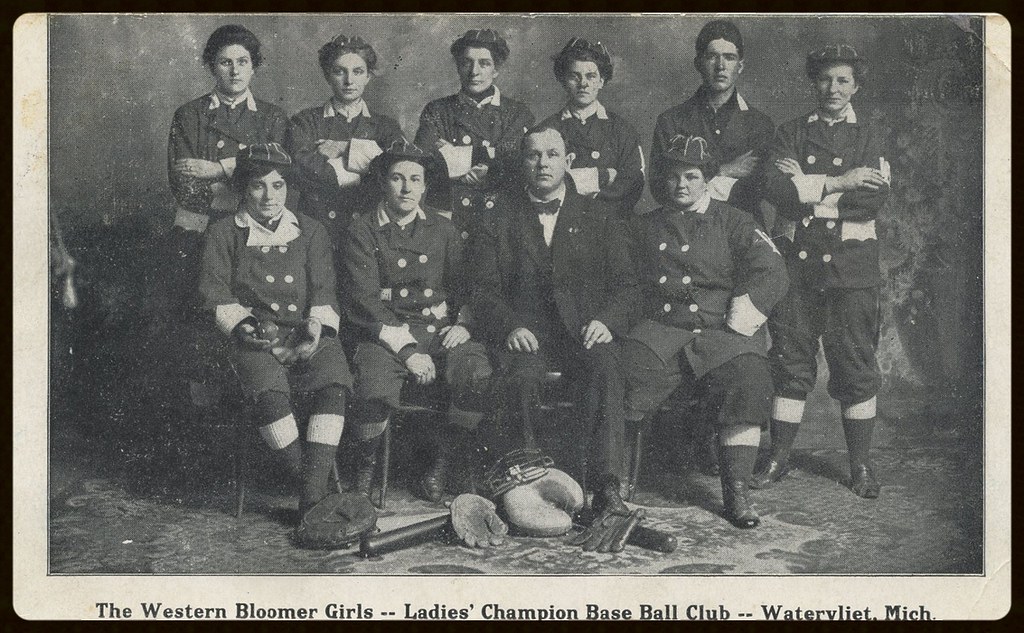
The Western Bloomer Girls actually came from the middle of the country, Watervliet, Mich., a rural farming community which in 1910 had a population of just over 700. How a town that size might field a barnstorming troop of professional women baseballers is a question I could find no answer for. But it seems as though far more than that showed up to watch the Bloomers in Allentown.
The next morning the Allentown Morning Call reported: “The desire to see how girls play baseball proved a strong enough magnet to draw several thousand people to Fourteenth and Liberty streets. The Bloomer Girls brought their own canvas, which was erected around the ball field, but it had no roof and this proved to be the salvation of an army of small boys and of a big crowd of grown-ups, who either did not have the price or did not care to give it up. Every roof and tree for a radius of two blocks was packed with humanity, all anxious to see the Bloomer Girls in action.”
No early 20th century newspaper account of a Bloomer Girls game was complete without some reference to the players’ appearance. In Allentown, the Bloomer Girls pitcher was identified simply as Miss Krowl, who, according to the Morning Call, was “unusually tall and brawny.”
But she also had “control of all the curves and shoots known to the game.” Kroll went the distance (seven innings) giving up four runs on eight hits, striking out seven and walking six. She also batted leadoff, got one hit and scored a run.
The Western Bloomer Girls featured a lineup of five women and four men. The locals scored two runs in the first inning and added single runs in the fourth and fifth. Trailing 4-0, the Bloomer Girls rallied for four runs in the seventh to tie the game. For those who suspected something fishy, the Morning Call assured: “although the Balliet players are noted for their chivalry, they did not thrown (sic) the game to the ladies and they deserved all they got.”
Aug. 9, 1925
Baltimore White Sox 15, Philadelphia Bobbies 6
Baltimore White Sox 12, Philadelphia Bobbies 4
Baltimore, Md.
One of the main attractions of the team that the Baltimore Sun referred to as “Philadelphia’s flapper baseball team” was 13-year-old shortstop Edith Houghton. A native of North Philadelphia, Houghton had tried out for the team at age 10 and was immediately signed up.
Edith Houghton
In this doubleheader in Baltimore, Houghton was the leadoff hitter in the opening game. She went 0-3 but scored a run and had four assists in the field.
The Bobbies visit was the lead story on the Sun sports page the following day. A couple of subheads pretty well summarize what this non-bylined reporter thought of the game. “Quaker Lassies Play Cleverly” read one, followed by “Local Sandlot Nine Too Good for Philadelphians in Exhibition.” One suspects a double meaning in the last subhead “Edith Ruth, On Mound for Visitors, Displays Real Assortment of Curves.”
This reporter was not beyond commenting on the players body types, referring to Jennie Phillips, the hitting star of the game with four hits, as the Bobbies “rotund catcher.” Some 2,000-2,500 fans came out to see the Philadelphia Bobbies and the Sun reported that they “applauded the efforts of the girls, who, for their sex, displayed unusual ability at the national pastime.”
About six weeks after their appearance in Baltimore, Houghton, along with the rest of the team set out on a tour of Japan. They reportedly drew large crowds and impressed playing all-male Japanese teams. They also ran out of money and ended up staying longer than expected until they found a donor to provide the funds to get them home.
Houghton continued her career with other teams, including the Hollywood Girls and the New York Bloomer Girls and also played softball which had already begun in the 1930’s to replace women’s baseball. She enlisted in the Navy WAVES program for women during World War II. She later went on to become Major League Baseball’s first female scout, having been hired to that role by the Philadelphia Phillies in 1946.
Philadelphia Bobbies
Aug. 20, 1928
Johnson City Soldiers 8, New York Bloomer Girls 5
Government Park, Johnson City, Tenn.
The New York Bloomer Girls came to Tennessee with the title of women’s baseball champion. This was achieved this by beating the Quaker City Girls 49-5, slipping by the Fleisher Yard Girls by a mere 27-8 score, then topping that off with a 51-2 victory over the Baltimore Black Sox Girls. Runs were apparently a little tougher to come by against the Johnson City Soldiers.
In the lead up to the game, the Johnson City Chronicle said: “Women are making rapid strides in athletics, as will be shown when the well-known and popular New York Bloomer Girls make their bow on Sunday against the local favorites.”
The Bloomer team that came to Tennessee included three male players, which was common for the barnstorming women’s teams of the time. One of the stars of the team was Babe McCutton. She started at third base and moved to the mound in the sixth inning. The box score, which the Chronicle describes “as near accurate as possible” shows McCutton went 2 for 5, scored a run, had five assists and made one error.
The Chronicle’s account of the game had this to say: “Miss McCutton is one of the best athletes on the team. She not only made several good plays at third base during the first five innings of the game but she looked good in the hurling role.”
The paper didn’t carry any attendance numbers but the crowd was described as the largest of the season and this despite a persistent drizzle throughout.
The paths of three 19th century baseball players crossed in 1887 and their encounter would define race relations in organized baseball for the next 60 years. One was the first of a number of dominant black pitchers who never got a chance to apply their trade in the major leagues. One was a bare-handed catcher who is considered by many the first black major leaguer. And one is a Hall of Fame player and manager and virulent racist.
George Stovey
George Stovey was born in 1866 in Williamsport, Pa. His stepfather Henry Johnson supported the family as a laborer. Stovey began playing ball with local semi-pro clubs at the age of 19. One year later he joined the all-black Cuban Giants in Trenton, N.J. It only took one impressive outing against the Jersey City team in the Eastern League for that team to whisk him away. He pitched in 31 games for Jersey City that year compiling a record of 16-15 with an outlandish ERA of 1.13. The following year, 1887, he joined the Newark Little Giants of the International League (the highest level of minor league baseball). He won 35 games for the Little Giants that year, an International League record that still stands.
Moses Fleetwood Walker
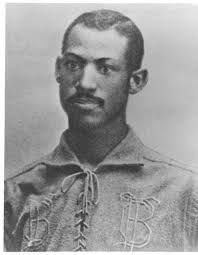
“Fleet” Walker was born in 1856 in Mt. Pleasant, Ohio. His father was one of the first black physicians in the state of Ohio. Walker attended Oberlin College where he majored in philosophy and played baseball on an integrated team. He was soon recruited by the University of Michigan where he continued to impress. In 1883 he was signed by the Toledo Blue Stockings of the Northwestern League, a minor league. In 1884 the Toledo team moved up to the major league American Association. Walker batted .264 during an injury-plagued campaign, but made his mark as an outstanding defensive catcher. It was that season which is the basis for the claim that Walker was the first black major leaguer. Baseball historians have identified an earlier black player who passed as white and played one game, but Walker was the first to play a substantial number of games and to clearly identify as black. Financial troubles and Walker’s injuries led the Blue Stockings to release him at the end of the 1884 season. Walker kicked around a couple minor league teams then was signed by the Newark Little Giants in 1887.
Cap Anson
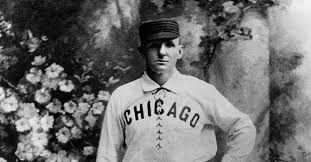
Adrian Anson was born in 1852 in Marshalltown, Iowa. He attended the University of Iowa but only lasted one semester before being shown the door for bad behavior. By age 19 he was playing first base for the Rockford Forest Citys during their one and only year in the National Association, a predecessor of the National League. He was traded to the Philadelphia Athletics where he played two seasons and finished among the league’s top five hitters. He was then recruited somewhat underhandedly and joined the Chicago White Stockings. In 1879 he was named captain and manager of the White Stockings, thus the nickname “Cap.” Anson played 27 seasons in the National League, compiling a career batting average of .334, and is considered by some to be baseball’s first superstar. He led the Chicago team to six national league pennants.
Anson was elected to the Hall of Fame in 1939. He might well have been inducted into the Hall of Shame. Anson was a racist who used his position in baseball to foster bigotry and segregation. He encountered Walker in 1883 while the latter was at Toledo. Chicago and Toledo was scheduled to play an exhibition game and Anson announced his team would not take the field if Walker was playing. Toledo’s manager Charlie Morton called his bluff and put Walker in the starting lineup. Anson, under threat of losing the gate, went ahead and played but not without hurling a racial epithet at Walker. Anson was even said to have directed racial slurs at the White Stockings mascot.
Newark Little Giants
At this point baseball was not exclusively segregated. All of the major league teams were white and there were both all-white and all-black teams in the minor leagues. But there were also teams who tried to sign the best players irrespective of race. The Newark Little Giants were one of those teams. They entered the 1887 season with Stovey and Walker, two of the eight black players who started the season with International League teams.
The Little Giants were in the Eastern League in 1886 where they compiled a 68-26 record and won the championship. They stepped up to the International League in 1887 and finished 59-39 in fourth place. They had the first all black battery in baseball, a fact that they proudly promoted. Their fireballing left-hander and bare-handed catcher were among the main attractions for Little Giants fans.
Newark Little Giants vs. Chicago White Stockings
On July 14, 1887, the Little Giants and the National League champion Chicago White Stockings were scheduled to play an exhibition in Newark. The White Stockings (the franchise that would later become the Cubs) had just finished a series in Washington and were scheduled to start another with the New York Giants the next day. As was typical of teams at the time they decided to use their day off to get a payday as a large crowd was expected in Newark.
1887 Chicago White Stockings
Prior to the game Anson sent a telegram to Newark manager Charles Hackett threatening that the White Stockings wouldn’t play if “colored” men were “at the points.” Hackett backed down, not starting Stovey, who had been scheduled to pitch. The manager claimed he was feeling ill. He also left Walker on the bench with no explanation.
Meanwhile in Buffalo representatives of the International League were meeting. Newspaper reports the next day focused on the decision to grant a franchise to Wilkes-Barre and to censure the Newark and Jersey City teams for playing Sunday exhibitions. But the Rochester Democrat and Chronicle reported on a decision which would mean far more for the future of baseball: “Manager Humphries (Rochester Maroons) stated to a reporter last evening that a petition was presented at the meeting of the International League held in Buffalo yesterday asking that colored players be banned from the league. Secretary White was instructed to promulgate no more contracts of colored players.”
The background for this was Anson’s threat to not play in Newark. But there were other issues. Binghamton’s white players had petitioned the team to release their two black players (which they did). And other teams, like Jersey City, claimed black players would drive white players from the league. Surely there is a whiff of hypocrisy about this since Stovey had pitched for Jersey City the year before and they had desperately tried to keep him from jumping to the Little Giants.
The vote was 6-4. The Liittle Giants and the three other teams with black players, Buffalo, Oswego and Syracuse, voted against it. Binghamton, which had just released its two black players cast the swing vote. The ruling didn’t ban existing black players but prevented future signings (and that worked until Jackie Robinson played in the International League for the Montreal Royals in 1946). This was the first time that an organized baseball organization voted on and put in writing a policy of racial discrimination. The color barrier in the major league was always referred to as a “gentleman’s agreement,” though surely gentleman is the wrong word for it.
On the field that day the Little Giants beat the White Stockings 9-4 even without their star battery mates before a crowd of 3,000.
Stovey went on to finish the season with the Little Giants. It was rumored that the New York Giants of the National League were interested in signing him that year. The deal never went through, some say because of the objections of racists like Anson, and some claim it was simply because he was under contract to the Little Giants and Newark refused to sell him. After the 1887 season he played another 10 years with minor league and semi-professional all-black teams including the Cuban Giants, New York Gorhams and Worcester Grays. Following his playing career he umpired in his home town of Williamsport until 1913. During prohibition he tried his hand at bootlegging, but died in poverty in 1936.
Walker finished out the season in Newark then followed his manager Hackett to the Syracuse Stars for the 1888 and 89 seasons. He was a popular player among Syracuse fans, as he was in both Toledo and Newark. When he was released in 1889, he was the last black International League player until Robinson in 1946. Following his baseball career, Walker was successful both as a businessman and an inventor. At various times he ran a theater, an opera house and hotel. And he successfully had four inventions patented. In 1891 he was attacked by four white men outside a saloon. He killed one of them with a penknife and was charged with murder. He was acquitted by an all-white jury. Walker would become a black nationalist. He co-edited a newspaper The Equator with his brother and later wrote a book “Our Home Colony” about emigrating back to Africa.
After the 1887 season, Anson signed a 10-year contract as player manager for the White Stockings. His on field prowess as well as his managerial successes declined over that period. He never won another pennant. In 1897 he was fired. After retiring he ran a billiards and bowling hall and also went on vaudeville tours, singing and doing monologues. Unlike the man who he had refused to take the field with, most of Anson’s business ventures failed. He organized the American Baseball Association in 1900, a league that folded before playing a single game. And his bottled ginger beer was found to explode on store shelves. He spent one year as Chicago city clerk then ran for sheriff but was defeated in the primary. He later published a ghost written book titled: “A Ball Player’s Career: Being the Personal Reminiscences of Adrian C. Anson.”
As for the Little Giants they held onto their black stars until the end of 1887 when the team folded. They returned in 1889 for two seasons in the Atlantic Association before going under for good.
“All Newark was baseball ‘crazed’ today. The fans were on edge for their first taste of big league baseball.” That was a UPI dispatch from Harrison Park in Harrison, N.J., on Friday, April 16, 1915. The occasion was the one and only major league home opener played in the state of New Jersey.
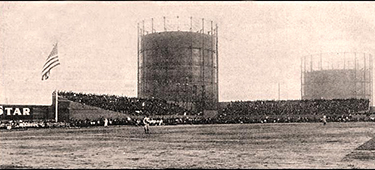
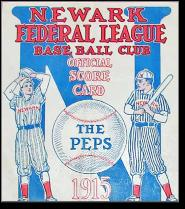
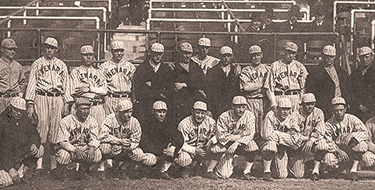
The Newark Peppers of the Federal League were playing their first game in the brand new, $100,000, 20,000 seat stadium in Harrison, just across the river from downtown Newark. 25,000 squeezed in on opening day.
Harrison Park
The Federal League was beginning its third season. It started in 1913 as an independent minor league circuit, but declared itself major league in 1914. The Indianapolis Hoosiers won the title that year. Owned by banker and oil magnate Harry Sinclair they then moved east and became the Newark Peppers.
The Peppers, aka the Newark Federals, had opened the season one week earlier, sweeping a three-game series from the Terrapins. The Baltimore team, not unlike the present-day major league club in that city, would go on to have a 100+ loss season, finishing dead last with a 47-107 record. That opening series caused Baltimore Sun sportswriter C. Starr Mathews to observe: “Bill Phillips (Peppers manager) took his team away from here last night, and, to tell the truth, we’re glad of it. They used the broom on us with telling effect, taking three straight games and were entitled to all of them. Newark has a corking ball club, and if the fans of that city do not rave over it I’ll be greatly disappointed.”
No need for such disappointment when the teams met again in Newark. The April 17 New York Times described the atmosphere on opening day: “The opening was a howling success, with a pippin of a warm afternoon, a crowd which bulged out the fence around the park, an exciting ball game… Everybody in Newark and its environs quit work when the whistle blew at 12 o’clock, put on their new Spring spangles, and got ready for the big parade. It was just like Fourth of July or circus day.” Hardly a mention of the fact that the Peppers lost the game 6-2. Modern day baseball fans will be interested in noting that the game took 1 hour, 54 minutes.
A week or so later, excitement over the Peppers spilled out onto the streets. The Buffalo Blues were in town for a three-series and on Sunday, April 25, after a 2-1 loss to the home team, Blues first baseman Hal Chase took a stroll down South 2nd Street in Harrison. There he encountered a heckling Newark fan named Billy Quinn. The ‘discussion’ between to two eventually came to blows and Quinn got reinforcements in the form of local tavern owner Paddy McGuigan. The brawl was broken up by police but when they tried to apprehend Quinn, other Peppers fans intervened and spirited him away. Chase was evidently not seriously hurt as he appears in the box scores for the next two games.
But alas, Peppermania did not make it through the full season. By mid-August, in an effort to boost attendance, the team announced a reduction in ticket prices. Bleacher seats, which had been selling for a quarter, were reduced to 15 cents. And the high-end seats in the grandstand went from $1 to 75 cents.
On the field the team could hold their own. This despite the fact that they had to give up their best player Benny Kauff, the 1914 league batting champion, at the start of the season. He was sent to the Brooklyn Tip-Tops as compensation for moving into their territory. For most of the season the Peppers were involved in a tight five-team race. A dismal September in which they went 12-20 dropped them to fifth place in the final standings, six games behind the pennant-winning Chicago Whales.
That was to be the last Federal League pennant race and the last major league baseball season in New Jersey. Long before the days of free agency the outlaw league provided players a rare opportunity to leverage the competition to increase their salaries. That pushed the costs for major league baseball owners and the National and American Leagues were anxious to make the Federals go away. The way they did this was to buyout half the owners, leaving the remaining four teams without a viable league. Sinclair pocketed a $100,000 buyout and somehow managed to retain the right to sell the players on the Newark Peppers roster to major league teams.
He told a New York Times reporter in December 1915, “I’m not out much. If I did lose anything, the fun was worth it. I’ve heard ridiculous statements that the Federal League lost $2,000,000 this year. That’s absurd, We came out alright.” By ‘we,’ I guess he means those owners who got the buyout.
On Feb. 16, 1916, the Times reported: “The final meeting of the Federal League has been called by President James A Gilmore for Chicago on Saturday, when the remaining club owners will wind up their affairs and officially declare the league a thing of the past.”
Was the Federal League a major league? Its proponents pointed to the fact that it paid major league salaries and had pinched several dozen major league and former major league players from the American and National Leagues. But the question remained unanswered until 1986 when Major League Baseball appointed something called the Special Baseball Records Committee, in anticipation of the publication of the first Baseball Encyclopedia. That supposedly esteemed group decided that yes the Federal League was a major league. End of discussion.
The Newark Peppers were a relocated team in an outlaw league playing in a city that was never before and has never since been considered major league. But they were not without their influence. Two members of the ‘Peps’ ended up in the Hall of Fame.
Bill McKechnie
Bill McKechnie, the son of Scottish immigrants, was nicknamed ‘Deacon’ because he sang in a church choir. He left the New York Yankees after the 1913 season where he had a dismal .134 batting average and jumped to the Indianapolis Hoosiers. In 1915 he was the Peppers third baseman and batted .251 for the season. That’s not Hall of Fame numbers but what the Newark team didn’t know is they had a future Hall of Fame manager on their hands. He got his managerial start in Newark. Midway through the season, with the team in a slump, the Peppers fired Phillips and installed McKechnie as player/manager. McKechnie would go on to manage 3,600+ games with four major league teams. He won four National League pennants and won the World Series with two different teams, Cincinnati and Pittsburgh.
Edd Roush, the Peppers centerfielder, broke in with the Chicago White Sox in 1913 before jumping to the Federal League for two seasons with Indianapolis/Newark. He batted .298 for the Peppers. He later spent 10 years with the Cincinnati Reds, winning the national league batting title twice and leading the Reds to a World Series win, albeit a tainted one, in 1919. Roush always insisted that the Reds would have won that series even if the Black Sox hadn’t been bought. Overall he had an 18 year career with a .323 lifetime batting average. He was elected to the Hall of Fame in 1962.
The Peppers also helped bring into the vogue the Sunday single-admission doubleheader. In the early part of the 19th century most doubleheaders were played with separate admissions and usually on Saturdays. The Peppers played their first of nine Sunday doubleheaders on June 13, splitting a pair of games with Buffalo. The Sunday afternoon doubleheader would become a regular feature of Major League Baseball at least through the 1950’s.
There was no 1916 Federal League season. But there was still one more Newark Pepper. Their back-up first baseman was a local guy named Rupert MIlls. He had lettered in four sports at Barringer High in Newark. Mills then went on to Notre Dame where he played all four of the sports, baseball, football, basketball and track. He also graduated with an undergraduate law degree, something that would come in handy during his brief baseball career. After his graduation, the Peppers signed Mills to a two-year, $3,000 per contract. He appeared in 41 games, batting a paltry .201.
Sinclair made him a low-ball offer to buyout his contract. Mills refused. Since there was a provision in the contract that he would be paid as long as he showed up at the stadium, Mills reported to Harrison Park daily during the 1916 non-season and collected his salary. After a couple months of this, Sinclair relented and paid off Mills’ contract in full.
Mills played a couple years in the minors then enlisted in the Army and was stationed in France during World War I. After the war he went into politics and was elected a state senator. Unfortunately, Mills met a premature end when he died in a canoeing accident on Lake Hopatcong at age 35.
Harrison Park would only last for a few more years before it burned down in 1923.
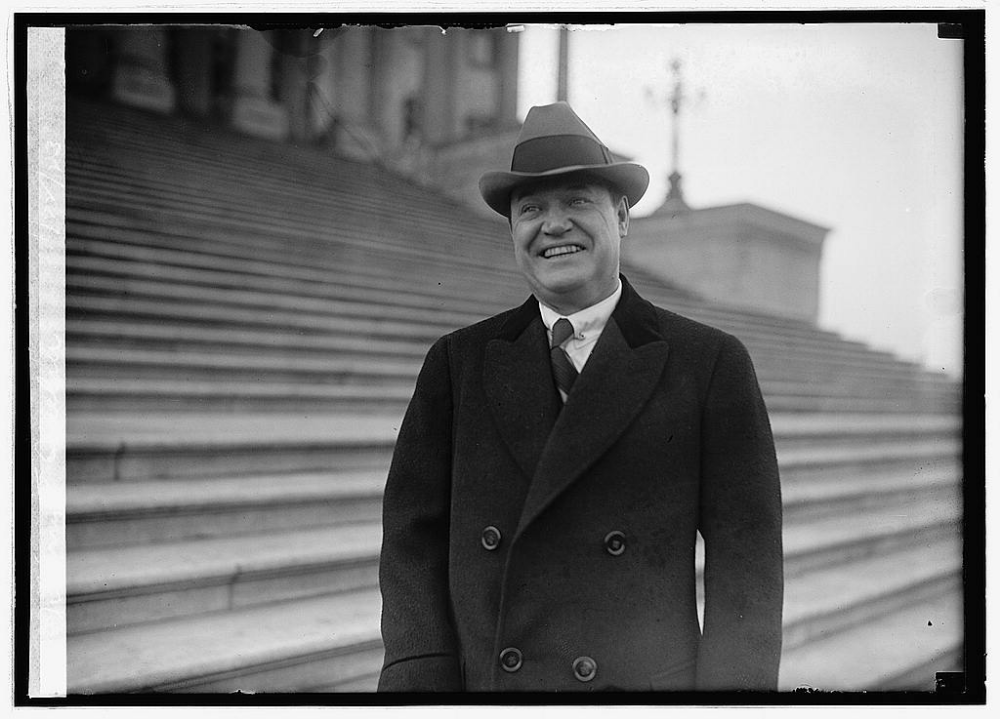
And as for Harry Sinclair, who had since founded Sinclair Oil, he would make a name for himself as part of the Teapot Dome Scandal during the Warren Harding administration. He ended up going to jail for a few months for jury tampering, but he re-emerged prosperous and successful.
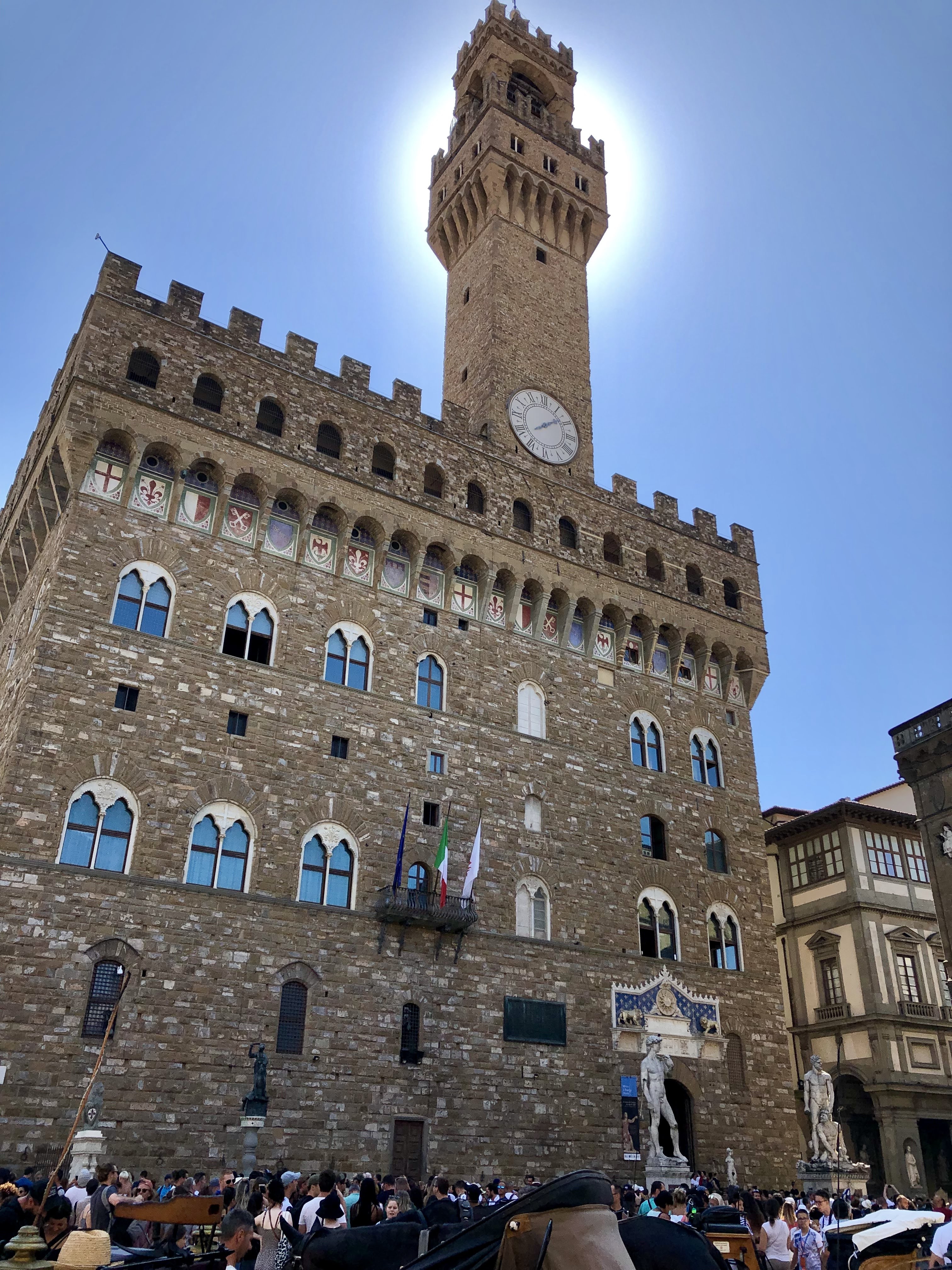
The Palazzo Vecchio is the municipal building of Florence, and it has been since it was built at the end of the 13th century. Cosimo de’ Medici, the first of the line of Medici bankers to rule over Florence, lived here. After the unification of Italy in the 19th century, the provisional government was housed here during the time that Florence was the temporary capital. To this day, the mayor’s office is in the Palazzo Vecchio.
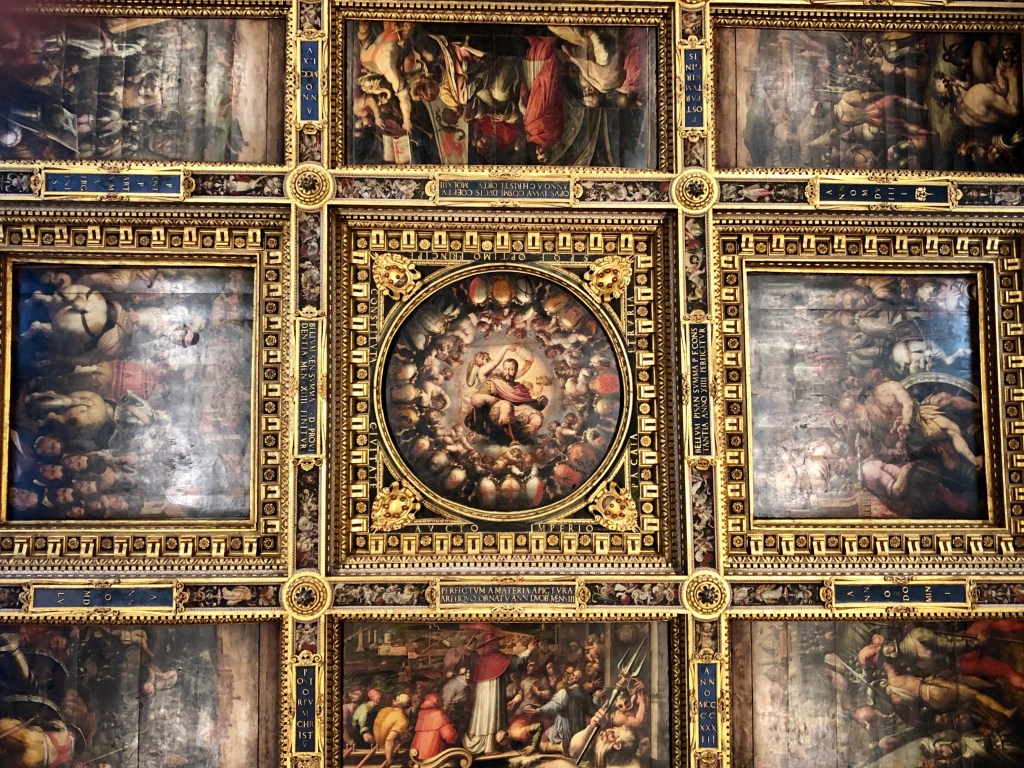
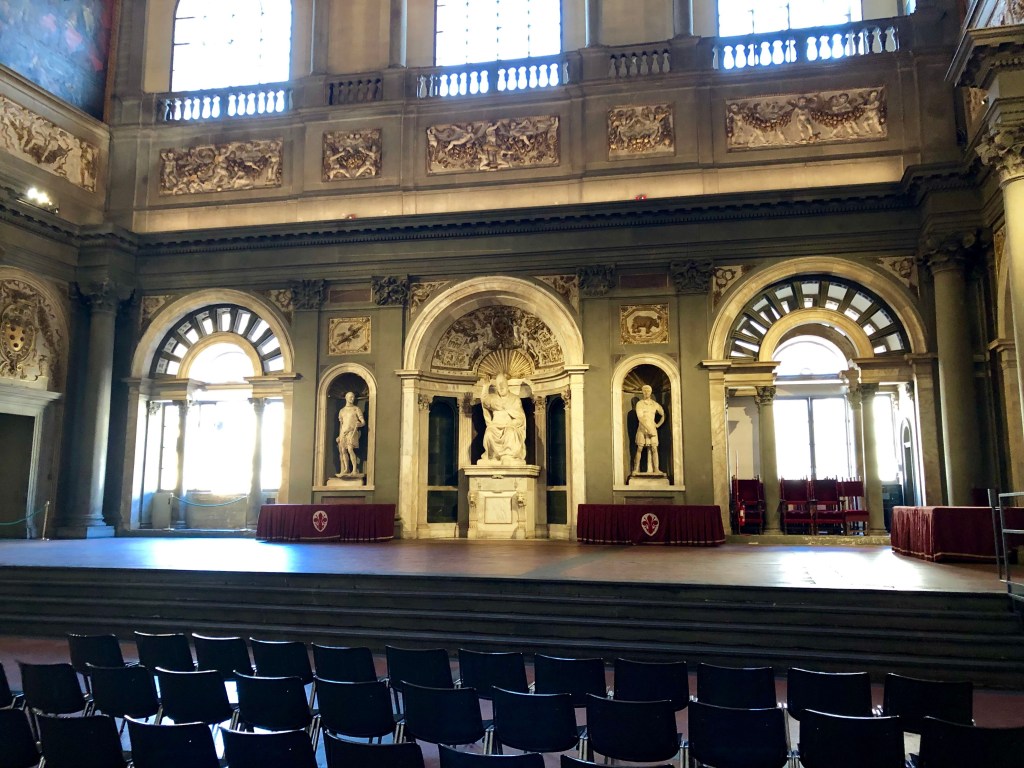
Salone dei Cinquecento
Hall of the Lilies
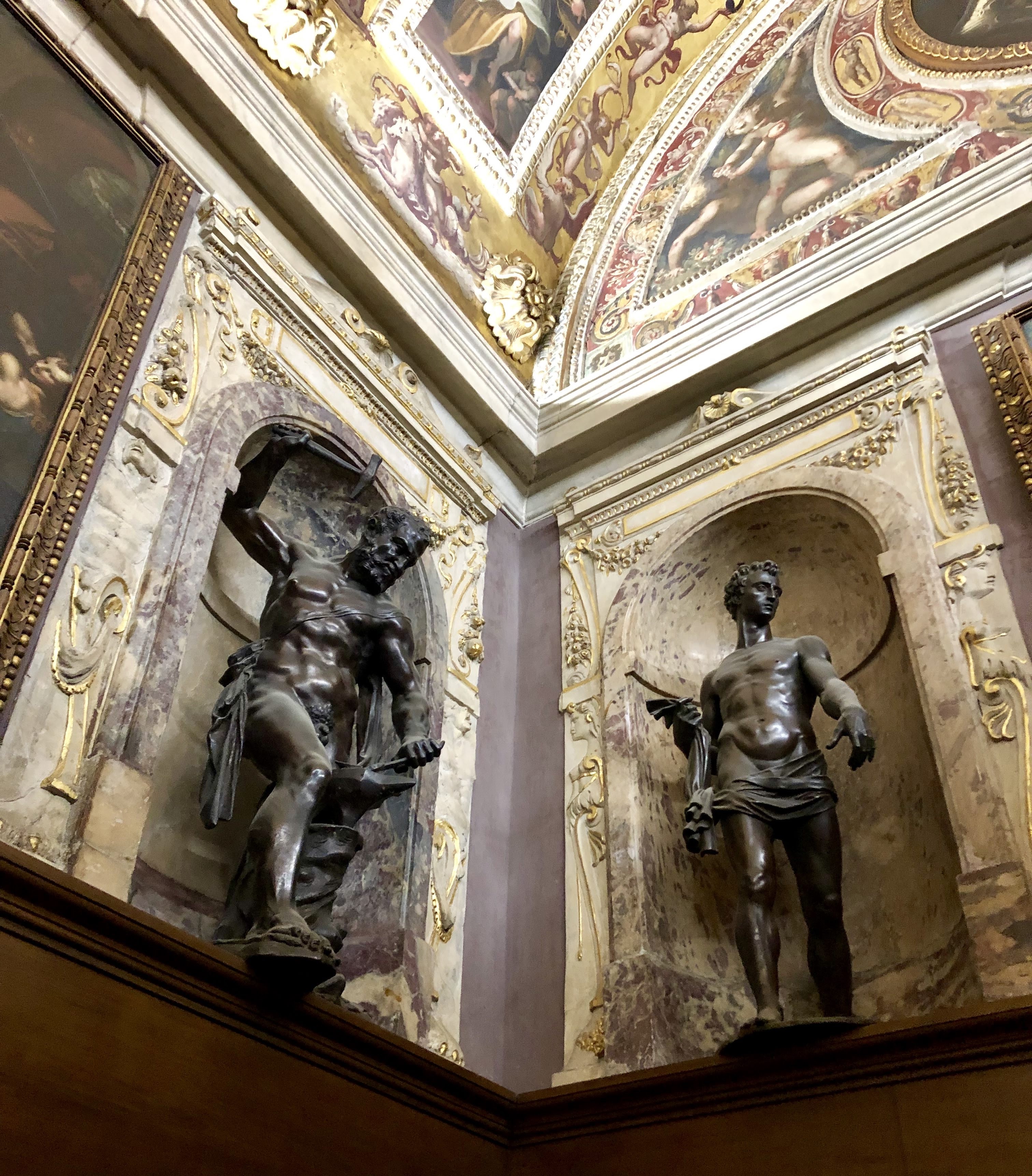
Studiolo of Francesco I
A secret study next to the Salone dei Cinquecento. Francesco I de’ Medici used a peep hole to keep an eye of proceedings.
This weather vane once adorned the roof of the Palazzo Vecchio
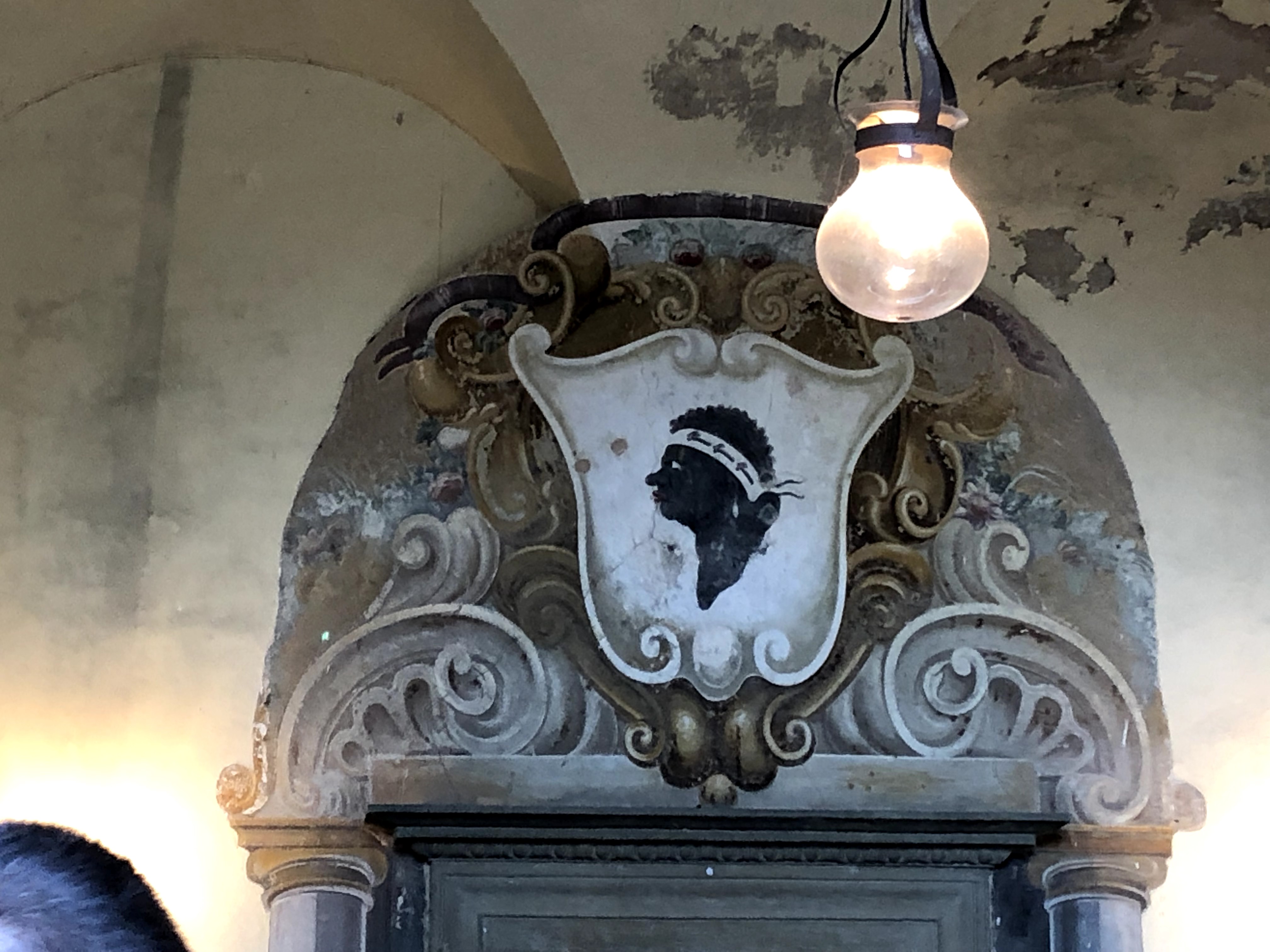
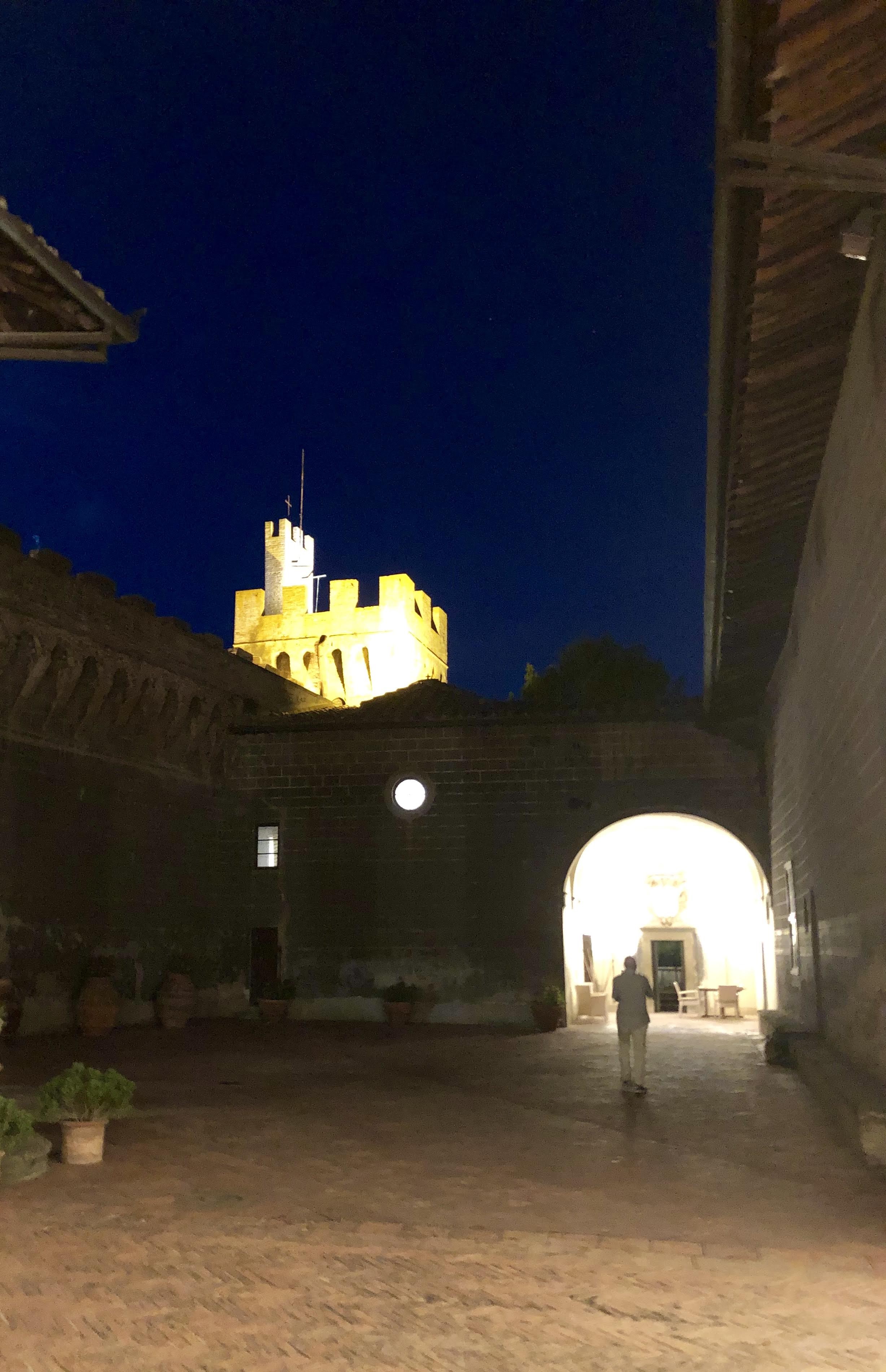
The Castello di Olivetto was built in 1424 by the Pucci family, an off and on ally of the Medici’s.During the wars with the Florentine Republic there was a battle at the castle during which all the adult members of the Pucci family were killed. A servant hid a male child in an underground tunnel. She was credited with saving the family line and her image later would grace the Pucci coat of arms as shown on the doorway above.