


N.J. State Fair/Sussex County Farm and House Show
Sussex County Fairgrounds
Augusta, N.J.


The Industrial Revolution, which most historians date back to the 18th century, had a profound and lasting effect on the way we live. It was a defining stimulant of urbanization, capitalism and consumerism.
It profoundly changed where and how we work. Artisans, craftsmen and growers became factory workers. We left the home, the yard, the garage or shed and made our living in factories, mills or office buildlngs.
 It ushered in an era of mass production of products by giant organizations. Originally that meant making goods available to a far broader segment of the world’s population at affordable prices. As the Western world moved toward a more service oriented economy, the same model was followed: massive organizations providing cookie-cutter services.
The producer/provider organizations grew their business by becoming larger yet, merging with or swallowing up competitors. And they grew their profitability by outsourcing, by automating, by using cheaper materials, less expensive labor and generally providing less for more.
There has been a simmering backlash in some quarters. Many have chosen to celebrate the local, the organic, the artisan. The purchase of food is one example, with more and more Americans choosing to buy what they can at local farmers’ markets rather than going to giant chain stores to consume the products of agri-business conglomerates. It’s why coffee drinkers search out the local roaster rather than buying a can of Maxwell House. Why some opt for a growler of local craft beer instead of a six-pack of Bud.
While it was nascent technology that fueled the early Industrial Revolution, it may well be technology that puts an end to the cultural, business and labor environment that the Industrial Revolution created. There are two trends which ultimately may have an equally profound effect on what we consume, how we work and our overall lifestyle. One is the peer-to-peer sharing economy. The other is the DIY maker movement.
Most of us are familiar with some of the early success stories of the sharing or on-demand economy. Uber instead of taxis. Airbnb instead of hotels. Zipcar instead of private car ownership. These services have been wildly successful because of the cost or poor quality or lack of convenience or availability of the products or services they are replacing. There are many others that are not as widely known, services delivered through apps for dog walkers, tutors or grocery deliveries.
Many decades ago the renowned American architect R. Buckminster Fuller, inventor of the geodesic dome, espoused the philosophy that we need to do more with less. By doing so, he believed that there were enough resources in the world for everyone. The shared economy does just that. It utilizes excess capacity, whether that is an unused car seat or bedroom or maybe it is knowledge. The world’s greatest information resource has become Wikipedia, which is put together by volunteers and has wiped out the encyclopedia industry.
Peer to peer shared services fundamentally change the nature of work. What is cut out is the massive organizational provider, replaced instead by an app. NYU professor Arun Sundararajan describes this as a “transition from institutions to communities. What it also means is that people put together work based on their available time, knowledge and resources, providing it directly to the consumer peer outside the boundaries of a full-time job as we know it.”
And while peer-to-peer sharing has the potential to revolutionize the service economy, there are other new technologies, the best known of which is 3-D printing, which could completely disrupt the world of manufacturing.

(Kaboompics_com)
There are some amazing things that have been done with 3-D printers:
Will we reach a point at which there is a 3D printer in every home? It has been suggested that these DIY home manufacturing units could create everything from car parts to hearing aids. And the Chicago example shows that even before that happens most of us may have access to DIY manufacturing through our local public library. What this offers is exactly the opposite of what came out of the Industrial Revolution. It’s local, it’s customizable and it can be done in your home or neighborhood.
Writing in the Guardian, Paul Masur, economics editor of Channel 4 News in the UK, describes this as the era of post-capitalism. (The End of Capitalism Has Begun.) “The coming wave of automation, currently stalled because our social infrastructure cannot bear the consequences, will hugely diminish the amount of work needed – not just to subsist but to provide a decent life for all.”
Some of these visions may be pretty far off, like on-demand driverless cars that eliminate the need to have one in your driveway, or home production units that create your own dental implant. But these are irreversible trends that are going to change the way we live. Maybe as radically as the Industrial Revolution did.

Stone Harbor is the southern half of the Seven Mile Island that sits between Sea Isle City and Wildwood. No more than three or four blocks at its widest, it is flanked by the ocean on one side and the intercoastal waterway on the other. In addition to the standard Jersey Shore features of beach, ocean, pizza and seafood, Stone Harbor also offers up a healthy dose of nature. There’s the Wetlands Institute, the Bird Sanctuary and Stone Harbor Point, the habitat at the very end of the island.



81st Street Surfers’ Beach


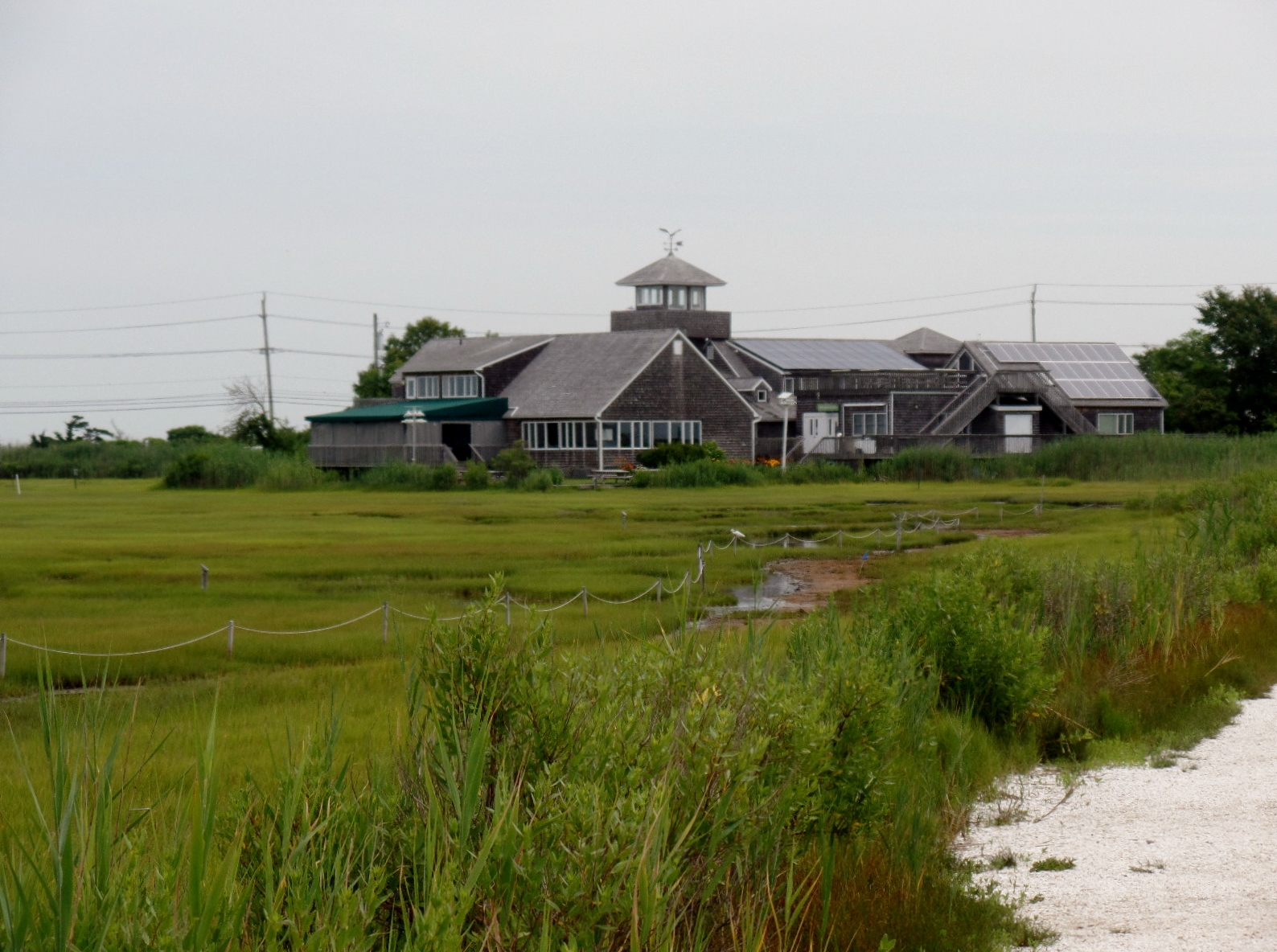
The Wetlands Institute


Robots are replacing factory workers. Automated operating systems are taking the place of customer service centers. Computers are writing news that used to be composed by journalists. And wearable devices are making diagnostic healthcare workers expendable.
It is easy to come to the conclusion that the advance of technology and the automation that comes with it will soon leave a substantial portion of world’s population without the wherewithal to make a living. But in fact, among the researchers who have studied this issue, few, if any, have found statistical evidence of this.
While there is no question that technology disrupts the job market, the question of whether it creates or destroys more jobs has no clear answer. The Pew Research Center recently posed the question to 1,896 persons who they considered experts. (AI, Robotics and the Future of Jobs). Asked whether technology will displace more jobs than it creates, 48% said yes; 52% said no.
Those supporting the more positive outlook argued that “advances in technology may displace certain types of work, but historically, they have been a net creator of jobs.”
Those who celebrate the advance of technology and its impact on the labor market also look at it from the standpoint of quality of work. Writing in the Harvard Business Review, Liviu Nedelescu, founder and CEO of Avansys Solutions discusses “Why We Should Want Robots to Take Some Jobs.” Nedelscu dismisses “the dominant dismal view that rapid technological innovation has been gobbling up jobs faster than it is creating them.”
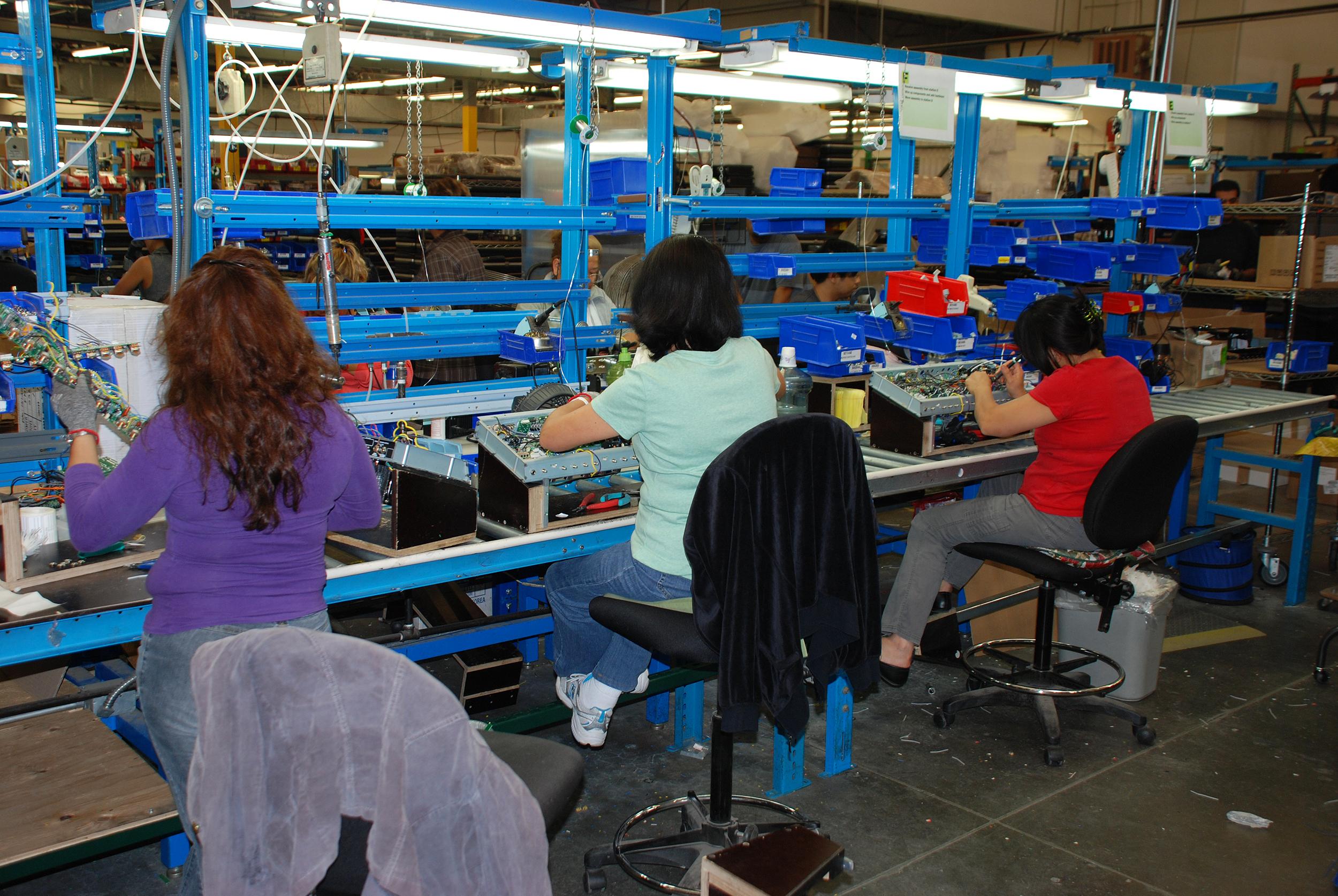
(phaewilk)
“We have for the majority of humanity’s history used humans for menial, robotic, repeatable efficiency-minded tasks,” Nedelscu notes, suggesting instead, “Humans should eventually be left to more or less exclusively deal with open-ended endeavors that generate new organic value (as opposed to efficiency derived value).”
There are also those in North America and Western Europe who see automation as a way of reversing the decades old trend of outsourcing work to those parts of the world with the least expensive labor pool, those places where workers get paid the least. They see automation as a way to bring the work back home.
These arguments are perhaps most attractive when viewed from the position of the relatively comfortable classes in the developed world. I’m not sure we can in fact create work based on “open-ended endeavors” for the millions of factory workers in Asia, fruit pickers in Central America or outsourced office workers in India.
What happens to persons who don’t have access to the education that enables them to thrive amidst the new opportunities that automation creates. Even in the U.S. there are those who don’t get the education necessary to enable them to aspire to something more than unskilled labor.

(Peter Griffin)
If one robot can replace 100 factory workers in China and 50 of these robots can be managed by one guy sitting at a laptop in the U.S., we have indeed brought jobs home, but I’m not sure what we have achieved.
(See also Coding Our Future: What Becomes of Work?)
 Wildwood







Beginning in 1811 a group of English textile workers, originally based in Nottingham, rioted and destroyed machinery in protest of the textile industry’s adaption of new technology that threatened to replace skilled artisans with low wage labor. They were called the Luddites and to this day that is a name that is used to describe folks who resist change and progress. They also ushered in an ongoing era of distrust of technology by workers.
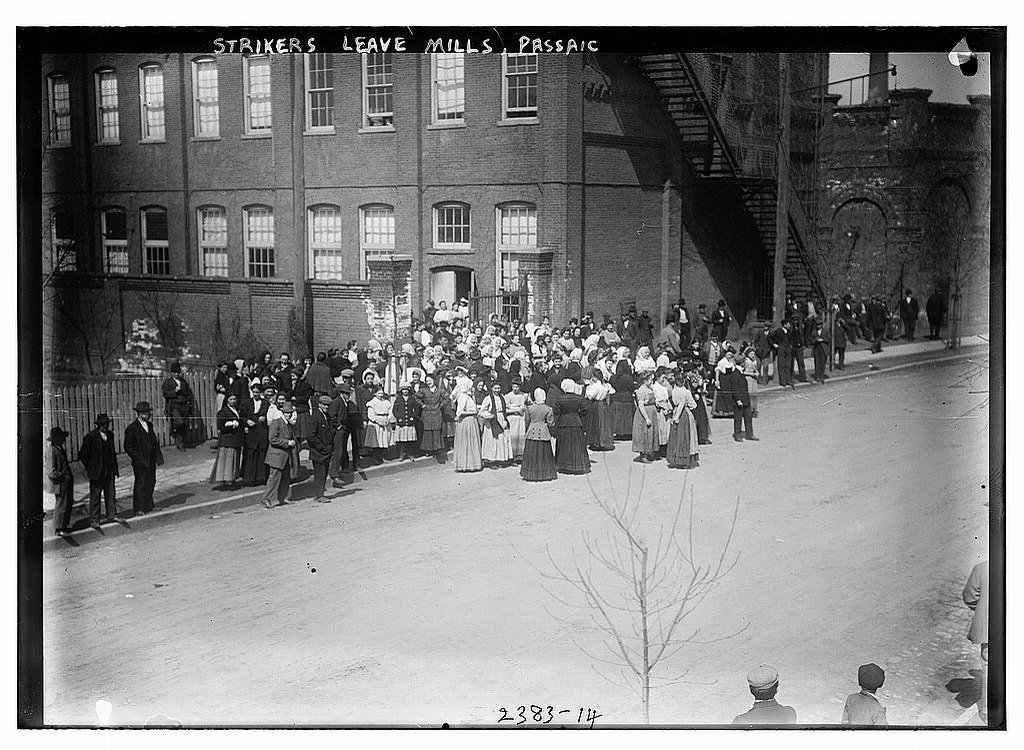 A century later the same issues in the textile industry played a large role in the development of the U.S. labor movement. In 1913, 25,000 silk workers went on strike in Paterson, N.J. Among the reasons for the strike were technological advances that improved production, reduced the labor requirement and replaced skilled with unskilled labor.
Now, another century later, and labor is equally suspicious of the growth of technology. Many foresee a march of the robots that will forever change the nature of work,
It is widely expected that most manufacturing will ultimately be done by robots. A group of authors writing in the Harvard Business Review predict that by 2020 the industrial robot population will double to 4 million (The Age of Smart, Safe, Cheap Robots is Already Here).
The drive to take manufacturing out of human hands is all about economics. Most large scale manufacturing is done by large public corporations. Large public corporations are focused on maximizing value for their shareholders. That means maximizing profitability. So vast numbers of manufacturing jobs have long since fled developed areas like North America and Western Europe. And now robots offer a solution that is even cheaper that the miniscule wages paid in places like Bangladesh or Guatemala.
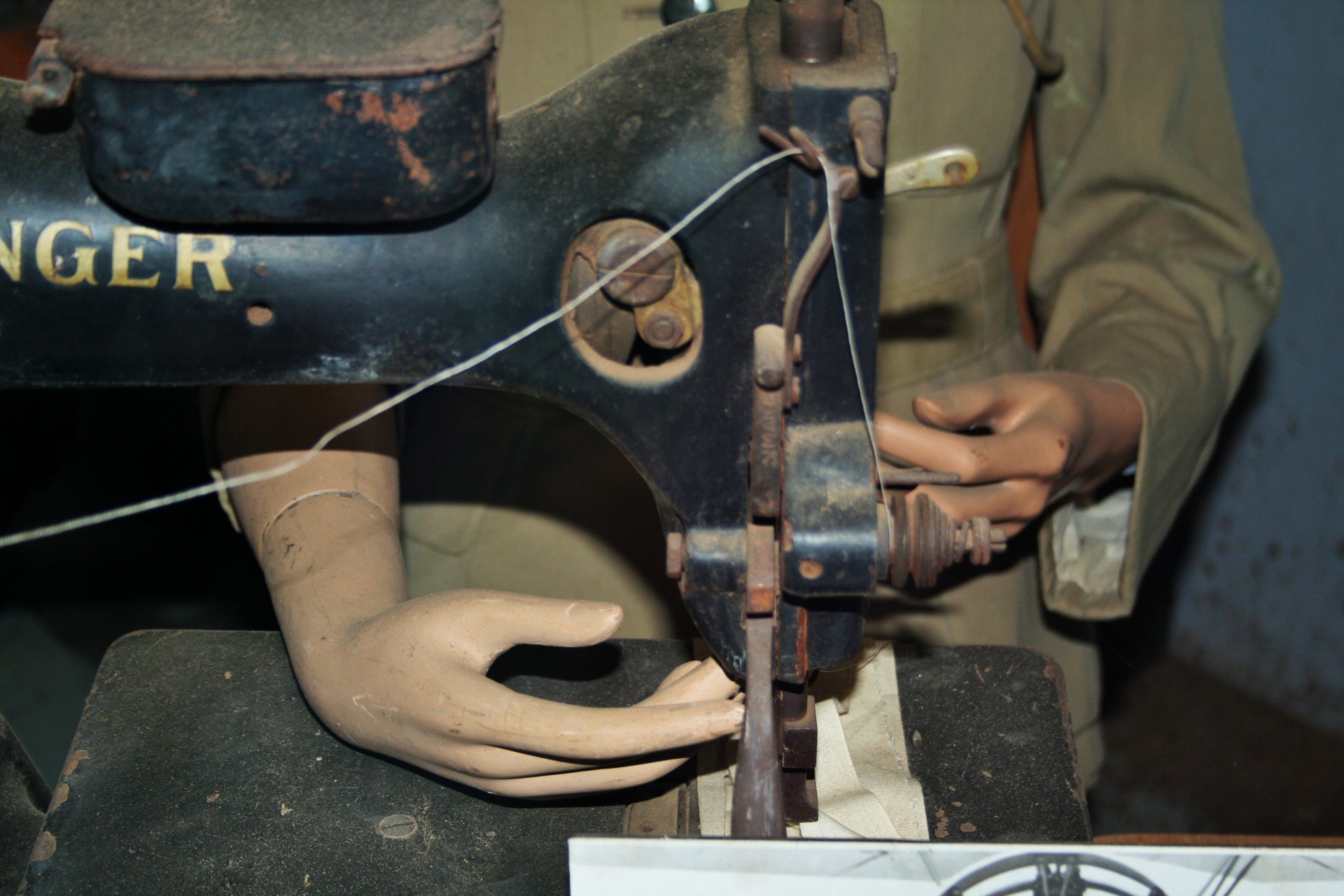
(Lynn Greyling)
Most modern electronics are manufactured in China. This is not because of skilled workmanship. The Chinese company Foxconn is one such manufacturer. It is known for two things. One is that it manufactures most Apple products. The other is the number of suicides among workers at its plants. Foxconn expects to solve that problem by automating 70% of its assembly work in the next three years.
Presumably, someone will have to be employed to build the industrial robots. And as demand increases the robot makers will no doubt outsource this work to the most desparate labor pools around the world. That is, of course, until they come up with robots to make the other robots.

(tpsdave)
The march of the robots is not limited to the factory floor. Cube farms are equally susceptible. For quite a while now we have seen how companies have sought to cut the human touch out of what should be the most human of jobs, customer service. Initially the auto-attendant would simply replace the receptionist by routing callers to the appropriate person or department. But now if you call your bank, utility, phone or cable company, you’ll find that every effort has been made to avoid having someone actually talk to you. If you make it through the maze of menu options you enter the twilight zone of being on hold while a recorded message tells you every 30 seconds how “your call is important to us.” Right.
The problem of having to talk to annoying marketers making cold calls has been replaced by the even more annoying robocall. Honestly, does anyone ever buy anything when a robot cold calls you at home or on your mobile multiple times a day? One would expect Washington to do something about this invasion of privacy, except for the fact that when election time rolls around, guess who’s hiring these robots.
The Japanese have taken robo-service a step further. The Henn na Hotel in Sasebo has empoyed robots as receptionist, concierge and porter (Robots Do Check-In and Check-Out at Cost-Cutting Japan Hotel.) Wonder if you can go the front desk and ask the “female humanoid with blinking lashes” for a toothbrush if you forgot to pack one?
On demand ride sharing apps like Uber or Lyft have been widely denounced by taxi and limo drivers for threatening their jobs. It is not clear whether these technology-based services have created and destroyed more jobs. But the endgame for the Ubers of the future will be to provide transportation in driverless cars. No more drivers, just the app.
With customer services reps, call center and help desk staffers on the way out, the robots will be casting a glance higher up the ladder. In last week’s post I mentioned a company called Narrative Science that produces robotic journalism. As if it wasn’t tough enough to find an entry-level journalist job. But many other classes of professionals may soon be casting a wary eye to a new generation of apps.
Software has long since cut into the legion of tax preparers. But thanks to a voluminous set of confusing rules in the U.S., many accountants are still gainfully employed figuring out our taxes. Surely the technology exits that would enable the IRS to calculate our taxes for us based on the information they already get from us with the taxpayer only needing to fill out a simple form with additional deductions and any non-reported income he or she chooses to report. Guess the feds would rather spend their money on spy tech.
The medical or dental check-up might become a thing of the past. A world in which wearable devices measure bodily functions is already within reach and the next logical step is for those devices to suggest remedies and perhaps even prescribe medications. I have even heard it suggested that implants can identify dental issues and smart diapers can monitor infants’ health. And do we really need multiple consultations with lawyers rather than smart apps to create wills, finalize divorces and complete real estate transactions?
Imagine the impact on the economy if there is not enough work for the hordes of doctors and lawyers our higher education system churns out. How many lab and legal assistants, collection agents and insurers lose their jobs? And what do we do with all the suburban office buildings and downtown storefront offices?
Will there be nothing left but to be a cop or a coder?
Not everyone thinks this will be a problem. Many experts believe technology creates as many jobs as it displaces and some others welcome the changes in work that the march of the robots will bring about. In next week’s post I’ll take a look at why some think we should embrace these changes (instead of acting like Luddites).









If you write algorithms, you are in the business of creating formulas that enable computers to perform tasks, in some cases tasks that otherwise would be done by humans. Initially your goal is to replicate human processes so things can be done quicker or more effortlessly, or in the case of business, less expensively. Ultimately your goal is to create technology that outperforms human beings.

(Piotr Siedlicki)
Before you scoff at that notion think of this common example. Pretty much all of us now carry navigation systems around with us. I have gotten in the habit, when I am going somewhere that I don’t know how to get to, of getting in my car, plugging the address into my phone and following the verbal directions that I play through the car radio system.
Before GPS, how did I do this? Maybe I called someone who knew how to get there and wrote down the directions they gave me. Or I could have acquired a map, looked over the alternatives, and planned the best route. In either case, the computer, in this case taking the form of my smart phone, is quicker, more up to date, easier and usually less prone to error. In a word, smarter.
Granted these are simple decisions, but the computer is making decisions for us. And the decisions are being made based upon data that is stored in the devices memory, data about maps and routes, and about things like speed limits and traffic lights, one-way streets, traffic and construction. That’s not stuff that’s stored in our human memory or that can easily be accumulated in a timely manner by an individual who just wants to find his way to the place he wants to go.
Now think about all the data that starts to be accumulated when we are wearing devices, when there are devices embedded in numerous things in our homes, sensors in stores, on utility poles and in our vehicles. Devices everywhere, accumulating data about everything.
With this army of computers and massive stockpile of data, what kinds of decisions can computers make? Already computers are being used to read scripts for Hollywood movies to determine which ones to pursue. Will our smartphone be able to tell you which of your clothes you should wear that would give you the best chance of a successful job interview?
There are even some inroads in replacing knowledge workers. Computers are already being used to write news. There are companies such as Narrative Science that have built apps that can take a company financial statement or a baseball box score and write a story. It won’t be brilliant prose, it won’t be insightful, but it will likely be factual and certainly more readable than the source data it was derived from.
This may be attractive to companies like Reuters or Dow Jones who are in the business of trying to get relevant market moving information, such as company financial results, to their Wall Street clients as fast as possible. But even that may be too late because the trading outfits who would buy this information are using algorithms to take the same data and convert it into trades, pretty much cutting out the whole layer of middlemen that includes journalists, analysts and traders.
This has interesting implications for business management. I’ve come across corporate CEO’s who are in the position they are in because they can talk the talk. But they may not nearly be as good at making the decisions they need to make to run a company. How they must welcome data-driven decision making. Of course if a business can be run on decisions made by an automated analysis of the available data, there’s lots of less expensive folks sitting in the cubes who could make the same decisions as the CEO.

(geralt)
Computer scientists are focused on how they can put together sets of data that take into consideration not just the environment, but the social setting, behavioral history and a person’s interests to make day to day life decisions. They call this “contextual computing.”
Does human intelligence then lose its value? Is this the end of the dreaded but understandable “human error?” Theoretically we all would make the same decisions when faced with the same problems and having the same set of data. Or does decision-making ability in our society begin to reflect income inequality? Those with the most money to have access to the best information gathering and processing systems on a personal level would then make the best decisions.
If all that isn’t jarring enough there are also some characters knows as neuroscientists who are working on ways to use machines to read people’s minds. That could produce another pretty interesting set of data to guide not just your decision making but your personal behavior. We’ve seen something like that before…in science fiction movies.
Throughout my career I’ve been someone who always focused on intuition, experience, and judgement based on human knowledge. I feel I may be part of a vanishing breed.
On this day in 1865 the first issue of The Nation was published. The first sentence of the first story of the first issue read; “The week has been singularly barren of enticing events.” Thus was born a magazine that valued candor above marketing savvy.
The editorial in that first issue marked its place in time. “Before this meets the eyes of our readers, the Fourth of July will have been celebrated. We celebrate not simply the national independence, but the close of the agitation about slavery, and the extinction of slavery itself.”
 In April of this year, The Nation published its 150th anniversary issue, a 268 page digest of stories that have appeared in The Nation along with a “Radical Future” section. I don’t ordinarily blog about magazines. But this is no ordinary magazine.
In a digital age, The Nation remains committed to print even if it is on the cheapest paper known to man. In an age of visuals, The Nation focuses instead on the words. And why shouldn’t they when their list of contributors has included E.L. Doctorov, John dos Passos, Alan Ginsberg, Henry James, Arthur Miller, John Steinbeck and Gore Vidal.
The Nation is not neutral. It is left-of-center advocacy journalism. In her introduction to the anniversary issue long-time editor Katrina vanden Heuvel lets you know what to expect as she describes the issues she is passionate about:
In one of the testimonials, Harry Belafonte comments. “The Nation brought to the table of human needs a menu of truth. Its stories enlighten us, give us choices for ascertaining how to deal with the complexities of daily life, and fuel our need for honesty.”
The 150th anniversary issue is not just the history of The Nation. It is also a history of our nation. And it is a history not written in the dry and dreary style of textbook writers, but by some of the finest American writers of their time, as well as newsmakers like Albert Einstein, Martin Luther King Jr. and Ralph Nader.
Here’s a taste of what The Nation has produced in its 150 years of continuous publishing:
“It has been a melancholy task to read this book (Drum-Taps); and it is a still more melancholy one to write about it. It exhibits the effort of an essentially prosaic mind to lift itself, by a prolonged muscular strain, into poetry.”
“We admire the gallantry of General Custer and his men; we mourn their loss; but who shall blame the Sioux for defending themselves, their wives and children when attacked in their own encampment and threatened with destruction? This calamity is simply a chance of war – of a war waged by our government upon these Indians, nothing more and nothing less.”
“Jazz to me is one of the inherent expressions of Negro life in America, the eternal tom-tom beating in the Negro soul – the tom-tom of revolt against weariness in the white world, a world of subway trains and work, work, work; the tom-tom of joy and laughter, and pain swallowed in a smile. We younger Negro artists who create now stand to express our dark-skinned selves without fear or shame. If white people are pleased we are glad. If they are not it doesn’t matter. We know we are beautiful.”

The Men Who Made the Nation, Howard Cook, May 6, 1963
“The migrations of the farmer have begun. We passed them on the road, all their household goods piled on wagons, one lucky family on a truck. Lucky, because they had been able to keep their truck when the mortgage was foreclosed. All they owned in the world was packed on it; the children sat on a pile of bureaus topped with mattresses, and the sides of the truck were strapped up with bed springs.”
“It is clear that Detroit today is designing automobiles for style, cost, performance and calculated obsolescence, but not for safety. Doors that fly open on impact, inadequately secured seats, the sharp-edged rearview mirror, pointed knobs on instrument panel and doors, flying glass, the overhead structure – all illustrate the lethal potential of poor design. Automobiles are so designed as to be unsafe at any speed.”
“Ever since World War II, California has been strangely plagued by wild men on motorcycles booming along the highway and stopping here and there to get drunk and raise hell. Most of the cyclists are harmless weekend types. But a few belong to what the others call ‘outlaw clubs.’ Despite everything the psychiatrists and Freudian casuists have to say about them, they are tough, mean and potentially as dangerous as packs of wild boar.”

His Master’s Voice, Victor Juhasz
“Slums with hundreds of thousands of living units are not eradicated as easily as lunch counters or buses are integrated. Jobs are harder to create than voting rolls. Negroes expect their freedom, not as subjects of benevolence but as Americans who were at Bunker Hill, who toiled to clear the forests, drain the swamps, build the roads – who fought the wars and dreamed the dreams the founders of the nation considered to be an American birthright.”
“I live six blocks from the ruins of the north tower of the World Trade Center, which is about as close as you can be to ground zero without having been silenced. My specific neighborhood was violated, mutilated. As I write these words the acrid, dark, rancid stink – it is the smell of death – of the still smoking site is in my nostrils. In an instant and without warning on a fine fall morning, the known world has been jerked aside like a mere slide in a projector, and a new world has been rammed into its place.”
“Well, sheesh. I don’t know whether to warn you that since George Dubya Bush is President the whole damn country is about to be turned into Texas (a singularly horrible fate) or if I should try to stand up for us and convince the rest of the world we’re not all that insane.”


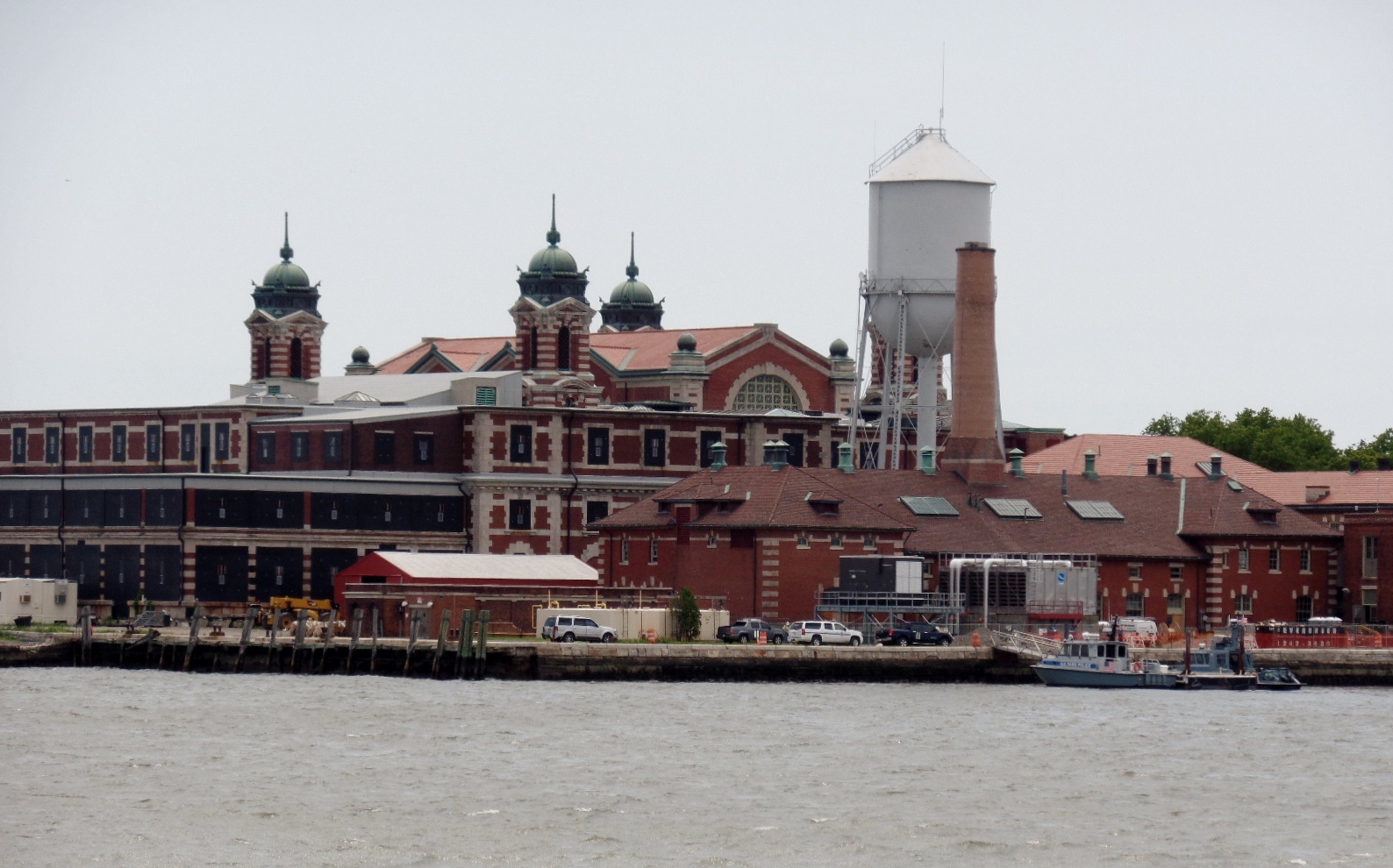
Ellis Island
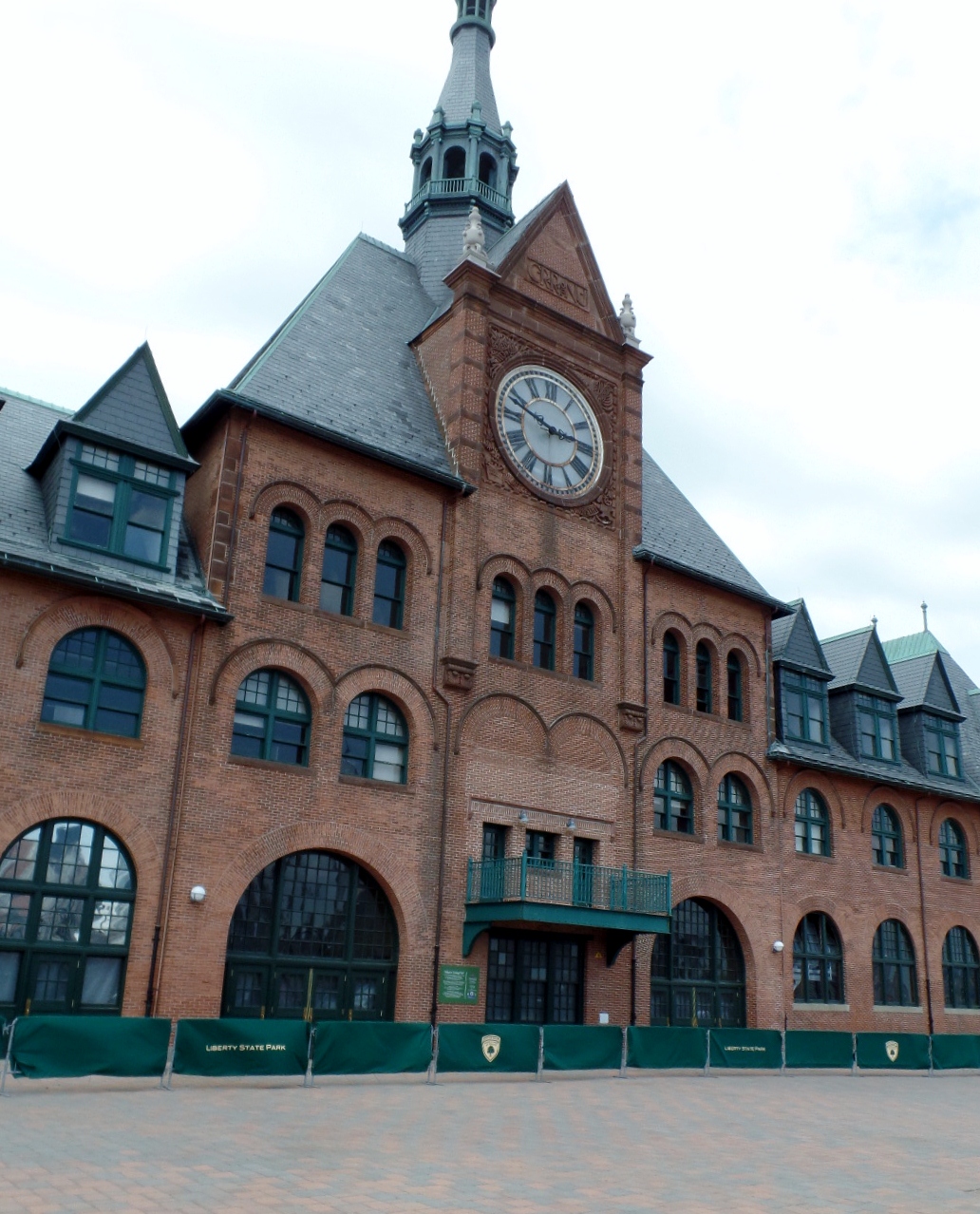
If you made it through Ellis Island, your next stop was probably the Central Railroad of New Jersey terminal

9/11 memorial

Liberty Marina


View from the Liberty House restaurant

The king of the goat habitat
 off the leash