The Industrial Revolution, which most historians date back to the 18th century, had a profound and lasting effect on the way we live. It was a defining stimulant of urbanization, capitalism and consumerism.
It profoundly changed where and how we work. Artisans, craftsmen and growers became factory workers. We left the home, the yard, the garage or shed and made our living in factories, mills or office buildlngs.
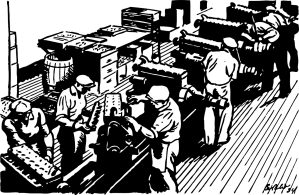 It ushered in an era of mass production of products by giant organizations. Originally that meant making goods available to a far broader segment of the world’s population at affordable prices. As the Western world moved toward a more service oriented economy, the same model was followed: massive organizations providing cookie-cutter services.
The producer/provider organizations grew their business by becoming larger yet, merging with or swallowing up competitors. And they grew their profitability by outsourcing, by automating, by using cheaper materials, less expensive labor and generally providing less for more.
There has been a simmering backlash in some quarters. Many have chosen to celebrate the local, the organic, the artisan. The purchase of food is one example, with more and more Americans choosing to buy what they can at local farmers’ markets rather than going to giant chain stores to consume the products of agri-business conglomerates. It’s why coffee drinkers search out the local roaster rather than buying a can of Maxwell House. Why some opt for a growler of local craft beer instead of a six-pack of Bud.
While it was nascent technology that fueled the early Industrial Revolution, it may well be technology that puts an end to the cultural, business and labor environment that the Industrial Revolution created. There are two trends which ultimately may have an equally profound effect on what we consume, how we work and our overall lifestyle. One is the peer-to-peer sharing economy. The other is the DIY maker movement.
Most of us are familiar with some of the early success stories of the sharing or on-demand economy. Uber instead of taxis. Airbnb instead of hotels. Zipcar instead of private car ownership. These services have been wildly successful because of the cost or poor quality or lack of convenience or availability of the products or services they are replacing. There are many others that are not as widely known, services delivered through apps for dog walkers, tutors or grocery deliveries.
Many decades ago the renowned American architect R. Buckminster Fuller, inventor of the geodesic dome, espoused the philosophy that we need to do more with less. By doing so, he believed that there were enough resources in the world for everyone. The shared economy does just that. It utilizes excess capacity, whether that is an unused car seat or bedroom or maybe it is knowledge. The world’s greatest information resource has become Wikipedia, which is put together by volunteers and has wiped out the encyclopedia industry.
Peer to peer shared services fundamentally change the nature of work. What is cut out is the massive organizational provider, replaced instead by an app. NYU professor Arun Sundararajan describes this as a “transition from institutions to communities. What it also means is that people put together work based on their available time, knowledge and resources, providing it directly to the consumer peer outside the boundaries of a full-time job as we know it.”
And while peer-to-peer sharing has the potential to revolutionize the service economy, there are other new technologies, the best known of which is 3-D printing, which could completely disrupt the world of manufacturing.

(Kaboompics_com)
There are some amazing things that have been done with 3-D printers:
Will we reach a point at which there is a 3D printer in every home? It has been suggested that these DIY home manufacturing units could create everything from car parts to hearing aids. And the Chicago example shows that even before that happens most of us may have access to DIY manufacturing through our local public library. What this offers is exactly the opposite of what came out of the Industrial Revolution. It’s local, it’s customizable and it can be done in your home or neighborhood.
Writing in the Guardian, Paul Masur, economics editor of Channel 4 News in the UK, describes this as the era of post-capitalism. (The End of Capitalism Has Begun.) “The coming wave of automation, currently stalled because our social infrastructure cannot bear the consequences, will hugely diminish the amount of work needed – not just to subsist but to provide a decent life for all.”
Some of these visions may be pretty far off, like on-demand driverless cars that eliminate the need to have one in your driveway, or home production units that create your own dental implant. But these are irreversible trends that are going to change the way we live. Maybe as radically as the Industrial Revolution did.