
The 19th century was not a great time to be a woman in America. Large portions of our nation fell under the influence of the Protestant ethic, a philosophy that valued women primarily for their ability to birth and raise children. Combine that with the stifling mores of Victorianism and you have what historians have dubbed the Cult of Domesticity.
 This of course was still a time when women couldn’t even vote, no matter how many useless dolts the men of America elected. But for at least some women discovering vacation freed them from this trap even if only temporarily.
Working at Play author Cindy S. Aron says vacations define “what people choose to do rather than what they are required to do.” By that definition who needed a vacation more than the Victorian era American woman. Aron writes, “Summer resorts encouraged more relaxed rules of conduct. Women found and helped create a resort culture freed from some traditional middle-class constraints. “

Cape May
This was apparent at the earliest American resorts, places like Saratoga Springs and Cape May. Women fished, bowled and played billiards. They swam in the same ocean the men swam in. At these more fashionable and affluent resorts flirting and courting were commonplace. Raised in a culture that expected them to be in the house some women found places where they could instead see and be seen. By the late 19th century women outnumbered men at the popular high end resorts. Some city-dwelling wives and their children would spend part of the summer in places like the mountains in New York State or the beaches of Long Island and their husbands would commute there on weekends.
As vacationing spread to a broader segment of society, women were among the participants in different types of vacations, among them camping. They climbed and fished side-by-side with men and accompanied hunting parties. Early in the 20th century, they joined in “tramping” trips, camping and traveling on foot carrying gear on their back.
Improved transportation options and an expansion of tourist accommodation, particularly in the West, sped the development of tourism in the early decades of the 20th century. See America First author Marguerite S. Shaffer notes, “The landscape of tourism offered women a venue outside of the domestic sphere in which they could re-imagine themselves as independent, self-sufficient active members of society.”
John F. Sears, author of Sacred Places, adds, “Tourism, unlike hunting or plowing, tending a flower garden or caring for children, was never gender identified. Both men and women participated in it, often together.”
The story of the growth of vacationing in America has largely been put together through the diaries, memoirs and narratives of early travelers. Authors of these recorded experiences include many women who could be considered pioneers of the American vacation experience.
Margaret Cruikshank, a 58-year old teacher from Minneapolis, was one of the early visitors to the new Yellowstone National Park in 1883. She went by train to Montana and then took a coach to the hotel at Mammoth Hot Springs. Her travel around the park was by carriage or horseback. She wrote a story about her trip titled “Earth Could Not Furnish Another Such Sight” that was later published in Montana: The Magazine of Western History. Cruikshank describes accommodations in the park as “ludicrously insufficient.” “Wherever you go there are streams to ford, corduroy to fall over, sagebrush plains to crawl along and mountains to cross,” but also “every stop reveals new wonders.” Cruikshank suggested that “the strong can stand it and enjoy it. But this is no place for the delicate.” She concluded “All who have made the tour of the park are expected to return half-dead, spent and powerless.”
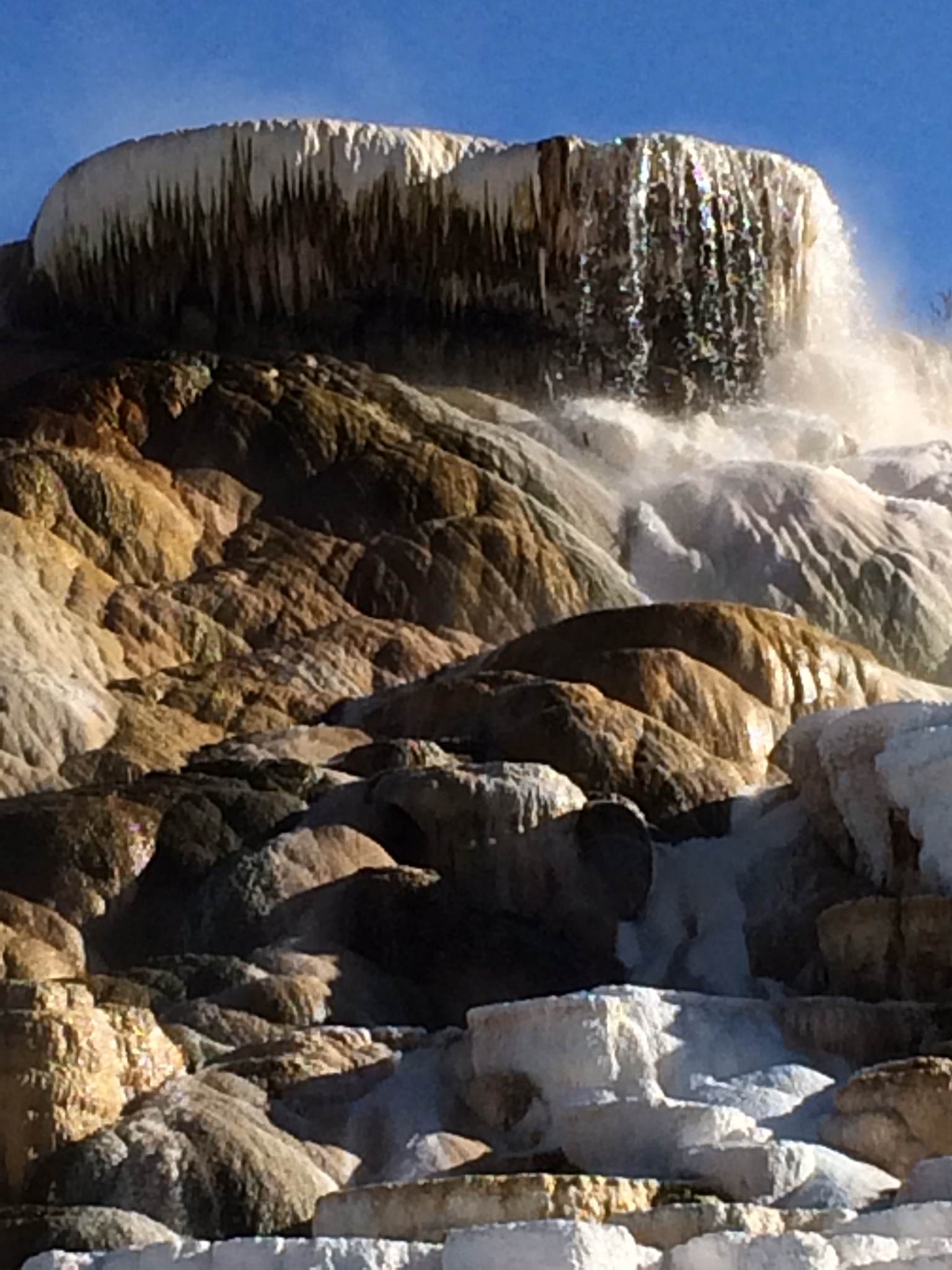
Mammoth Hot Springs
Alice Huyler Ramsey was a 22-year old housewife from Hackensack, N.J. In 1909 when she set off on her gender’s first transcontinental auto voyage. She left from New York with three other women in a Maxwell touring car and arrived in San Francisco 59 days later. During the trip she changed 11 tires, cleaned the spark plugs, and repaired a broken brake pedal. During her journey she caught bedbugs in a hotel in Wyoming, was surrounded by a Native American hunting party with bows drawn in Nevada and slept in the car when it got stuck in the mud. But she survived and in later years drove across country more than 30 times. In the year 2000 she became the first woman inducted into the Automotive Hall of Fame. In an interview with Ms. Magazine in 1975 she stated the obvious: “Good driving has nothing to do with sex.”
In 1923 Katherine Hulme set forth on a cross country trip with a female companion referred to as Tuny in her later published account of the journey. Shaffer comments that “in many respects their decision to make a transcontinental tour represented a declaration of independence.” The two logged 6,000 miles motoring from New York through Minneapolis, South Dakota, Wyoming, Montana, British Columbia, Idaho, Washington and Oregon before ending up in San Francisco. While many men gave their cars women’s names, Hulme christened her’s “Reggie.” There is a story in the book about a garage attendant who warned the two not to try to cross the Big Horn Mountains at that time of year. Hulme blew him a kiss and Tuny drove on.
(See also American Discover Vacation: Overcoming Our Heritage)

































 off the leash