Growing Up in the 50’s: Thinking in Ethnic Slurs

I often wonder what idiotic backward thinking might still be lodged in the recesses of my brain based upon what I was exposed to growing up.

My father ranked high among the most prejudiced men on the face of the earth. Virtually everyone was referred to by him as “that _____,” usually with a preceding adjective like stupid or greasy or lazy. The blank was always a derogatory ethnic slur. Who did he envision being outside the safe haven of our home and the home of our relatives? There were chinks and kikes, spics and micks, polacks, frogs and krauts. There were worse slurs but some were so obnoxious my fingers refuse to key them in.

Fortunately there was virtually no diversity in our neighborhood so he didn’t have to add slang terms for Indians or Arabs or non-Chinese Asians into our everyday vocabulary. And since neither Yugoslavia nor the Soviet Union had broken up yet, dad didn’t have to come up with another dozen or so derogatory monikers to cover all of those ethnic groups that he didn’t know existed.

017ac6835e46a4ea31241bd69e13251550f0689627I don’t believe he was worldly enough to realize that not every person who spoke Spanish as a first language came from Puerto Rico. And I suspect that he didn’t believe gays existed outside of maybe Hollywood. Liberace was the archetype in his mind. In fact about the only times he encountered people of substantially different origins was in watching TV.

The town we lived in, if it had a population of 5,000 included at least 4,000 Italian-Americans. So one ethnic slur wasn’t enough for my father, there were guineas, wops and dagos. I doubt that there was any difference in meaning between them and have no idea what bizarre factors prompted dad to use one or the other.

These derogatory missiles not only explained other peoples’ appearances but also provided a stereotypical guide to their behavior. If a business of any type was destroyed by fire, my father’s account would be about “Jewish lightning.” Once, while we were all driving home from a trampoline demonstration at the YMCA that I participated in I remember by father’s observation on the show. “Those colored boys sure can jump.” This was in reference to a black kid who got more air off the trampoline than I did, not because he was four inches taller, 30 pounds heavier and a few years older, but apparently because of the color of his skin.

Sometimes I want to excuse his attitude as being a result of time and place and his isolation. But I know that isn’t a very good excuse and that smart people overcame that. My mother was the same age and lived in the same town but I don’t ever remember her using an ethnic slur.

Fortunately this Neanderthal view of the peoples of the world never seemed to impact my father’s face to face communication with anyone. Faced with an individual whose race or ethnicity suggested a group my father held a dozen negative stereotypical views about, he would instead decide that this person was an exception and act like a decent human being.
Posted in Growing Up in the 50s | Tagged , , , | 5 Comments

The Content Quality Quest

If you have been anywhere near the neighborhood of digital publishing in the last couple years you may have heard some discussion about quality content. In fact you might have heard quite a lot about it. It has been posed as the answer to any number of questions.

For journalists, it is their raison d’etre, what separates them from PR people, marketers, bloggers and the rest of us in general. The quality of their content is based upon context, journalistic standards, objectivity and so on and so forth.

Marketers on the other hand seem to have finally come to the realization that as they have focused on placement, marketing content as they have known it for decades is primarily garbage. Having taken the next step in analytics they have discovered that the video and banner ads they have sunk their money into have been largely ineffective. So quality content, in the form of content marketing or native advertising or brand publishing, is viewed as the antidote to the failure of display.

The quality quest is also a big topic of conversation at the big tech companies. Why do you think Google tweaks its algorithms several hundred times a year? Or why does Facebook change its news feed parameters so often that it hardly looks the same from one week to the next? Do you think writing code is the way to identify quality? I don’t.

What the search robot programmers use is a statistical analysis of attributes that correlate with quality. So keywords seemed a good predictor of relevance and links a sign of authority. These types of measures however were easily gamed, then overused, so Google at some point started associating quality with sites that didn’t use too many keyword repetitions or too many links.

The dataheads and their legion of followers believe that the answer to pretty much everything lies in analyzing ”big data.” Can big data find big quality? In a word, no.

A few weeks ago I met a guy who worked for one of the big three financial news services. He is a veteran journalist who works on the commodities desk. He expressed his frustration at a new management group which was encouraging him and his colleagues to include mentions of celebrities in their headlines.

If you don’t think too much about it, that is what the data will tell you to do. Mention Justin Bieber in a headline and you get way more views than a headline about the prices of soybean futures. Is that quality? How does that play with the readers of this guy’s reports who are likely commodities traders? Data measures popularity and that’s completely different than quality.

That example also shows quality is defined by the reader. One person’s quality is another’s trash.

I wrote a blog post for Beyond PR a while ago in which I attempted to define quality content. The short answer is that good quality content at minimum must be either interesting or informative. It must educate or entertain the audience, whether that is a mass audience or a small narrowly-defined group.

Deciding whether something is interesting or informative is not something robots, algorithms or data analysis do very well.

Posted in Digital publishing | Tagged , , , | Leave a comment

Growing Up in the 50’s: The Night Two Guys Burned Down

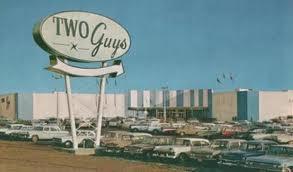
Two Guys From HarrisonWhat were the most important events of the 1950’s? Maybe the Korean War, the Soviets launching Sputnik, or the Cuban Revolution. But for me none of those events made much of an impression. I was born on the last day of 1949 so the 50’s were the first decade of my life and I may not have been at the top of my game as far as world events go.

For me one event eclipsed all others. The night Two Guys burned down. Where was I when this life-changing event took place? I was sitting in the parking lot watching.

Two Guys was short for Two Guys from Harrison, although I believe they eventually came to be headquartered in Newark. They had a few stores but for me there was only one, in Totowa. Two Guys was a department store. You could buy clothes, records, footballs, paintings, TV’s, virtually anything. This was before New Jersey had a megamall every 10 miles so a department store was pretty cool.

2 Guys matchesThe Totowa store was a long narrow one-story building. My strategy for a Two Guys visit was to enter the last entrance at the back of the store and walk the length of the store which brought me through every department. My usual stops were sporting goods and records (45’s and albums). The front of the store was mostly clothes which held little interest for me other than the occasional sports jersey.

The Two Guys parking lot was also the setting for the carnival in Totowa. The carnival was a week long affair and I spent every night of the week there along with most of the other kids in Totowa who were old enough to go out alone at night (in the 50’s that meant being 8 or 9).

Sadly, my mom worked nights in the Two Guys cafeteria as a cashier for a little while. I say sadly because she was grossly underemployed and proved it later in life when she became the owner of a successful insurance agency business. But she also was limited by the cultural norms of the times, mothers stayed home with their children and fathers were the primary bread winners. The fact that my mother worked at all was something of an insult to dad’s masculinity.

I don’t know how we found out about the Two Guys fire. There was no Internet and no cable TV. It certainly wasn’t on one of the five or six New York TV stations that we pulled in with our rooftop antenna and we hardly ever listened to radio. Perhaps my grandparents, who entertained themselves by listening to a police radio, heard about it and called.

However we found out, as soon as my father got the word he sprung into action. Within minutes we were all in the car, me in pajamas, and headed for a prime spot in the Two Guys parking lot to watch the fire.

Two Guys burned to the ground. It was eventually rebuilt and remained a favorite shopping spot in Passaic County for another 10 or 20 years.

-0-

Some other “Growing Up in the 50’s” posts:

The Corner Store

Christmas Time in Paterson

Thinking in Ethnic Slurs

A Decade of DIY

Tricky Dick on Main Street

Bomb Scare!

The Shop

Baseball

Posted in Growing Up in the 50s | Tagged , | 19 Comments

Three Phases of Online Media — ISOJ 2014

Jim Bankoff, chairman and CEO of Vox Media, described the three phases of online media at his keynote presentation today at the International Symposium on Online Media in Austin.

The first phase is porting to the web. This is probably 15 years ago and involved publishers taking what they did in print and reproducing it online. Mostly this was an experiment that no one expected to make much revenue from.

Phase 2 is what Bankoff describes as the “race to the bottom.” This was driven by engineers who focused on how things could be done more cheaply and directed by intelligence gained from data. It was characterized by SEO farms and content farms.

Phase 3 is “race to the top” according to Bankoff. The goal in phase 3 is to create quality at scale. He described the keys to producing great quality as great talent, great stories and making it look good.

The International Symposium on Online Media is taking place at UT Austin today and tomorrow. It is sponsored by the Knight Center for Journalism in the Americas at University of Texas.

Posted in Digital publishing | Tagged , , , , | Leave a comment

Men and Women of the South (Mostly Men)

Fall Line The Calling

One of my favorite authors who is also a personal friend is Joe Samuel Starnes. Sam has published two novels, Calling and Fall Line. What is distinctive about his writing is the depth of the characters he creates. They are, from the most part, archetypal rural and small-town Southerners brought to life through Sam’s storytelling.

The stage for Calling is a cross-country bus. The passengers include a down-on-his-luck radio DJ and a small town preacher turned bad, very, very bad. In Fall Line we meet a stubborn old woman living in the woods who isn’t prepared to go anywhere, even though her turf will soon be a lake. And what Southern tale would be complete without the glad-handing good ole boy crooked-as-they-come politician. You even get some perspective from an old country dog.

Sam’s been living in the Northeast for a couple of decades now but he’s a Georgia boy at heart and that is clear in his writing. These are good stories and I’d recommend them even if Sam wasn’t my friend.

You can find out more about Sam and his writing here or watch a trailer for Fall Line.

Posted in Book reviews | Tagged , , , | 1 Comment

Growing Up in the 50’s: Religion

Totowa United Methodist Church

Totowa United Methodist Church

The 50’s are a decade that was all about conformity. And conformity is all about appearances. Nothing symbolized that better that my family’s attitude toward and participation in religion.

We were a devout, Christian, church member, believer sort of family. Except for one thing. Nobody ever went to church. There was no praying or other rituals in our house and we had none of the accoutrements like a Virgin Mary birdbath or mantelpiece manger.

I remember when I was very young, probably pre-school, we would go to a sunrise service on Garrett Mountain in Paterson on Easter Sunday. That’s sounds pretty cool, though primarily as a photo op. There may also have been some family churchgoing very early on in the decade on Christmas and Palm Sunday as well.

Other than that church attending was limited to me being sent off to Sunday School once a week. The one-hour Sunday session didn’t seen too bad compared to what many of my Catholic friends were being put through. But I recall very little of what we were taught. We did go over Martin Luther, even though we were Methodists not Lutherans, and I think John Wesley was brought up as well, even though we were not Wesleyans. (Apparently there was no one named Method among the founding fathers of Protestantism.) In other words the lessons were about how the Christian church was broken up into different sects by the various individuals who took issue with how it was being managed.

My only other church-going memory was going to an Episcopalian church with a friend’s family after a Saturday night sleepover at his house. At some point in the service they kneeled. I didn’t have a clue what was going on. My first thought was that Episcopalians were a lot shorter than Methodists. I sat on the edge of the pew and arched my back so I was roughly at the same level as everyone else.

(While writing this post I searched Yahoo! for Episcopalian to check my spelling and I got a spam email inviting me to meet Episcopalian singles online. Brilliant marketing!)

The Sunday school gig culminated with a graduation of sort. A confirmation, which I believe is some sort of coming of age, become a church member type of event. I stood up in front of the church with a bunch of other kids, went through most of the ceremony, then fainted, fell to the floor and passed out cold. It is the only time in my life I have ever fainted.

From there my presence in a church, temple or other house of worship has been limited to family gathering occasions like weddings, funerals or bar mitzvahs.

Posted in Growing Up in the 50s | Tagged , , , | 2 Comments

Opening Day Citi Field

01df429a43c0de98a608e8cb49e98cd152f51c44cf011ac3b215457a4bb2a5c60b75a86806fbd7ed9099 Opening Day City Field016dbb151990ed8b93d9d3593102c45cbb742cc1da01e045c57bbaede140661be94b8b95b59c0ca9580d

Posted in Baseball, Sports | Tagged , , , | Leave a comment

Vote for the Ugliest Pirate Giveaway T-Shirt

I attend a fair amount of sporting events. Thus from time to time I am handed a t-shirt as I walk through the turnstile. This year I got two especially ugly ones. Both came from teams that use the name Pirates. Which one’s worse? You decide.

Entry #1 — Pittsburgh Pirates “AJ Gangsta”

01d41296aaa6404791d24c4e79d69fc2c0cb8f3690 013710fe010689073b26f72fb9d8438c8915e5f0f4

First of all let me say that if you’re going to a baseball game you can’t do much better than Pittsburgh. TripAdvisor rated PNC Park #1. The stadium is in a beautiful setting and there is a great atmosphere both inside and ouside the ballpark. And the Pirates now have an exciting team to watch. But what were they thinking when they made this t-shirt? At first I thought it was Vanilla Ice on the front. But that’s the Pirates 2013 ace pitcher AJ Burnett. Of course after about 20,000 of these babies were circulated AJ had to leave town and is now a member of the Philadelphia Phillies.

2.  Seton Hall Pirates “Fear the Beard”

014f0a08e38a7e627f2b182e6955599a02f2a442c3

These have not been the best of times for Seton Hall University basketball. The team usually squeezes out a record that is close to 500 but that is only because of the cakecake infused early season schedule. What makes matters worse for these Pirates is that they play in a major league facility, the Prudential Center in Newark. If you play in an arena like that in the Northeast your attendence goes up and down with your won-loss record and beating Pitchfork State in November doesn’t count. So how do you boost attendence until such time as they put together a good basketball team. Time to turn to marketing. So one snowy night in January, as the next-to-last place team in the Big East, Seton Hall, was hosting the last place team, Butler, the marketers held a promotion to brand the SHU student section. In honor of this new branding, the Bluebeard Army (since they’re marketers they probably spelled it with two capital B’s), we were all given pathetic looking styrofoam blue beards and one of these t-shirts was draped across the back of each seat. Since only about a third of the arena was full, as you can imagine, some folks went home with armfuls of these prizes.

I got one other giveway t-shirt in the past year. It was from the Red Bulls, but since it was a nice quality adidas t-shirt with a decent design it doesn’t belong in this competition.

Posted in Sports | Tagged , , , , | Leave a comment

Growing Up in the 50’s: A Decade of DIY

Amateur plumber

A few years ago I read Shop Class as Soulcraft, by Mathew B. Crawford. The premise of the book is that modern man experiences a level of alienation because he is disconnected from his environment. He doesn’t know how anything is made, how it works or how it can be fixed.

Reading the book made me realize that I have a virtual army of outsourced help in my day-to-day existence. I have a plumber and another guy who fixes my appliances. A landscaper and a specialist who drains my lawn sprinkler system in the fall. I’ve got an electrician, although I tend to try a different one every time I need help, and a handyman who repairs and resurfaces all kinds of stuff. I’ve got a guy who comes and takes my dog on hikes in the woods three times a week and a woman who cleans our house. There’s the guy who cleans my chimney and one of these days I’ll get around to finding someone who cleans the rugs. I bring my cars to a mechanic and my screen door to the screen guy every time my dog puts his head through it trying to get at the mailman.

That wasn’t the case when I was growing up. My dad did everything. (Except the house cleaning which my mom did in an immaculate fashion.) My dad fixed all the plumbing and the electrical issues. He changed the oil, sparkplugs, and antifreeze in the cars. He even built a dormer on our house and finished off two new bedrooms and a bathroom.

Usually when someone recalls this DIY decade of the 50’s, it is accompanied by some funny stories about less than intended results. I remember having dinner at a girlfriend’s house and having her explain to me that the light in the dining room was waxing and waning because her father and grandfather did the wiring.

That was not the case with my dad’s work. He was something of a perfectionist and the stuff he fixed worked, the stuff he built needed no fix.

So DIY blunders had to wait for another generation. Here are some of the highlights of my efforts, which go a long way toward explaining the reason for the aforementioned army of outsourced help.

  • I was about 50/50 on oil changes. I never actually incapacitated any of my cars but I often had to abandon plans to change the filter and our driveways were invariably slicker after I did an oil change.
  • I once set out to repair a salvaged washing machine given to me by Pete the laundromat guy who you may remember from an earlier blog post. I ended up in a laundromat a time or two myself while the parts to the machine were strewn about my kitchen for about a month before I discovered a problem with the timer and got it working again.

    Where the leak?

    Where’s the leak?

  • Plumbing being my forte I also changed the faucet in the kitchen. The cabinet under the sink was never completely dry again. I brought my father over to take a look at why it was dripping and he put my mind at ease by commenting, “Don’t worry about it. There’s so much shit in the water these days that will plug up in no time.”
  • Buoyed by that encouragement I set out on another venture to change the faucet handles on my bathtub. That produced a series of escalations that resulted in no hot water in the entire house. At that point I did cry “Uncle!” and call the plumber.
  • On the electrical front I changed out the ancient ceiling light fixture when we moved into our Jersey City condo and replaced with a modern, utilitarian Ikea unit. All seemed well until I noticed sparks flying out at Melissa as she was painting the wall.

So my childhood had instilled in me some of the 50’s ethos of building and fixing your own stuff but sadly I grew up somewhat short of the knowledge and patience required to really make it work.


Posted in Growing Up in the 50s | Tagged , , , | 3 Comments

How Greed Stunts the Growth of Our Economy

trcikle down

We are all pretty familiar with the causes of the 2008 recession. In a word, it was greed, as evidenced by America’s bankers and brokers. What we saw from Wall Street was a willingness to do what they knew was wrong in order to enrich themselves.

How well have we recovered from that? Have the Americans who were most severely impacted by the recession been made whole? Has unemployment improved? Have wages kept pace with cost of living? Corporate earnings have shown some modest growth and the stock market has appeared to be reasonably healthy. Has it trickled down? At best an occasional slow drip.

There is an air of stagnation about the economy for most Americans and it is because of a level of greed that may be a little less obvious than that demonstrated by the pirates of Wall Street in 2008. But the theme is the same, make as much as you can as fast as you can and don’t worry about what that means for the future.

So analysts who follow companies focus primarily on profitability and evaluate public companies through that lens. Those companies in turn focus on short-term profit. Growing a company requires innovation, development, building customer loyalty and a strong reputation. None of those things happen in a matter of weeks. So if you want to improve your bottom line now, what do you do? You can raise prices and you can cut costs. Neither is going to make your business any better and may in fact hurt you in the future but if it’s short term profitability you are after it works.

I recently saw some news about the retailer Macy’s that demonstrates this approach. Macy’s reported 2013 sales growth and improved profitability and as they announced that they also announced they were laying off 2,500 employees. Screw you Macy’s employees. Screw you Macy’s customers, who can now expect an even lower quality of service than has been the norm at these stores. The stock price? It has risen smartly.

But the greed is not confined to investment bankers. Take a look as well at the C-Suite of many medium and large corporations. We would like to think of the average CEO as someone who is committed to and passionate about the business he or she manages. Someone who is concerned about the long term health of the business, its customers and its employees.

But in all too many instances that is not the case. It is no longer fashionable among the executive set to grow with the business that they manage and commit to its success on a long-term basis. Instead what we often have is the totally self-absorbed CEO interested not in growing the business but in growing his or her own personal brand. Their goal is to appear to achieve enough success to enable them to move on to bigger and better things.
So what are the implications of this for businesses that are managed by people of this ilk:

 — Decisions are made only on a short-term basis because the executive doesn’t expect to be around long-term. So this month’s results are far more important and thus if there are decisions to be made which would benefit a business long-term but which require an investment that reduces short terms results, those investments are never made.
 — Quality is neither a concern nor necessarily even a goal. It is in fact the goal of these individuals to produce what is “just good enough” to sell because their appearance of success depends on running a profitable business and every effort to cut corners is made to achieve that immediate profitability even if it may mean loss of customer satisfaction or loyalty.
 — The same lack of concern for quality impacts the status of companies as employers. Again the goal is to get just the minimum that is necessary with the smallest amount of spend. That is why so many employees of large corporations don’t make a salary on which they can support themselves or their families no matter how hard they work.
 — Employee development is of little concern because the “what’s best for me now” philosophy has no room for building a future. The CEO doesn’t expect to stay more than 2-3 years and any employee who does is considered a loser. Far easier to hire from outside than to train and mentor over a period of time. This erodes employee morale throughout an organization.

So the overall impact on the economy is that we may see a growth in revenues, a growth in stock prices and at least the appearance of short-term success. But the overall economy does not benefit because, jobs are not created, wages are depressed and the overall productivity of the country suffers from a lack of quality. This in turn places a limit on these very same corporations because their customers don’t have the means to maintain or expand their spending.

I don’t really have any suggestions as to how to change the attitude of America’s corporate leaders. Their greed is usually accompanied by a sense of entitlement that insulates them from things like basic ethics. I do know that it is mostly in small business where you find managers who are committed to the long term survival and growth of their business because their business is their livelihood. Thus they care about the quality of what they produce or sell, they care about their customers and their reputation and they value the employees who help them achieve their goals. I personally try to make my buying decisions with that in mind.

Posted in Uncategorized | Tagged , , , | Leave a comment