Upholding the Constitution With a Sense of Humor

My Tour of Jury Duty in Newark

I arrived 15 minutes ahead of my 8:15 appointed time and first went through the X-ray scanner. They just need to make sure no one is packing heat as they enter the Essex County Courthouse. Personally, I was more concerned by the guy in front of me eyeballing my iPhone than I was about getting shot.

I checked in and got my parking ticket stamped, because no one pays to park for jury duty, and then had a seat. I was surprised to see on the video screen that there was what in effect was a customer satisfaction survey you could fill out because it said they wanted to know how they could make jury service better (more on that later).

The real action didn’t start until 9. It started with a video about CASA (Court Appointed Special Advocates). It was a pretty effective video that had interviews with children who were abandoned by their parents and shuffled around in foster care until a CASA volunteer helped them get adopted into a stable home. Then a woman from Essex County CASA made a pitch and handed out pamphlets.
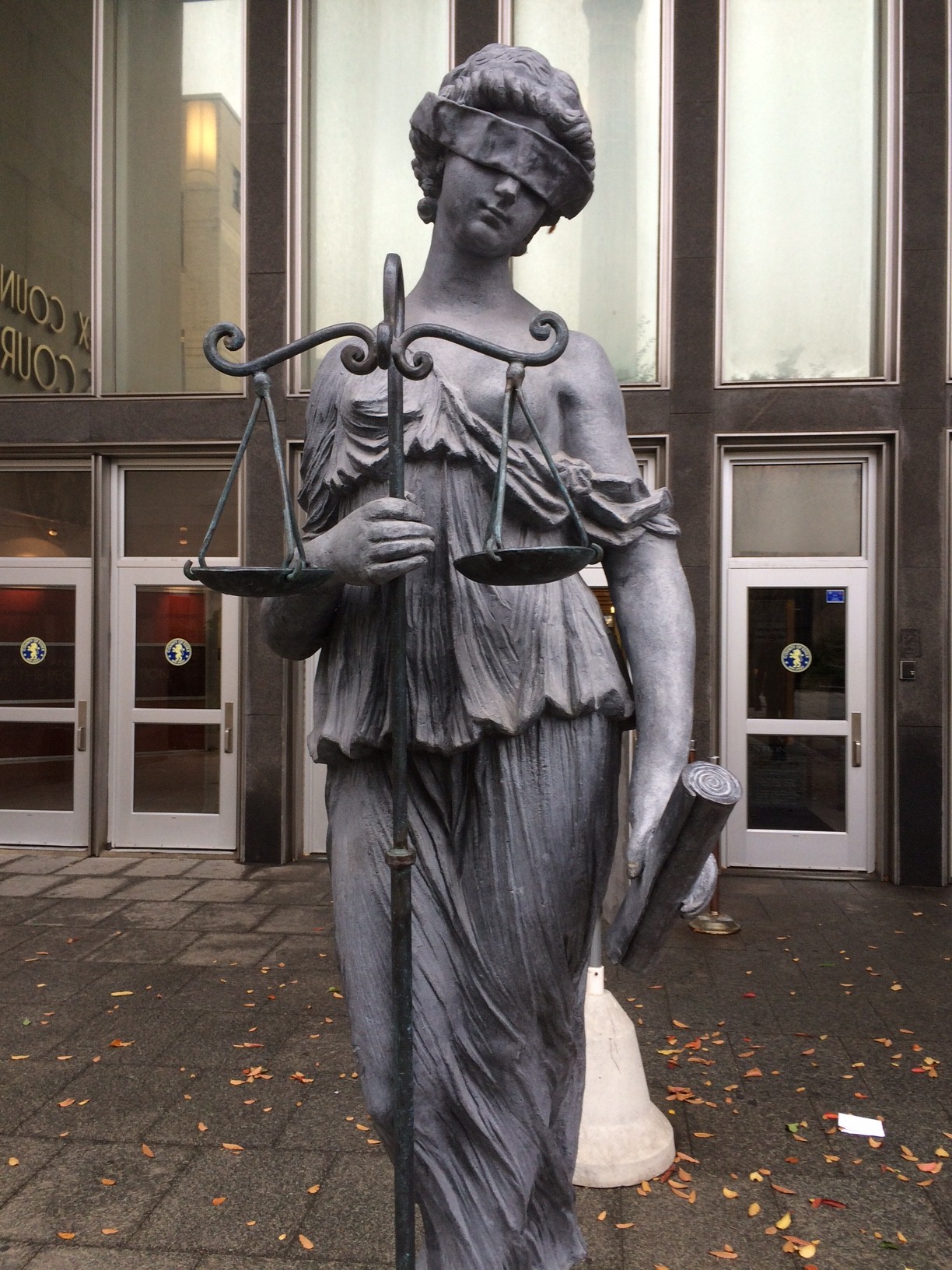
Blind JusticeThat was followed at about 9:20 by the juror orientation video. That one started with a judge telling us how fortunate we were to live in a society that has jury trials. The morale of that story was of course that we should see jury duty as a privilege and honor rather than an inconvenience. After that we got some jury trial 101 explaining what words like plaintiff, defendant and prosecutor meant. There was some slightly more advanced stuff like an explanation of the jury selection process. (Don’t take it personally if one of the attorneys doesn’t want you on the jury even though you didn’t say anything stupid that made you seem unacceptable.)

Then we got a live orientation by an energetic dude with a sense of humor. He set forth some of the more practical issues, such as, sit in Room A to watch HGTV, Room B to watch ESPN or Room C for CNN. Lunch was from 12 to 1:30. One thing you can always count on in the courthouse is a robust lunch ‘hour.’ He also noted that you shouldn’t ask for an advance on your five bucks to buy lunch. (The per diem rate for jurors in New Jersey is $5.) He also encouraged us to fill out the survey questionnaire and promised to read them all before he left work that night. That’s customer service you can’t get in the private sector.

We all then stood up, raised our right hand, and took an oath to uphold the Constitution. And by god, that is exactly what I intended to do, although I admit to being a little sketchy about the right to bear arms bit. Seems to me there were probably some trials going on in that very courthouse involving some folks who were in deep shit for bearing arms.

By then it was 10 a.m. and after all of that activity we sat down to take a break. By 10:30 they started calling names to go up to a courtroom. The second group was at 10:40, they called more at 10:55 and at 11.  And then at 11:10, my name was called. Being on the list at this point was a mixed blessing. On the one hand you held out the hope that after calling three or four jury groups, they would say, well that’s it folks thanks for coming but we won’t be needing you. On the other hand I was thinking that the highlight of my day was going to be heading down into Newark where there were some excellent lunch options. And while 90 minutes seems a good amount of time for lunch for non-judicial workers, once you get up into a courtroom they don’t like to cut it that tight.

It took until 11:30 to get the 90 or 100 people who were called to this courtroom upstairs and in place. It was a criminal trial and the judge went over some of the details. Hours would be 8:30 to 5. He mentioned that in his 16 years on the bench no one ever stayed past 5. Good news for jurors but I’m sure a lot of people in the room were thinking “when’s the last time I got out of work at 5?”

Then he said the trial would last 7 days and described a schedule that would take it to Nov. 6. Bear in mind that it was Oct. 22. Try to do the math. Start with Oct. 22 and count out 7 days. Try it not counting weekends and Fridays. Try it not counting weekends, Fridays and Mondays. It still doesn’t stretch to Nov. 6. I suspect there probably aren’t any judges who follow my blog, but if you are a judge reading this can you explain to me why you guys can’t work at least a four-day week. Even a three-day week?

So since I had a trip planned and paid for in early November, when the judge asked anyone who couldn’t serve on this case or anyone who just didn’t want to serve on this case to stand, I got up, told him my name, and left along with at least half the other people in the room.  Just in time for lunch and my trip down Market Street into downtown Newark.

In the back of my mind was the fact that the Cuban at Dinosaur Barbeque was perhaps the best sandwich I had ever had, but I decided instead to try Hobby’s deli, an old-school Jewish deli that somehow has managed to survive for decades in downtown Newark. I was richly rewarded with a cup of mushroom barley soup and a classic corned beef sandwich. Adding to the ambiance was a wall full of framed Devils jerseys and big “Henrique! It’s Over!” photo. (If you’re a Devils fan or a Rangers fan you know what “Henrique! It’s Over!” is.)

So then it was back to the jury assembly room, after taking a couple pictures for this blog post.

I would like to tell you what happened that afternoon, but in fact nothing happened. So I’ll interrupt this chronological narrative to talk about the Essex County Courthouse. I’ve also done jury duty in Paterson and Jersey City and I can tell you that the Newark courthouse is the Taj Mahal of North Jersey judicial buildings. It is a new, modern complex with a spacious garage, walkways between buildings so you don’t have to go outside in bad weather and lots of elevators that work. The jury assembly room has good wifi, state of the art audio visual gear, a computer lounge and a coffee lounge with free tea and coffee all morning. You don’t often hear about things being nicer in Newark but for jury duty that is in fact the case.Essex County Courthouse

After a full afternoon of non-activity, at 3:25 they called a large group of names to the front desk. They were then given some good news and some bad news. They were dismissed for the day, but they needed to be back the next day at 9:30. Based on the grumbling as they left, the bad news seemed to override the good for this group. The people who run the jury room are pretty nice folks so they waited until this group cleared out so as not to hurt their feelings when they advised the rest of us that we were done. Done for the day, done for this term of service. We high-tailed it out of there with smiles on our faces, overlooking for the moment the thought of being fortunate to live in a society with jury trials.

Posted in Uncategorized | Tagged , , , , | 2 Comments

When Big Data Comes Up Small

When you pretend the subjective is objective.

The first time I detected a slightly fishy smell in how data was used came from hanging around human resources. At some point the old fashioned employee evaluation which involved having the boss sit down with the employee and discuss his or her performance was replaced by online forms that you fill out staring at your screen rather than your employee.

These software apps produce an evaluation that is numerical. So subjective evaluations of things like leadership or teamwork, attitude or aptitude, are converted into numbers on a form. That way calculations can be made comparing employees in departments or industries, they can be used to determine promotions, firing or raises and they can be used within an organization to stack rank employees. If your goal is to destroy the morale of your staff, no tool is more effective than stack ranking.

I’ve been involved in dozens, if not hundreds of these evaluations. For example I have had three different bosses evaluate my ability to communicate by plugging a 1-5 number in a form. The results from the three were wildly different. Do you think that is because my ability to communicate went up and down like a roller coaster? Or did the form tell you more about the evaluator than the evaluated? If you do this on a companywide basis and have dozens of different evaluators tryng to interpret behavior with statistics, what are you likely to find out? Perhaps that the software company that sold you that HR system took you for a ride.

If you want to let your imagination loose on what this could eventually look like read Dave Eggers novel The Circle. In his story, the Circle is a massive technology company that evaluates its employees in real time on a scale of 1-100. If you think that is a good idea, this post is for you.

When the system in gamed.

There seems to be no more straightforward use of online data than to gauge the popularity and effectiveness of content, whether it is a news story, advertisement or Web page. By looking at what gets the most views you’ll find out what was most widely read. That is, unless you only want to consider views by human beings.

You can buy views for just about anything, online articles, ads, video. This is something that publishers have been found to do. They buy thousands of views which make it appear they have more reach than they really have and then charge advertisers accordingly. What do advertisers get for their high rate? They get pinged thousands of times by robots.

Using crowdsourcing to produce numerical ratings for anything from restaurants to businesses to books again appears to be a pretty attractive application of data. Until you find out there are people in places like the Philippines getting paid a buck a shot to hype certain entities and trash others. Yelp at one time estimated that up to 25% of its reviews were fake (Digital Deception: Astroturfers).

Another application of big data that caught on quickly is using data to identify online influence. This is done through a calculation of followers, connections, like, retweets, comments, etc. I’m not certain that actually tells you how influential someone is but I can say with some certainty that if you’ve bought those followers and likes, and the Internet is full of offers to do just that, it really has nothing to do with influence.

The gold standard of online influencer ratings is Klout. As I mentioned in an earlier post (Digital Deception: The Illusion of Influence), my Klout score will go down if I’m travelling for a couple weeks and ignore my social media accounts. But if I catch my dog in a cute pose, post it on Facebook, and get a few dozen likes, my Klout score goes up. Neither of these things have anything to do with whether or not I am influential.

When you need a little context

The one application of big data that most of us have experienced is the recommendation engine. Most commonly this is used on ecommerce sites. If you bought this, you might want this. Just like being prompted to get fries with your burger.

Amazon is well known for this. If I look at my Amazon account history, I’ll find purchases of books about architecture. There will be books intended for young readers that are fantasy fiction. There will be fashion-oriented coffee table books. And when I look at what Amazon recommends to me, there is nothing that I find of any interest. That’s because the missing piece of information here, the piece that big data is powerless to identify, is the fact that all of the above purchases were gifts for different people. The absence of context makes the recommendation engine fail. Except that maybe it reminds me that since I bought my sister a book for Christmas last year I should get something different this year. Not what Amazon is going for.

Another example of a data-driven recommendation engine that is being used by publishers and Web-site operators is to recommend content that is supposedly of interest to persons reading what is on the currently viewed page. Outbrain is one of the leading providers of this type of recommendation service. They are used by CNN. I went to CNN and took a look at this story about the U.S. trying to combat the Islamic State. And then I looked at what stories Outbrain recommended at the bottom of the page. They included “Celebrities Who Have Turned Heads With Their Sense of Style” and “How Much House Can You Afford.” Are you kidding me? Likely this may be more about what Outbrain is getting paid to promote than it is about what their supposed recommendation engine finds to be contextually relevant.

When the data becomes the goal in itself

One area where the growth of big data offers some promise is in education. Standardized tests have been around since the SAT’s were created in the 1920’s. But today’s standardized tests and our ability to absorb, analyze and interpret the data that comes from them (especially if administered online) is starting to be used to evaluate teachers and school systems. The promise is it will tell us what school systems are underperforming and need help and identify the best teachers and the worst.

My concern with that whole process is that the education our children get starts to be geared toward the tests. Considering how they are being used, are schools and teachers focusing on preparing students to score on these tests instead focusing in the classroom on literature or math or science? I suspect that those teachers who are most insecure about their abilities would be the ones who have the most to lose and hence would be the most focused on assuring their students do well in these tests. That in turn probably makes them less effective as teachers even if they are able to get their students scores up.

The world of data that we have at our fingertips really does give us the potential to understand things we didn’t have access to before, to evaluate the way we do things to find the best approach and to manage more effectively whether in the shipping department or the classroom.  But that potential is realized only when we use data in an appropriate way. It is not a substitute for vision, for effective decision making or for leadership. And if you don’t bring that to the table, no amount of data is going to be big enough.

(See also The Use and Misuse of Big Data)

Posted in Technology | Tagged , , , , , , | 21 Comments

The Use and Misuse of Big Data

What is big data? It’s a lot of data. There is no need to try to come up with some more sophisticated definition. That’s all there is to it. It is what it is.

Big data got big because so much more of the world’s knowledge is now stored digitally and because data scientists have developed increasingly more sophisticated methods for capturing, calculating and analyzing it.

With this growth has come an enormous interest in how big data can be used to manage businesses, govern countries and control epidemics, not to mention sell everything under the sun to just the right folks.

What can big data accomplish?

  • It is given some credit for the reelection of Barack Obama in 2014.
  • By studying where and when most crimes occur, it can be used to determine the most effective deployment of law enforcement resources.
  • If Moneyball is to be believed, it is the reason the Oakland A’s made the playoffs despite a minimalist payroll.
  • Supposedly it can map out the best routes for package delivery systems, although the performance of the delivery companies during the last holiday season makes you scratch your head over this one.
  • Most of us are familiar with how Amazon and Netflix recommend products based upon our purchase history.
  • Target demonstrated (to the horror of some) that it could identify which of its customers were pregnant by analyzing their purchase history.
  • Google used an analysis of search terms by region to predict the location of flu outbreaks (although it was later determined that the study was flawed because of inaccurate reports of cases of influenza).

And yet, according to Matt Asay writing in Information Week (8 Reasons Big Data Projects Fail) “for those (organizations) who kick off big data projects, most fail.” Asay goes on to describe some failures in the design and implementation of these projects. But I would suggest another more overarching reason. In our enthusiasm to embrace the potential for intelligence to be gleaned from big data we have become blind to its limitations.Bid Data

Conclusions are drawn from data by identifying correlations. But big data cannot tell us anything about the reasons for those correlations. For example, we might analyze purchase patterns and find that women who buy a lot of shoes also buy a lot of handbags. The data has no clue why. Do they just buy a lot of everything, do they travel a lot, do they love leather? We have no idea. If we did know why that correlation would have far broader implications.  Data also cannot necessarily tell you what correlations are meaningful. Women who buy a lot of shoes may also drive automatic transmission vehicles, but that means nothing to anybody.

Writing in CIO, Jonathan Hassell elaborated on “3 Mistaken Assumptions About What Big Data Can Do For You.”  They are:

  • Big data cannot predict the future. It is all about past behavior.
  • “Big data is a poor substitute for values – those mores and standards by which you live your life and your company endeavors to operate.”
  • Big data tells you very little about individuals because you can’t quantify behavior. (Can you hear that one HR people?)

I’ve often found that the tech guys who have the responsibility for capturing and managing big data are a lot more realistic about what it can and cannot do than the business managers who are looking to use it. A couple years ago I attended at conference in Silicon Valley which included a session with search engineers. The audience for this session was mostly CEOs and marketers who were chomping at the bit to hear about how big data could be used to find exactly those customers who would buy their product.

One of the participants, a search guy from Yahoo whose name I can’t recall, commented that the main thing the data tells you is that “people are weird.” What he meant was that there really is no evidence that you can use data to predict what people are going to do, including what they are going to buy. Why? Because data can’t deal with individual differences, can’t deal with context, can’t understand why.

In my next post I’ll discuss some of my own experiences with the use and misuse of big data.

Posted in Technology | Tagged , , | 4 Comments

Digital Deception and the Law

From a legal perspective, sockpuppets are like guns. They aren’t illegal but many of the ways people use them are.

As the number of unethical, fraudulent and criminal acts perpetuated by online imposters grows, state legislatures in the U.S. have begun to enact laws to cover crimes that may not be clearly outlined in the lawbooks of the analog past.

Several states have enacted online impersonation laws. One of the first was in California (2011). It is fairly representative of the statutes created in many states. California SB1411 states: ‘Any person who knowingly and without consent credibly impersonates another actual person through or on an Internet Web site or by other electronic means for the purposes of harming, intimidating, threatening or defrauding another person is guilty of a public offense.”

There are two issues with the California law, and the substantially similar ones that were enacted in Texas (2009), Louisiana (2012), Washington (2012), South Carolina (2013) and several other states. One is the definition of what constitutes harm. The other is whether these laws also apply to the creation of completely fictitious personas, as opposed to the simple adoption of someone else’s identity. The answers to these questions, which will determine the breadth of these statutes, are only likely to come over a period of time as more cases of this nature come before the courts.

The Case of Lori Drew

Perhaps the most widely followed case of sockpuppetry is that of Lori Drew. In 2006 a 13-year-old Missouri girl committed suicide after a 16-year-old boy she had befriended on My Space sent her a message about how “the world would be a better place without her.” The author of that message wasn’t really a 16-year-old boy named Josh Evans, but rather a 40-something Missouri woman named Lori Drew who was a neighbor of the victim and the mother of another 13-year-old who was at one time the victim’s friend.

While local authorities in St. Charles County, Missouri, did not press charges against Drew, citing lack of evidence, federal charges were brought citing violations of the Computer Fraud and Abuse Act (CFAA). A jury found Drew guilty of misdemeanor violations of the CFAA but the verdict was later overturned by a District Court judge who reasoned that while Drew violated the terms of service of My Space, it would be a overbroad interpretation to consider that a violation of CFAA. The ruling was generally recognized by the legal community as establishing that violating the rules of a social network does not it itself constitute a violation of law.

Partly in response to this case the Missouri legislature in 2008 passed what was known as the cyberbullying bill. This was essentially an update of existing statutes about bullying that had specified that the communication would be via telephone or in writing.

Violators of Online Impersonation Laws

The arrests and convictions made under these new online impersonation laws give some indication as to how police, prosecutors and judges are interpreting what constitutes harm.

A 22-year-old Los Angeles man was believed to be the first person convicted under California’s online impersonation law. Jesus Frank created 130 Facebook accounts which he used to harass a 16-year-old former girlfriend.  He created online profiles that included sexually explicit photos and the girl’s contact details. Frank got five years probation, a one-year suspended sentence, 30 days on a road crew and counseling.

In Denton, Texas, a 32-year-old woman went to work on her husband’s ex. She hacked into the woman’s Goodreads account and created a fictitious Facebook page in her name. She posted items about the woman on a gossip site, theDirty.com, and emailed her employer entreating him to fire the victim. She was arrested and charged under the Texas online impersonation law, although I was unable to find the outcome of those charges.

Another case in Texas involved two juvenile girls in Hood County. They created a Facebook page in the name of one of their classmates who didn’t have one. They headed the page with a crass nickname for the girl and used the page to threaten other students. Despite being juveniles they were charged with two felony counts of online impersonation and sent to a juvenile detention center.

Online Impersonation Laws vs. The First Amendment

Not everyone is ready to jump on the online impersonation laws bandwagon. In fact there are some who see these laws as a threat to First Amendment rights. They cite the possibility that these laws could be used to go after parody accounts on Twitter or Facebook that are used for social commentary or satire.

There was a interesting case in Louisiana that addressed that point. A woman in Priarieville, La., who had previously been the parish president’s chief executive assistant, created a Facebook page in the name of “Kimmie Broad.” Kim Broad was the parish president’s top deputy. She filled the page with what appeared to be self-derogatory comments about such things as being unqualified to hold her post and preferring to be scantily clad at work.

The woman was charged with online impersonation under the 2012 Louisiana law. Her defense attorney argued that the Facebook page was a form of satire and that the online impersonation law was a restraint of free speech when applied to public figures. Charges were dismissed.

What’s Next?

So far there has been no federal legislation along the lines of the state laws. Will Congress weigh in on the issue? Or will the state legislatures try to expand or refine the online impersonation laws?

One would suspect that these new laws are starting to pop up on the radar of personal injury lawyers. Will we see the creation of cottage industry of cyberspace ambulance chasers?

And what about the online social networks? If they have rules about fake online profiles but fail to identify and delete such profiles, are they accountable?

We are still a long way from finding an answer to some of these questions. But the best summary I found on the state of digital deception and the law was on an Australian Web site called Lawstuff Australia. It is a site of the Australian National Children’s and Youth Law Center and offers legal tips for teens and young adults. Their advice: “Creating a fake account, profile or ad about someone else might seem like a bit of fun. But using someone’s personal information to create a fake account that threatens, intimidates, harasses or offends them can be a crime.”

Posted in Digital Deception | Tagged , , , , , | 26 Comments

A Baseball Fan’s Retirement Guide

There must be a lot of people retired, retiring and starting to see retirement on the horizon because there is no shortage of folks ready to offer retirement “counseling.” Most of it is financial or healthcare related. I’m going to jump on that bandwagon and offer some advice for a niche retiree audience. The baseball fan.

You do not really have to be retired to appreciate this guide. You could be working as a bartender or a barista while trying to figure out how to parlay your English or history or music degree into a job you can live on and live with. Or maybe you’re an older worker whose job was “eliminated” (until someone could come along to do it at half the salary). Or maybe you’re a freelancer of some type going through a slow season. The two things you need are free time and interest in baseball.

First of all, don’t be an MLB snob. I assume that if you are reading this you are probably not an investment banker on a hot run, so if you want to get to a full summer of games don’t forget the minors. I made the case for minor league baseball in last week’s post (Money Changes Everything) but if you missed it, here’s a quick review. It’s cheaper, you sit closer to the action, there’s not much traffic and it’s usually easy to park. More importantly, the minor league teams don’t have ESPN, Fox and every daily newspaper in the country promoting their game and their league so the only way they can be successful is to focus on the fan experience of the folks that come to the park.

And within the realm of minor league baseball, don’t dismiss the independents. While the lack of major league affiliation may mean that you aren’t going to see the top draft choices as they try to work their way up the ladder, what you will see is players who actually have more experience than most of the lower division affiliated minor leaguers and often play better ball.  Two of the best places to catch a ballgame in the New York area are TD Bank Ballpark in Bridgewater, N.J., and Provident Bank Park in Pomona, N.Y., home of the independents Somerset Patriots and Rockland Boulders, respectively. (See Best of the Minors 2014.)

Provident Bank Park, home of the Rockland Boulders.

Provident Bank Park, home of the Rockland Boulders.

As I noted in a earlier post (Childhood Heroes), there was a time when all of the most important baseball games, the World Series and the all-star game included, were played during the day. Now those games often stretch past midnight on the east coast and are started at the worst possible time (with shadows all over the field) on the West Coast. So first children were eliminated as attendees and then, through the collusion of MLB and the TV networks, the bar was raised to knock out anyone who had to get up in the morning.

You can, however, still go retro and see baseball the way it was meant to the played in the bright sunshine of the middle of the day. Major league teams will schedule a few games at 1 p.m., usually on get-away day. That is the last day of a homestand. The team is going to have to travel to another city for its next game so the daytime start gives them a little extra travel time. The minor league teams start their midweek day games earlier, 10:30 or 11 a.m., making it easier for the school and camp groups who are attending. Not to mention the long bus trips they may have coming up before their next game.

Their bright colored t-shirts makes it easy to spot the campers watching the New Jersey Jackals at Yogi Berra Stadium

Their bright colored t-shirts makes it easy to spot the campers watching the New Jersey Jackals at Yogi Berra Stadium

Doin' the YMCA at a Somerset Patriots game

Doin’ the YMCA at a Somerset Patriots game

Who goes to these games? A big part of the crowd is school groups in the spring and campers in the summer. They are not always the most attentive audience but they will liven the place up. You have not fully experienced the obligatory between inning YMCA song until you’ve done it in a ballpark full of campers from the Y. The other folks that wander in for the midweek day games are real baseball fans who will be more than happy to talk about the game. Nobody goes to a 10:30 a.m. minor league game on a date. Nor is anyone there to network.

Here’s a few more tips for enjoying baseball in your retirement:

You don’t need to plan this stuff in advance. Midweek daytime baseball doesn’t sell out (except on opening day). Go when you feel like it or when the weather looks good.

Buy the cheapest available ticket. At the minor league games they are happy you’re there and don’t give a shit where you sit. The majors still put an usher at the top of every section to enforce seating rules, but because most modern baseball stadiums are designed with wide open concourses you can alternate between spending a couple innings in your crappy upper deck assigned seat, watching from a café table near the concessions and standing behind the lower level stands.

If you are going to a major league game consider public transportation. While it may not be so convenient for you on weekends or nights because of sparse scheduling, if you are going to a weekday game you are traveling in peak times and you rarely have to wait long for a bus or train or subway.

I usually like to eat lunch at the ballpark but beware of the minor league team that doesn’t make proper accommodations to get food and snacks to the school and camp groups. If, for example, you go to an 11 a.m. Staten Island Yankee game, you can kiss the idea of lunch goodbye because you’ll never get near the concession stands. (Most are better organized than that.)

All of the minor leagues are shut down now and the MLB playoffs are in the final weeks, but some of the schedules are already starting to come out for 2015 so you can use the offseason to plan your summer of retirement baseball. I go to each teams Website and create a composite schedule of all midweek day games. I then go to a map app and figure out the driving time to all of the ballparks within 60 or 90 minutes of my house and add that to the bottom of the schedule.

So when April comes around, I’ll be ready.

Posted in Baseball, Sports | Tagged , , , , , | 1 Comment

17-Ton Marilyn, Enormous Abe and a Pitchfork in the Sky

Forever Marilyn

Forever MarilynForever Marilyn is part of the Seward Johnson, The Retrospective exhibit at the Grounds for Sculpture in Hamilton, N.J. The 84-year-old New Jersey native was the founder of the Grounds for Sculpture in 1992. More than 150 of his works are on display. The exhibit was scheduled for the summer of this year but it has been extended and will continue until July 2015.

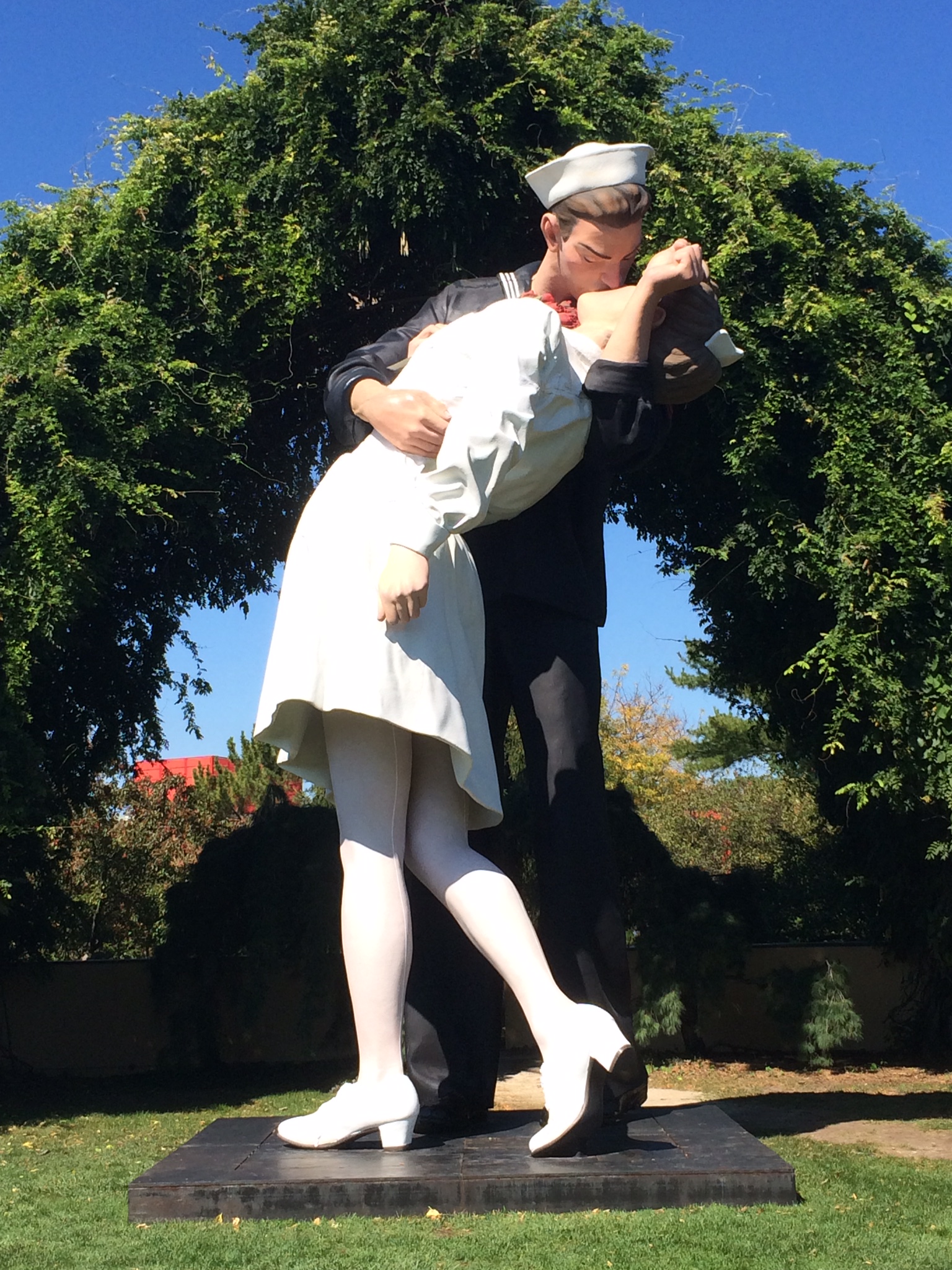
Forever Marilyn, completed in 2011, is part of Johnson’s icon series. Other works in that series, Return Visit, God Bless America and Unconditional Surrender, are shown below.

Forever Marilyn

Forever Marilyn

Return Visit

Return Visit

Unconditional Surrender

Unconditional Surrender

God Bless America

God Bless America

The Works of Seward Johnson

All of the works shown above are enormous. Forever Marilyn is 26-feet high and weighs 17 tons. Also on display are a number of Johnson’s life-sized sculptures, part of his Celebrating the Familiar Series.

As you walk around the Grounds for Sculpture, these works will sneak up on you. From a distance they look like park visitors, seated on benches or standing beside the road or paths. So many times during my visit I was surprised by a person that was actually a sculpture. What distinguishes Johnson’s work is the vibrant color, not something that is all that common in a sculpture exhibit, and the minute detail. Note the headlines on the newspaper and the spokes and chain on the bicycle.

Grabbing Some Peace

Grabbing Some Peace

Newspaper Reader

Newspaper Reader


A Little to the Right

A Little to the Right

Family Secret

Family Secret

Gotcha

Gotcha

 The Grounds for Sculpture

The attraction here is not just the art, the grounds are also pretty nice. In places it is like hiking in the woods or taking a lakeside stroll. The art is installed in such a way that it almost seems embedded in the grounds, as if it was conceived with this environment in mind.

The Grounds for Sculpture has plaques on many of the pieces inviting visitors to touch. That is true of most of Johnson’s works. Several of his large pieces have been installed on the roads surrounding the museum.  Since this is primarily a drab industrial area the sculptures on the side of the road or in front of the buildings are striking. The God Bless America piece shown above sits next to the main road leading to the Grounds.

There is an excellent restaurant on the premises with a full menu and prices that are modest considering the qualify of what they serve. Only downside is the name, Rat’s.

Chamber of Internal Dialogue

Chamber of Internal Dialogue

Confrontational Vulnerability

Confrontational Vulnerability

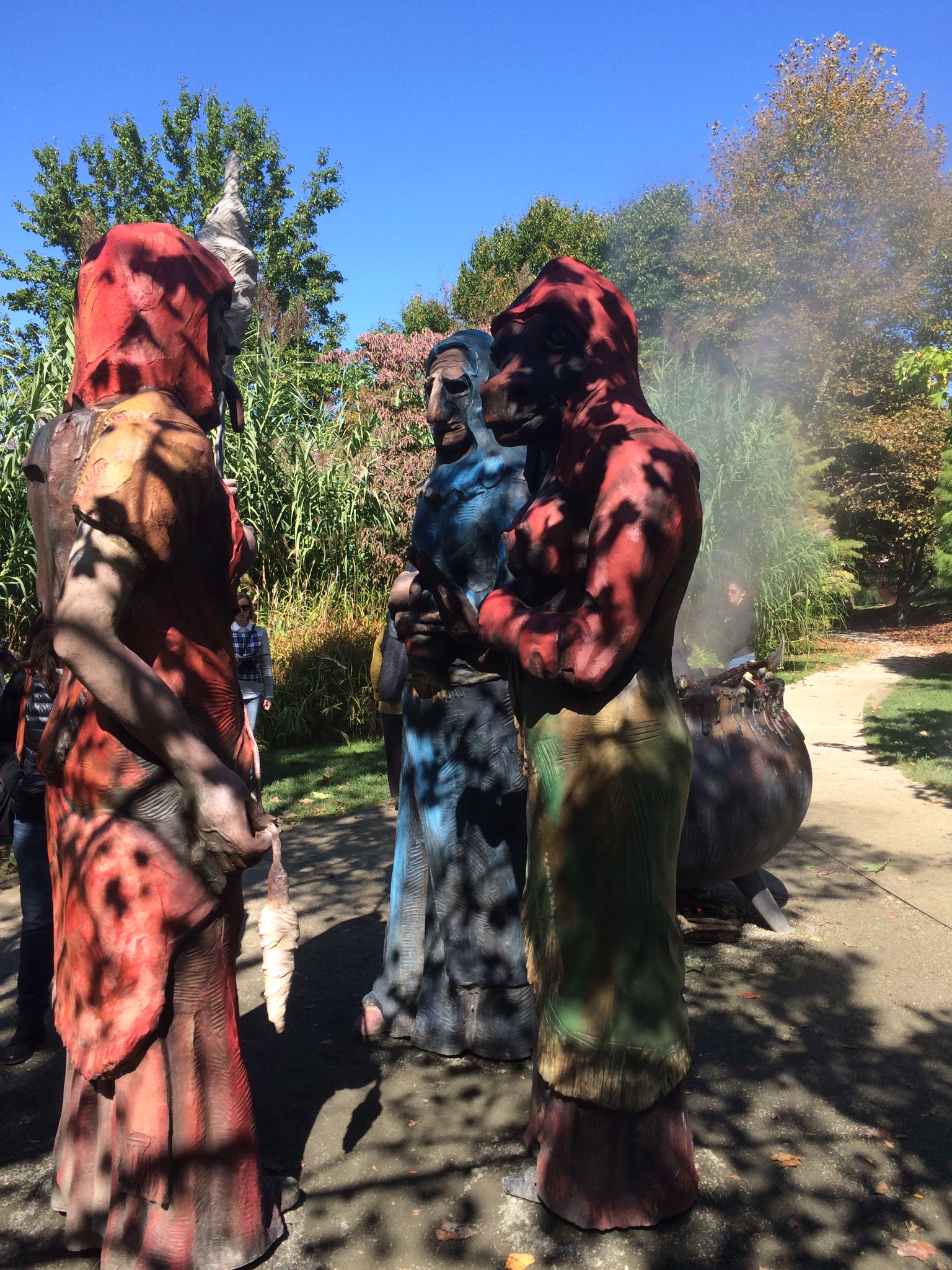
Three Fates

Three Fates

Posted in Art | Tagged , , , | 29 Comments

A Baseball Fan Memoir Chapter 5 – Money Changes Everything

Between 1991 and 2014 the cost of bringing a family of four to the ballpark for a major league baseball game increased 168%. That is based on a statistic called the Fan Cost Index which includes four average price tickets, two beers, four soft drinks, four hot dogs, parking, two game programs and two of the least expensive caps. In 1991 that amounted to an average of $79. In 2014 it was $212.

The average salary of a major leaguer during that time period increased 270% from $891,000 to $3.3 million. At the same time the inflation adjusted median U.S. household income increased 28% from $40,800 to $51,900.

That’s going to change baseball and it’s going to change the experience of attending baseball games. Just as income inequality has ballooned in America, income inequality among major league baseball teams has likewise expanded. In Boston, the most expensive place to attend a baseball game, the fan price index went up 290% to $350. By comparison, in Pittsburgh the increase was 120% to $161.

Fortunately for baseball fans, the disparity in wealth has not completely been reflected in team results. Of the five teams with the highest payrolls in 2014, only two, the Dodgers and the Tigers, made the postseason playoffs. The Yankees, Red Sox and Phillies all failed to quality with the latter two finishing dead last in their division. Two of the teams that did qualify, the A’s and the Pirates, were 25th and 27th, respectively, in the payroll standings.

However, the wealth disparity has clearly impacted the movement of players. The wealthier teams dominate the free agent market which in turn gives them the ability to attract more fans and command higher local TV fees and ad rates. This leads to a lot of player movement, the result of which is that in many smaller markets the fans routinely see the best players leave as soon as they mature. Some teams actively trade their best players before their contract expires because they know they won’t be able to compete in the free agent market. The Tampa Bay Rays this year traded their popular ace pitcher David Price for that reason.

One of the most glaring examples of how money changed baseball occurred in 1998 in Florida. After winning the World Series in 1997, the Florida Marlins owner Wayne Huizenga sold off most of the players who were responsible for winning that title. In 1998, the Marlins finished with the worst record in baseball. The owner sold the team and landed on his feet. The players landed on their feet. It’s only the fans that took it on the chin. (Huizenga was the CEO of Blockbuster and we all know how that worked out.)

Another example is the opening of the new Yankee Stadium in 2009. The Yankees opened the season with their usual star-studded cast. Their attendance was among the best in the league, but if you watched a game from the new stadium on TV, it looked half empty. That’s because no one was sitting in the prime seats behind home plate. The Yankees had the audacity to charge $2,500 a seat (that’s for one game not the season). Even in New York, very few people were stupid enough to pay that. Within two weeks of the season opener, the Yankees were slashing some of their ticket prices in half.

The stadiums where the costs were highest were now experiencing the Madison Square Garden syndrome. All the real fans were in the upper deck.

In baseball’s high rent districts (and I live in the New York area) the days when individual fans purchase season tickets year after year and sit with other fans who have been their longtime ballpark neighbors are gone. The so-called premium seats are for the most part filled with folks who were given those tickets because of a business relationship. The lower level is for expense accounts not family budgets.

Many of these “fans” arrive fashionably in the third inning or so and head out by the sixth. They may be more interested in being seen than seeing the game.  Not the people I want to sit with when I go to a game.

The decades of the 90’s and “ought’s” were probably the time in my life when I was best able to afford the inflated cost of MLB. I certainly forked over silly sums of money for some other stuff during those years. But the idea of spending hundreds of dollars to go to a baseball game just rubbed me the wrong way. I also was less then enamored with watching millionaire players who signed long term contracts and responded with increasingly diminished performance. (This was fairly typical of my hometown Mets until the owners decided to invest in a Ponzi scheme instead of ballplayers.)

But that hardly meant I was done going to baseball games. While the majors were awash in high finance, the minor leagues were having a renaissance in the New York/New Jersey area.

The period from 1961 to 1994 was the dark ages for New York/New Jersey minor league baseball. There was one short-lived venture in 1977-78 in Jersey City. The Jersey City Indians, a poor team affiliated with a major league franchise that had little following in this area and playing in a dilapidated stadium that was soon to be torn down, lasted two years. I made a couple of those games and was sorry to see them go.

Arm & Hamer Park, Trenton

Arm & Hammer Park, Trenton, home of the Thunder, opened in 1994 as Waterfront Park.

Things changed in 1994. In that year the Trenton Thunder began playing in the brand new Waterfront Stadium as a AA affiliate of the Detroit Tigers, and the New Jersey Cardinals, a single A St. Louis affiliate, opened play at Skylands Park in Sussex County. Both played to full houses. The Cardinals have since moved on, but the Thunder are still going strong and are one of the best organizations in baseball.

Independent league ball moved in four years later with teams in Atlantic City, Little Falls, Bridgewater and Newark. Camden came onboard in 2001 and a single-A Phillies affiliate was born that year in Lakewood. Also during this time the Yankees and Mets finally decided to stop blocking minor league baseball in their territory and the Staten Island Yankees and Brooklyn Cyclones were born.

That’s ten teams created in an 8-year period. Newark and Atlantic City have fallen by the wayside but most of the others are pretty successful.

While it would cost $337 to take a family of four to a New York Yankees game, for a few bucks more ($350) I could buy a season’s ticket for the New Jersey Jackals. And the Jackals will toss in the playoff tickets for free. Who knows what the Yankees would charge now for playoff tickets if they made it. The  Jackals have a once a week dollar beer night, a dollar dog night, an all you can eat night and even a weekly game when I can bring my dog. That’s pretty typical of minor league promotions.

Robinson Cano began his professional career as a Staten Island Yankee

Robinson Cano began his professional career as a Staten Island Yankee

Sometimes you get an early glimpse of players who are destined for stardom.  Watching the New Jersey Cardinals I saw the parent club’s number one draft choices Matt Morris and Adam Kennedy with their first professional team. Neither lasted too long in Sussex County before moving up the chain. I watched Robinson Cano as a Staten Island Yankee and Melky Cabrera in the Trenton Thunder outfield.

The majority of players in Class A and AA ball aren’t going to the majors. What you are seeing is guys chasing a dream. In independent ball, the chances are even more remote. These guys aren’t ready to give up because they love the game. A stark contrast from the over-the-hill millionaire playing out a long-term contract.

No one’s getting rich and fat in the minors. And no one’s blowing a paycheck to watch them. I like it like that.

In next week’s post I’ll offer some retirement advice for baseball fans.

Posted in Baseball, Sports | Tagged , , , , | 4 Comments

On a Street Once Lined with Striking Silk Workers

On a quiet residential street in Haledon, N.J., one house stands out from its neighbors. It is taller, more stately, and much older. And it is a national landmark because of its role in the history of the American labor movement.

Botto HouseThe Botto House was the rallying point for the 1913 Paterson silk strikers. Forbidden to assemble by Paterson authorities, they were welcomed to Haledon by its sympathetic socialist mayor William Brueckmann. The Bottos, an Italian immigrant family of textile workers, offered their home as a place where strikers could assemble safely and where strike organizers and sympathizers could meet.

Among the people who spoke from the balcony of Botto House were International Workers of the World founder Big Bill Haywood; Irish immigrant Patrick Quinlan, who was one of the organizers of the strike; Elizabeth Gurley Flynn, who later became a founding member of the ACLU; and muckraker author Upton Sinclair (“The Jungle”). As many as 20,000 striking silk workers attended the Sunday rallies in front of the Botto House.

1913 Paterson Silk StrikeThe 1913 strike included about 24,000 workers. It was a general strike, including women and men, skilled and unskilled, immigrants and English-speakers. The goal of the strikers was an 8-hour day. Pietro Botto, who owned the Haledon house, was himself a mill worker who worked 10-12 hours a day, 5-1/2 days a week.

Eventually the manufacturers outlasted the strikers and they went back to work. Some of the textile shops offered concessions, including reducing the work day from 10 hours to 9.

1913 Paterson Silk StrikePietro and Marie Botto and their daughter migrated from Biella, Italy, in 1892. They were part of a larger movement of weavers as what had been a cottage industry was consumed by industrial production. The Bottos first settled in West Hoboken (now Union City). After 15 years of working in silk mills and adding three more daughters, the family was able to purchase the house in Haledon which was known as a “streetcar suburb” of Paterson.

The 12-room Botto house was built in 1908. It was also used by the Bottos as a Sunday retreat for workers, offering a bocce court, card tables and food prepared by Marie and her daughters. The home has been restored to what it looked like as the early 20th century home of Italian immigrants.

Botto House kitchenBotto House


The Botto House is now the site of the American Labor Museum. In addition to its exhibit about the 1913 strike it also has temporary exhibits. True to its roots the focus of these exhibits is immigration and labor.

American Labor Museum

American labor Museum

American labor Museum

Posted in History | Tagged , , , , , , , , , , | 24 Comments

A Baseball Fan Memoir Chapter 4 – New Places, New Faces

I spent the 50’s in New York’s iconic and since demolished ballparks. The 60’s were all about Shea. And I started the 70’s drinking beer with my buddies at the “Mistake by the Lake.”

In the 80’s and 90’s, largely due to the nature of my job, I traveled a lot to cities in the U.S. These were cities where my employer had offices and more often than not they were major league cities. I visited stadiums n Philadelphia, Baltimore and Washington. I went to Atlanta and Pittsburgh and saw baseball in Chicago, Minneapolis, Houston and Denver.

Along the way I added a couple more “favorite teams.” One played in the best ballpark in baseball. The other in arguably the worst.

I went to Memorial Stadium in Baltimore a couple times. For me it was memorable mostly for the bumper-to-bumper parking lots. I was fascinated by the fact that you seemed to be able to get out of the bumper-to-bumper lots in Baltimore faster than the more modern sort of lots where you park between the lines and drive in aisles. Of course if you wanted to leave in say the sixth inning, you were screwed.

If you think of the things that changed baseball in the last few decades what first comes to mind might be money or steroids or TV. But in terms of positive impact on fan experience, nothing was more important than the opening in 1992 of Oriole Park at Camden Yards.

Think of the state of baseball stadiums at that time. They were mostly giant oval concrete structures. ”All purpose” stadiums, very utilitarian and utterly characterless. Veterans Stadium in Philadelphia, Three Rivers in Pittsburgh, Riverfront in Cincinnati. The sheer size of these structures (some had seating capacities in excess of 60,000) combined with the oval shape that didn’t correspond to the baseball diamond, assured that there was not a good seat in the house.

Also, following the urban flight and blight of the late 60’s and 70’s, many stadiums began to be built outside the city, in suburbs, maybe even atop landfills. There was nothing around. No strip of sports bars, no outside restaurants. There was the stadium and there was the parking lot. For some of these venues, the closest place to get food outside the stadium was a gas station convenience store.

So you had to eat in the stadium. And that was another story. Matching the institutional design of the all-purpose stadium was the institutional food service which at best served a quality of food that might match a high school cafeteria in a downscale neighborhood. Did people eat hot dogs at baseball games because they loved hot dogs? Or was it because the other options were a box of Crackerjacks or a cold, stale pretzel.

Built to be part of the city of Baltimore, not to run away from it, Oriole Park features an open outfield looking out onto the warehouse that made it look like Baltimore. Located downtown near the Inner Harbor with new light rail train service it brought people into the city. The iron and brick design was intended to be retro but it proved to be futuristic. Camden Yards set the standard for the next 20 years of stadium design with new stadiums in Philadelphia, St. Louis, Pittsburgh, New York (Citi Field) and many others built with similar designs.


camden yardsAnd when you walked onto the ground one of the first things you see is Boog’s Barbeque.  No longer will baseball fans have to eat ARA Services’ boiled hot dogs. Boog’s is independently owned, has great food and it’s all Baltimore because it has Boog’s name on it. (Boog Powell is a former Oriole great and fan favorite.) There’s a restaurant in the warehouse and concessions run by other local eateries. In the same way that Camden Yards changed the thinking about how to build a ballpark the Orioles changed the way MLB teams went about feeding their fans.

The stadium is more than 20 years old now but it is still a thrill to go there and as the Orioles head into the post season I look forward to seeing the atmosphere at Oriole Park, even if only on TV.

While I became an Orioles fan because of their stadium, I became a Twins fan in spite of it. I’ve attended several Twins games in Minneapolis and most of them were at the Metrodome. I’ve always felt the idea of indoor baseball was a little strange but even among indoor stadiums, the Metrodome had to be the worst. It was truly like playing in a giant inflatable plastic bag.

But what made the fan experience in Minneapolis were the fans themselves. Where were the 30-something blowhards standing, beer in hand, and bellowing out crude wisecracks that only their drunken buddies thought were funny? Why wasn’t anyone heckling the other team? Why wasn’t anyone booing every mistake or shortcoming by the home side? No one seemed to be moving their family to other seats because of the obscene language of their neighbors.

Twins logoI wasn’t in New York anymore. Nor Philly or Boston for that matter. It was the proverbial family atmosphere that was supposed to be part of the lure of baseball. I know friends have told me they’ve found the same thing in Cincinnati and in Kansas City and in other cities but it was in Minneapolis that I experienced it. The fans were friendly and polite, but also knew all the players, were completely attentive to the game and were unfailingly supportive of their Twins.

I remember one game in particular that I attended in the Metrodome as possibly the best baseball game I’ve ever seen. Johan Santana of the Twins and Curt Schilling of the Red Sox hooked up in the pitchers dual in which each went the full nine giving up only a single solo home run. The Sox ended up taking the lead in the 10th, but a Jason Kubel grand slam in the bottom of that inning won it for the Twins.

The Twins and the Orioles have had their moments in the sun but neither has won a World Series for a long time and neither routinely sports a roster with marquee names. But that isn’t what I’m interested in. It’s more the atmosphere at the ballpark, the facility itself and the fans, that would keep me coming to the games.

In next week’s post I’ll consider the influence of money on the game and how I became disillusioned with the major leagues.

See also, A Baseball Fan Memoir Chapter 3 – On the Banks of the Cuyahoga.

Posted in Baseball, Sports | Tagged , , , , , , , | 6 Comments

A Baseball Fan Memoir Chapter 3 – On the Banks of the Cuyahoga

As the decade of the 70’s began, I was a college student in Northeast Ohio. I had some time on my hands, a friend or two with cars, and an on-campus job that yielded a couple of dollars. That was the perfect scenario for becoming a Cleveland Indians fan.

The Indians played in Cleveland Municipal Stadium, a New Deal era structure which also went by the name of “Mistake by the Lake.” It was old, massive, dirty and windy.

The early 70’s era Tribe squads were about as appealing as their ballpark.  Between 1969 and 1972, the four years when I was in Ohio, the Indians finished last twice and next-to-last twice. I tried to think of who the best players were at the time, but I couldn’t think of any. I looked online to jog my memory and it did just that. Ray Fosse was the Indians catcher. He was an excellent player but was beset by injuries including a broken shoulder from a violent collision at home plate with Pete Rose in the 1970 all-star game.

I stole the title for this chapter from the movie Major League in which Bob Uecker uttered the phrase “on the banks of the Cuyahoga” in setting the stage for another Indians game. The Cuyahoga is the river that famously caught fire in 1969. So aside from the deteriorating stadium and crappy team, the Indians played alongside a river that stunk and looked putrid.

cleveland indianAnd yet what I learned in college was to love the Indians. While I considered myself a politically conscious and progressive college student I somehow managed to overlook the name of the team, the logo which featured a caricature of an Indian with a shit-eating grin on his face and the fact that there were usually some shirtless folks at the game banging drums and wearing dime store headdresses.

Going back to the idea that we had more time than money, we tried to maximize both by going to doubleheaders. Here’s what I remember about those glorious and long Sundays watching the Indians at Municipal Stadium.

First of all these games didn’t fill the stadium, nor were there a lot of people heading into downtown Cleveland for a Sunday stroll at the time. So we ignored the parking lots and easily found spots on the street. This was free…almost. After you parked your car you were likely to be approached by a young fellow who would offer to guard it for you for $5. We were up for that. Not much of a parking fee and my friend’s car was always there when the game was over.

It seems as though every one of these doubleheaders were against Detroit. And my memory is that the Tribe usually got ambushed in the first game and scalped in the second. I checked baseball-reference.com and it turns out that the Indians really didn’t play Detroit every weekend. But I did find a Sunday in June of 1970 in which the Tigers won the first game 7-2 and the second game 9-8 and the whole event took more than 7 hours. That sounds fairly typical of my experience going to Indians games.

As you can imagine, college students sitting in the hot sun for that length of time tended to put away some beer. In fact we would consume quite a bit of beer, so much that I remember having to change our seats because there were so many discarded beer cups there was no room for our feet. That of course was not a problem because as you slowly waded into the back end of the second game there were seats aplenty.

What was a problem was that if you were going to drink that much beer, you were going to have to pee, and just about every other guy who was still at the stadium had the same problem so there was a good sized line for the men’s room. The toilet facilities in a stadium as old as the Cleveland Muni were not what you would expect to find in a 21st century ballpark. So while I was not totally surprised to see a group urinal type of arrangement I was bewildered to see that the urinals here were like bathtubs and guys lined up around the tub trying to avoid eye contact while they peed. At the tail end of one of these games, my friend Jay and I stood in line for a good 20 minutes, bouncing up and down trying to hold it, and then when we got to this cluster flush, neither of us could make ourselves go.

I haven’t been to a game in Cleveland for many years although I very much hope to get there in near future. I have never quite been able to bring myself to wear a cap or shirt with a stupid-looking Lone Ranger era grinning “Indian” on it. But I will always be a Cleveland fan.

(In next week’s post I wander off into the midwest and find new teams to root for.)

Posted in Baseball, Sports | Tagged , , , , , , | 29 Comments